3.2 - Functions, domain and range
Learn to read a function as a rule connecting inputs and outputs. You will use function notation, identify forbidden inputs and find the outputs actually reached from a given domain. This lesson is for Higher students.
Mappings and function notation (Higher)
If two different inputs both produce , does the rule stop being a function? Think of a machine that squares a number, then adds : both and produce .
You already know
A set lists each distinct member once. When substituting a negative number into a square, keep brackets: .
The important question is whether each individual input has one definite output. It is fine for different inputs to share an output.
Function
A function maps every allowed input to exactly one output. The notation says that inputs come from set , and their outputs lie in set . Sending the same input to both and would not define a function.
A function can even send different inputs to a single output: does this for every one of them. “Exactly one output per input” does not mean “all outputs must differ”.
The notation reads “ maps to ”. Equivalently, write . The expression means evaluate the rule with input , replacing every by . It is not multiplication by a letter .
Worked example 1: list a finite mapping
Question. Let , with allowed inputs . Find the output for each input and list the distinct outputs.
Plan. Substitute each input into the complete rule.
Why bracket ? The whole input is squared, including its negative sign.
Answer. The mappings are , , . The distinct outputs are .
Check. Each of the three allowed inputs has exactly one output, so this is a function.
Change only the input set by adding . Its output repeats one already reached, but that creates no ambiguity about what each input does.
Worked example 2: two inputs share an output
Question. Let , now with allowed inputs . Find the outputs and say whether this is a function.
Plan. Keep the old mappings and evaluate the new input.
Why is the repeated allowed? Neither input nor input has two different outputs.
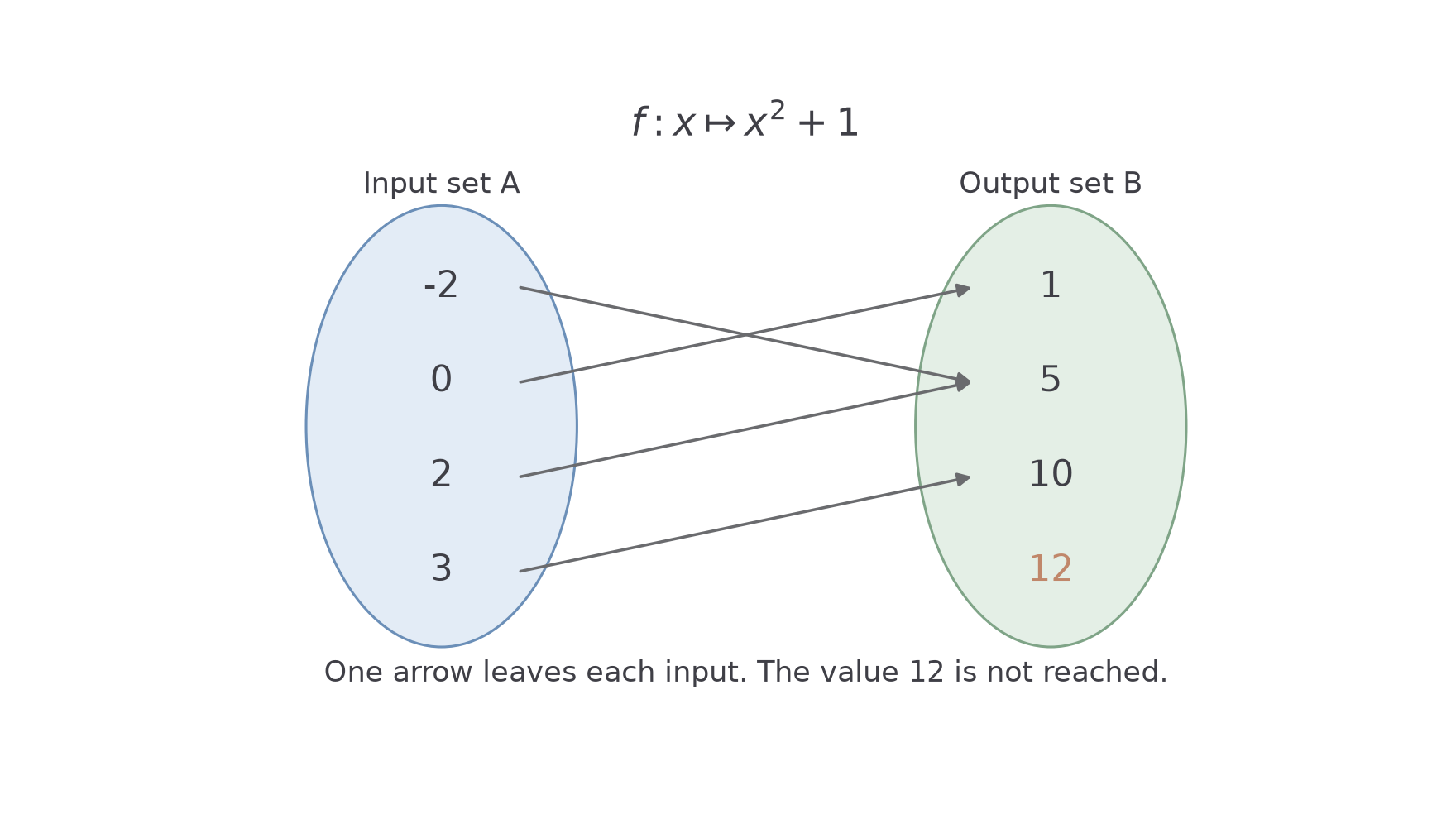
Answer. The outputs are for inputs respectively. This is a function; its distinct outputs are .
Check. There are four input arrows, one from each input, although only three distinct outputs are reached.
The diagram includes an unused member in the output set . That is allowed: saying outputs lie in does not promise that every member of is reached.
[DIAGRAM: asset_slug: m045_finite_mapping; caption: Two inputs share an output, while one member of the output set is unused; description: Function f maps minus 2 and 2 to 5, 0 to 1, and 3 to 10; the output set B also contains 12, which no arrow reaches; file: m045_finite_mapping.png; recommended_method: matplotlib]
Read the notation as an instruction to substitute.
Watch out
The wrong line treats the notation as multiplication. For , the correct calculation is .
The Higher formulae sheet does not supply function-notation rules. Use the definition and the rule stated in the question.
Domain and excluded inputs (Higher)
A formula can look perfectly reasonable while failing at a particular input. For , input would require division by zero. You must remove it before treating the rule as a real-valued function.
Domain
The domain is the set of allowed inputs. It may be given explicitly, or restricted by the calculation or setting. For example, a number of tickets must be a nonnegative whole number even if an algebraic rule accepts fractions.
Two common arithmetic restrictions are worth checking. A denominator must be nonzero. An expression under a real square root must be nonnegative, including zero because . These restrictions are not listed on the Higher formulae sheet: learn them.
Worked example 3: exclude a zero denominator
Question. Find the largest real domain of .
Plan. Find the input that makes the denominator zero and exclude only that input.
Why exclude ? Substituting it would require , which is undefined. Every other real input gives a nonzero denominator.
Answer. All real such that .
Check. A nearby allowed input gives , whereas makes the denominator zero.
Continue this lesson.
You’re previewing NovaLearn without an account. Create a free account to read the rest.
Create free account