2.5 - Direct and inverse proportion
Learn to turn a proportion statement into an equation, find its constant and solve for either variable. You will connect eight power, root and reciprocal models to their graphs, so you can check whether an answer fits the relationship.
Direct proportion and its constant (Higher)
If an input doubles, must its output double too? A fixed price per notebook does work that way: twice as many notebooks cost twice as much. A delivery charge would change the relationship. We will find a precise way to tell the difference.
You already know
Substitute a given value into an expression. To solve an equation, do the same operation to both sides. A straight line can be written as .
Start with notebooks costing pounds and costing pounds. Both give the same price per notebook, .
Direct proportion
is directly proportional to , written , when for a fixed constant of proportionality . For nonzero , the ratio is constant. For example, is direct proportion; is not.
The constant need not be or positive. Its sign and units depend on the quantities. The pair alone cannot determine it, because every value of gives that pair.
Direct-proportion model
The graph is a straight line through the origin, with gradient .
Not in the Higher formulae sheet: learn it.
Find the constant before using a new input. This keeps the model visible throughout the solution.
Worked example 1: finding an output
Question. , and when . Find when .
Plan. Use the given pair to find , then substitute the new input.
Why this step? Finding identifies the same multiplier for every pair, rather than adding the change in to .
Answer. .
Check. , as direct proportion requires.
Now change only the direction of the question: the model is unchanged, but the output is given and the input is unknown.
Worked example 2: finding an input
Question. In the relationship from Example 1, find when .
Plan. Put into , then undo the multiplier.
Why this step? Division reverses the multiplication linking to .
Answer. .
Check. ; doubling the original output doubled its input .
A constant increase and a constant multiplier are different ideas.
Watch out
The line is wrong. Its graph misses the origin, and its ratios are at and at . Direct proportion with constant is .
Use the inverse operation when the question asks for the input.
Proportion to powers and roots (Higher)
An output can be proportional to the square, cube or square root of the input instead of to the input itself. Here is a useful surprise: doubling a cube's side multiplies its volume by , since . Doubling an input need not double its output.
For each model, the constant ratio uses the whole transformed input.
Power and root models
For real square roots, , and is nonnegative. To find , use a pair whose transformed input is nonzero.
Not in the Higher formulae sheet: learn these models.
Doubling multiplies the three transformed inputs by , and . These factors provide quick checks on calculations.
Worked example 3: choosing the transformed input
Question. These are separate relationships. (a) , with at ; find at . (b) , with at ; find at . (c) , with at ; find at .
Plan. Transform the given input first, calculate the constant, then use the new input.
Why this step? The named power or root belongs to ; it must be applied before finding the multiplier.
Answer. (a) , (b) , (c) .
Check. The constant ratios are , , and .
Keep the three models, but change the direction again: find inputs from outputs. This reveals an important difference between squares and cubes.
Worked example 4: recovering the input
Question. For the models in Example 3, find all real inputs when (a) , (b) , (c) .
Plan. Isolate the power or root, undo it, then check permitted inputs.
Why this step? Squaring loses a sign, so a square equation can have two inputs; the real cube function gives one input for each output.
Answer. (a) , (b) , (c) .
Check. Both and equal ; and . A positive-length condition would remove .
The pictures show only nonnegative inputs, so that you can compare the four direct forms clearly. Each vertical scale is labelled separately.
[DIAGRAM: asset_slug: m033_direct_forms; caption: The four direct forms for k equals 1 on nonnegative inputs; description: Four exact panels for y=x, y=x squared, y=x cubed and y=square root of x. Each includes the origin and has its own labelled vertical scale.; file: m033_direct_forms.png; recommended_method: matplotlib]
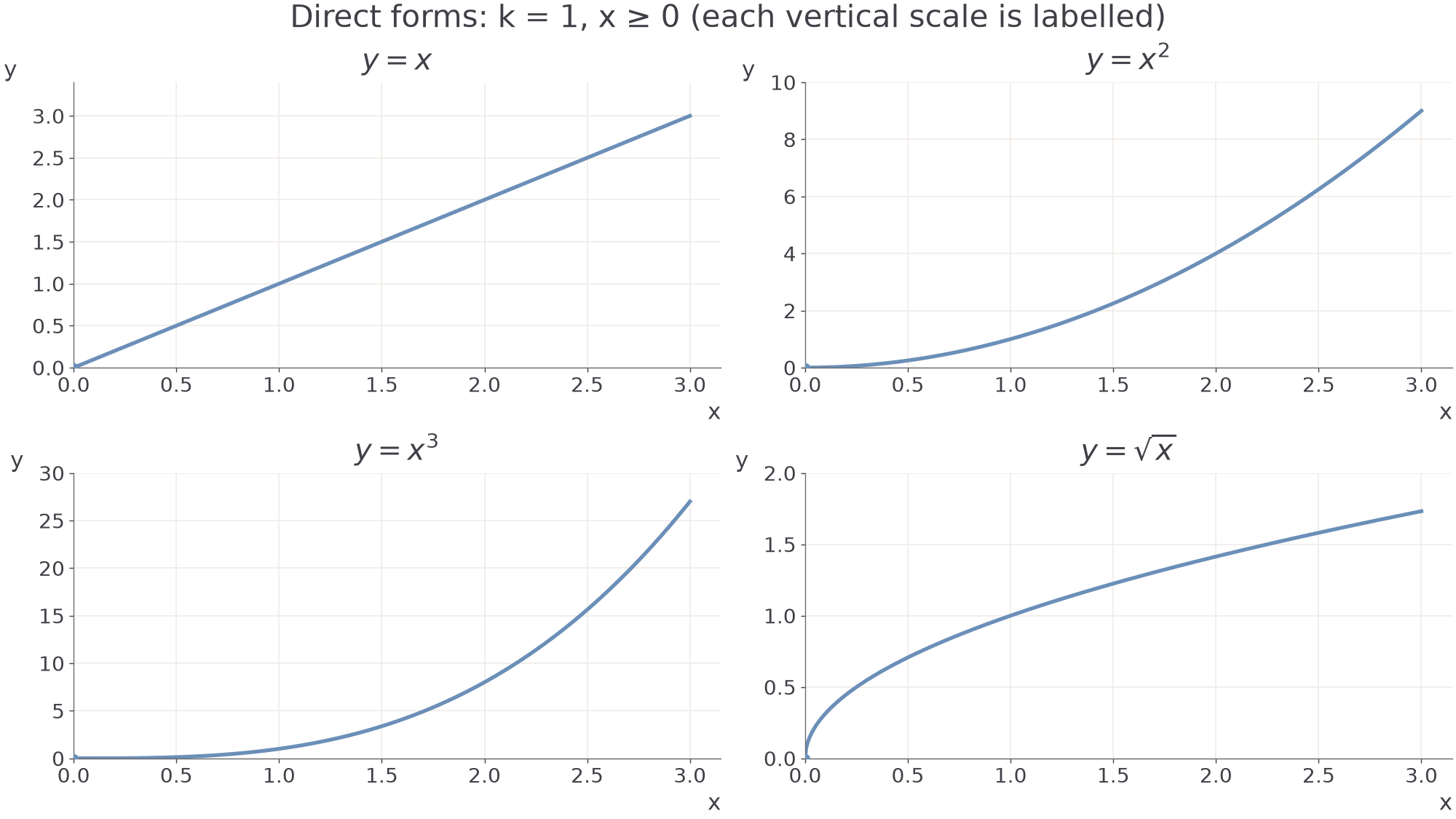
For positive inputs and , the square and cube become steeper, while the root curve becomes less steep. On all real inputs the square graph is symmetric about the -axis; the line and cube extend into negative inputs too. Negative reflects each graph in the -axis as well as scaling its heights.
Watch out
uses the wrong input. Write . If doubles, the square multiplies by , so does too.
For the next root model, the unknown is again the input.
Inverse proportion and reciprocal forms (Higher)
Sharing a fixed job between more equally productive workers reduces the time each needs. The simple ideal model keeps workers multiplied by time constant. This is inverse proportion, rather than a negative straight-line relationship.
Continue this lesson.
You’re previewing NovaLearn without an account. Create a free account to read the rest.
Create free account