4.2, 4.3 - Congruence and symmetry
You will recognise congruent polygons using the same-shape-and-size idea from 4.2. You will then use 4.3 to identify reflection axes and count matching positions during a rotation. A shape can have one kind of symmetry without the other, so you will test them separately.
Congruent shapes and corresponding parts
Can a shape have no mirror line but still fit itself after a half turn? We will test a sloping parallelogram. First, what does “fit exactly” mean when you move a shape?
You already know
A polygon has straight sides. You can recognise a rectangle, square, rhombus and parallelogram from their properties. Turning a paper shape does not stretch its sides.
Cut out a polygon and place it on an exact copy. You may slide, turn or flip it. If the complete boundaries coincide, the two shapes match in both shape and size.
Congruent shapes
Two shapes are congruent when they have the same shape and size. Corresponding parts are the sides and angles that match when the shapes fit onto each other. Corresponding lengths and angles are equal.
Corresponding does not mean “drawn horizontally” or “labelled with the same letter”. A rotation can move a horizontal side to a vertical one without changing its length.
[DIAGRAM: asset_slug: congruence_figures; caption: Two matching L-shaped polygons and a larger copy on equal-unit grids; description: Shape A has ordered vertices (0,0), (3,0), (3,1), (1,1), (1,2), (0,2). B is A rotated 90 degrees about the origin. C has every coordinate multiplied by 1.5. Every panel uses the same unit scale; file: congruence_figures.png; recommended_method: matplotlib]
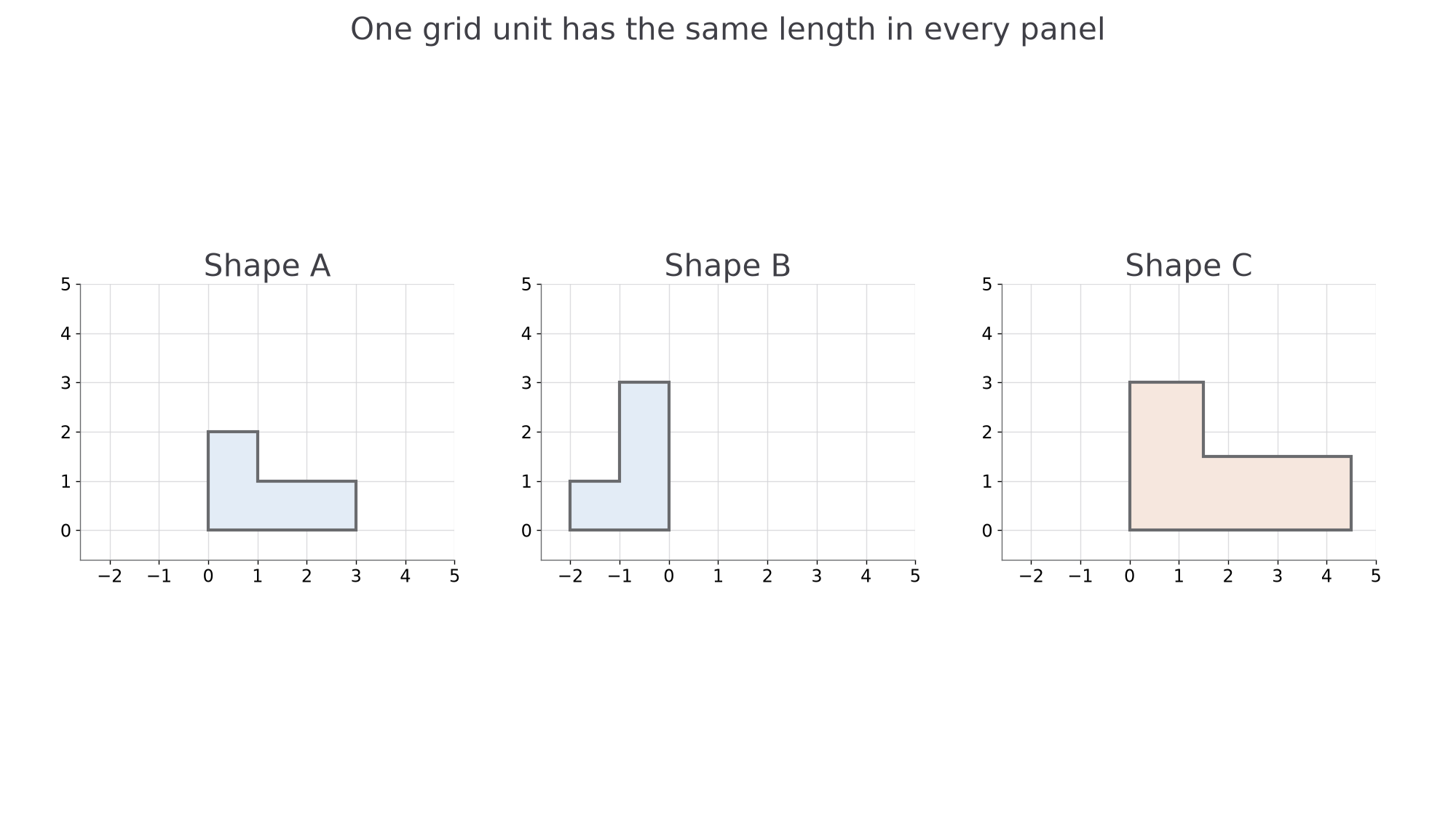
In this figure, and are congruent: a quarter turn matches every side and corner. Shape is larger. The longest side of has length units, while its partner in has length units. Equal shape alone is not enough. Congruence and its length/angle properties are absent from both the Foundation and Higher formulae sheets: learn them.
[DIAGRAM: asset_slug: congruence_comparison; caption: An L-shaped polygon, its reflected copy and a resized reflected copy; description: Equal-unit grids show original P, reflected Q and reflected-then-enlarged R with length factor 1.5. R keeps Q's orientation. The longest corresponding edges are 3, 3 and 4.5 units; file: congruence_comparison.png; recommended_method: matplotlib]
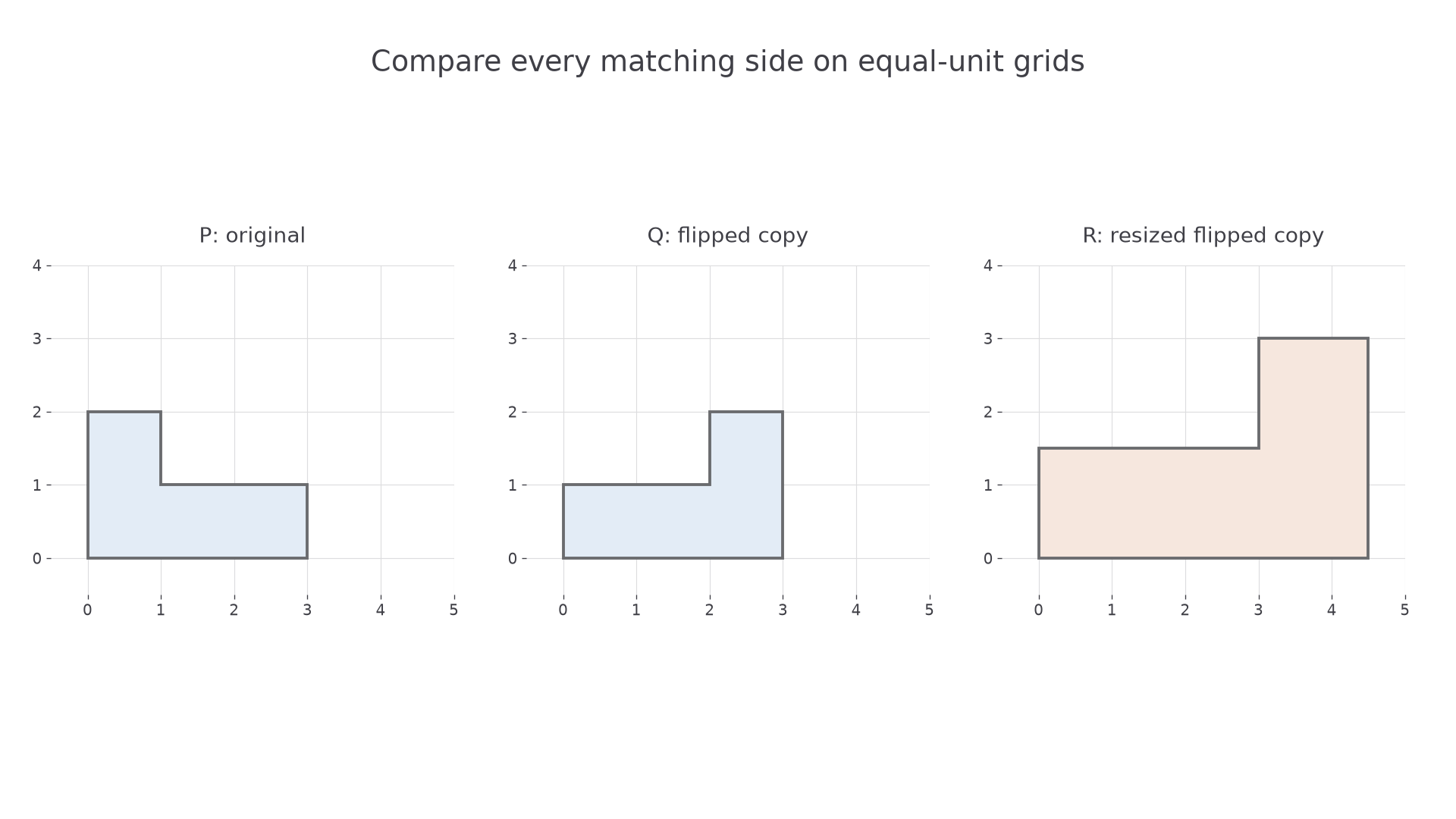
Use and to see why a flip is allowed.
Worked example 1: a flipped polygon
Question. Polygon is made by flipping without stretching. Are they congruent? Give a reason.
Plan. Check shape and size, allowing the orientation to change.
Why allow a flip? Congruence concerns shape and size; it does not require the same orientation. The flip preserves every side, not just the long edge shown.
Answer. Yes. and have the same shape and size.
Check. Flip back: every corner and side returns to .
Now change only the size of that reflected copy, keeping its orientation. Polygon has all of 's lengths multiplied by .
Worked example 2: the same outline resized
Question. Polygon is made by multiplying all lengths in by . Is congruent to ? Explain.
Plan. Compare a corresponding length to test whether size is preserved.
Why is one unequal matching length enough? Congruence requires every corresponding length to be equal; this one already fails.
Answer. No. The shape is the same, but the size is different.
Check. Turning or flipping cannot reduce a -unit edge to a -unit edge.
Equal area or equal perimeter alone also fails to establish congruence. Rectangles measuring units by units and units by units both have area square units, but their side lengths do not match.
Watch out
“Same area congruent” is false. The two rectangles above have equal areas but different outlines. Check the whole shape and its corresponding lengths.
In the next check, vary only the position of the unresized reflected copy.
Lines of reflection symmetry
Reflection symmetry asks whether a figure fits itself after a flip in a particular line. Imagine folding along that line: the complete boundary on one side must coincide with the other side.
Line of symmetry
A line of symmetry is a line whose reflection maps the whole figure onto itself. It includes any markings that form part of the stated figure. Equal areas on opposite sides of a line do not by themselves establish symmetry.
Try candidate lines through vertices, side midpoints and the centre. A single matching corner is not enough: every edge must match. A coloured logo may have fewer symmetries than its plain outline because its colours must match too.
[DIAGRAM: asset_slug: reflection_axes; caption: Symmetry of a rectangle, a square and another rectangle; description: Left is a 4 by 2 rectangle with its two midpoint axes. Centre is a 2 by 2 square with midpoint axes and diagonals. Right is an unmarked 5 by 2 rectangle for the check; file: reflection_axes.png; recommended_method: matplotlib]
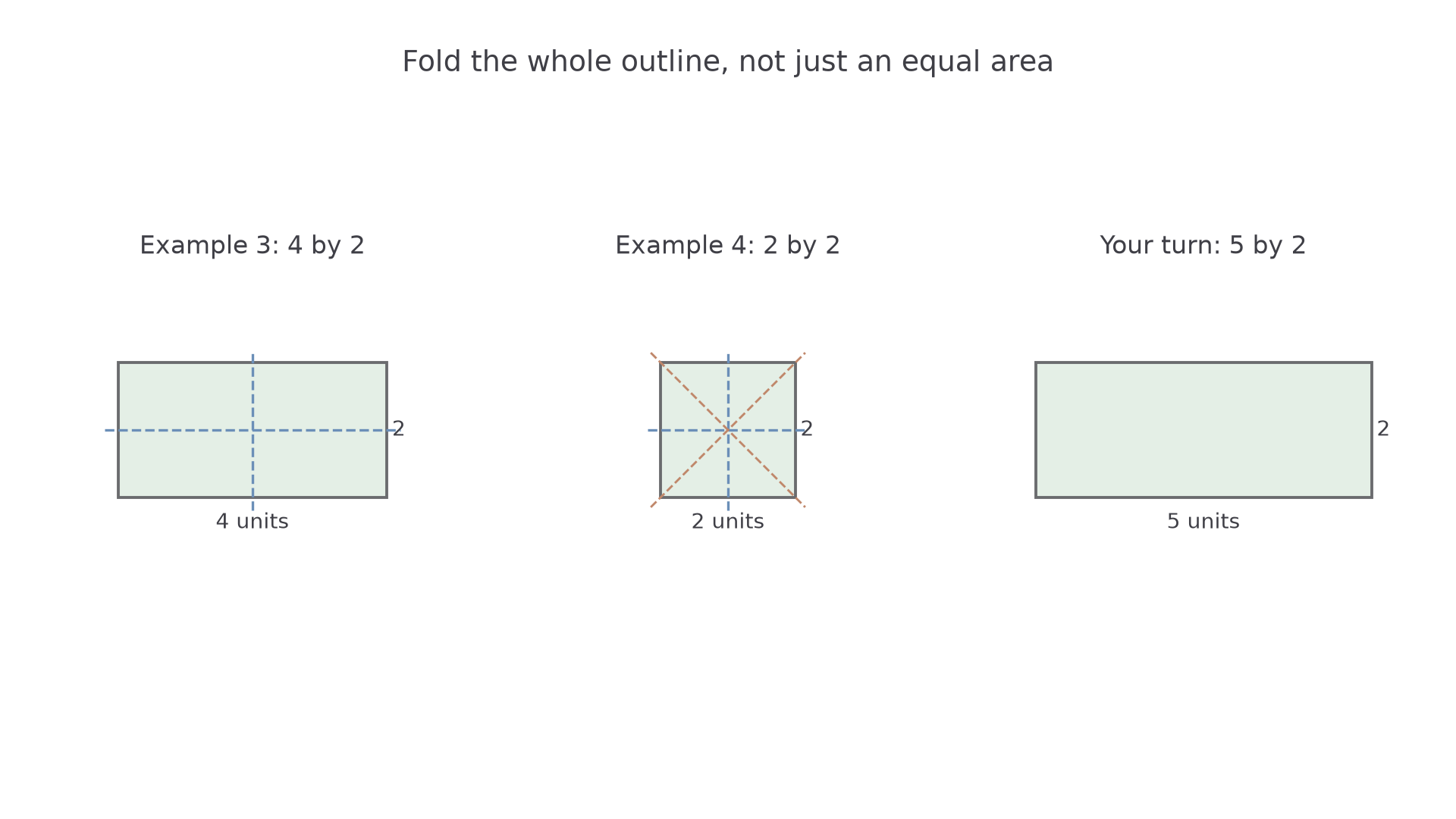
Start with the nonsquare rectangle. Its long sides cannot fold onto its short sides.
Worked example 3: find a rectangle's axes
Question. A rectangle measures units by units. State its number of symmetry lines and describe them.
Plan. Test the midpoint lines, then test the diagonals.
Why reject a diagonal? It would pair a -unit side with a -unit side, so the complete outline would not fit.
Answer. Two lines, each through the midpoints of a pair of opposite sides.
Check. Folding on either midpoint line matches every corner and edge.
Change only the rectangle's width from units to units. It is now a square; its former long and short sides have become equal.
Continue this lesson.
You’re previewing NovaLearn without an account. Create a free account to read the rest.
Create free account