1.2 - Calculating with fractions
Keep fraction calculations exact as you add, subtract, multiply and divide. You will use common denominators when combining shares, convert mixed numbers before multiplying, and use reciprocals to understand why division by a small fraction can make an answer larger.
Adding and subtracting fractions
A ribbon is long. You cut it into pieces each long, with no waste. How many pieces can you make? The calculation is a division, yet its answer will be larger than . We will find out why.
You already know
Equivalent fractions have the same value. A common denominator lets fractions count the same-sized pieces, and a mixed number can be converted to an improper fraction by counting all its pieces.
Addition counts pieces together; subtraction removes some. If the pieces are sevenths, they stay sevenths: . If the denominators differ, first change to equivalent fractions with a common denominator.
Adding and subtracting equal-sized parts
Here . If the original denominators differ, find a common denominator first.
Foundation and Higher: Not in the formulae sheet: learn it.
For example, . With mixed numbers, converting to improper fractions also avoids borrowing a whole when the fractional part being subtracted is larger. Keep the operation sign attached to each term.
Worked example 1: a mixed-number calculation
Question. Work out . Give your answer in simplest form.
Plan. Convert the mixed number, then give all three fractions denominator .
Why this step? A common denominator makes each counted piece a twelfth, so only the signed numerators need combining.
Answer. , or .
Check. Combine the last two terms first: , then .
Change only the subtracted quantity, from to . Subtracting one extra whole should make the answer one whole smaller.
Worked example 2: subtracting a mixed number
Question. Work out . Give your answer in simplest form.
Plan. Convert both mixed numbers, then use denominator .
Why this step? The entire is subtracted. Converting it to keeps that amount together.
Answer. .
Check. The first answer was . Subtracting one more whole gives , as expected.
The denominator names the size of the pieces; adding their counts must not alter that size.
Watch out
Wrong: . This adds different-sized pieces as if they were alike. Right: . A quick check helps: the sum must exceed , but does not.
For your turn, increase only the first whole-number part, from to .
Multiplying fractions and mixed numbers
Multiplying by a fraction scales an amount: taking half of a half gives one quarter.
Imagine a rectangle divided into three equal columns and four equal rows. Two of its three columns cover . Taking three of the four rows within those columns selects six of the twelve equal small rectangles, so . Multiplying numerators counts the selected pieces; multiplying denominators counts all the pieces.
Multiplying fractions
Here and . Convert mixed numbers to improper fractions before multiplying.
Foundation and Higher: Not in the formulae sheet: learn it.
You do not need common denominators for multiplication. Cancelling before multiplying means dividing a numerator factor and a denominator factor by the same common factor. The product is unchanged, and the numbers become smaller. This works across a product because all the numerator factors form one numerator and all the denominator factors form one denominator.
Worked example 3: cancelling a mixed-number product
Question. Work out .
Plan. Convert both mixed numbers, then cancel common factors before multiplying.
Why this step? The factors cancel, and dividing and by leaves and .
Answer. .
Check. Multiplying without cancellation gives .
Change only the second mixed number's whole part, from to . Its improper numerator changes, so one cancellation will be different.
Worked example 4: when one factor no longer cancels
Question. Work out . Give your answer in simplest form.
Plan. Convert both factors, cancel the common , then multiply.
Why this step? The numerator is not divisible by . Cancellation is optional, but it must use actual common factors.
Answer. , or .
Check. The uncancelled product is . Also, multiplying by makes larger, as expected.
Cancellation belongs to multiplication of factors, not to arbitrary numbers separated by an addition sign.
Watch out
Wrong: , found by multiplying the whole parts and fractional parts separately. This omits products between a whole part and a fractional part. Right: convert first, then .
The same warning protects addition: in , cancelling the two occurrences of would be invalid. The numerator is a sum, not a factor of .
Exam tip
If a question asks for a fraction in simplest form, give that form explicitly. A decimal, even an exact one, does not fulfil a request for a fraction.
Now change only the second whole-number part from to .
Dividing with multiplicative inverses
Division can ask how many pieces of a given size fit into a total.
Four quarter-length pieces fit into one whole, so . Dividing by a positive number smaller than one can make the answer larger. You are counting smaller units, rather than making the original length grow.
Unit fraction and multiplicative inverse
A unit fraction has numerator , such as . A multiplicative inverse, or reciprocal, multiplies a nonzero number to give . For example, , so is the reciprocal of . The reciprocal of is , not . Zero has no reciprocal.
Dividing by means taking one fifth, so . To divide by a fraction, multiply by its reciprocal. This works because multiplying the divisor by its reciprocal makes it : in , scaling both dividend and divisor by leaves the quotient unchanged and changes the divisor to one.
Dividing by a fraction
Here , and . Keep the first fraction unchanged and use the reciprocal of the divisor. Convert any mixed numbers first.
Foundation and Higher: Not in the formulae sheet: learn it.
For example, . Checking gives , the original dividend. Likewise, , because .
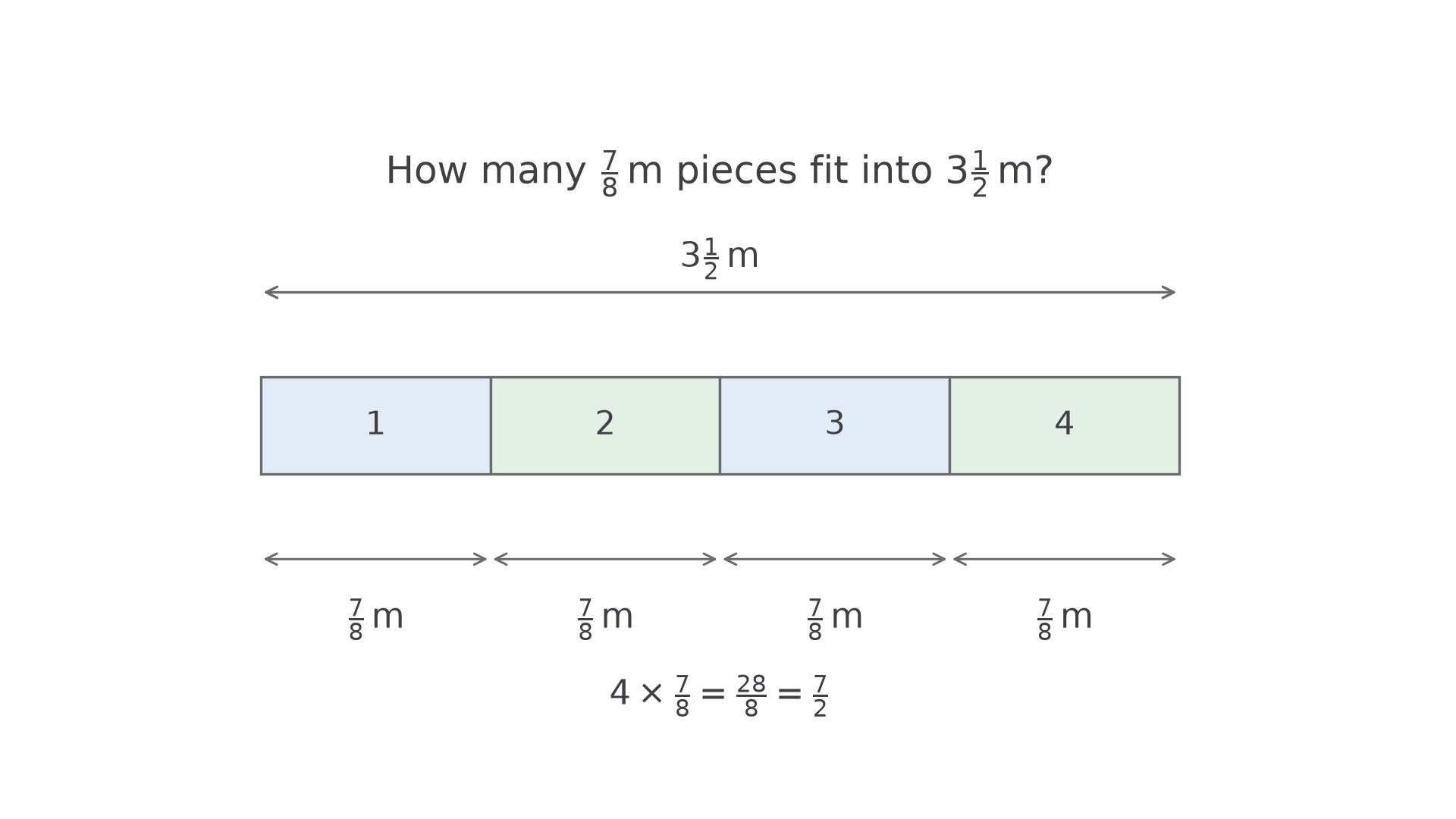
The ribbon picture counts pieces of equal length. The numbered pieces join end to end, so their total length checks the division.
[DIAGRAM: asset_name: Dividing a ribbon into fractional lengths; asset_slug: m004_fraction_division_ribbon; caption: Four pieces of length seven eighths of a metre make three and a half metres; description: A ribbon of total length three and a half metres is divided at exact equal positions into four pieces. Each is labelled seven eighths of a metre and numbered one to four. A total-length arrow sits above the ribbon, separate piece-length arrows below it, and a multiplication check below the arrows.]
Worked example 5: counting ribbon pieces
Question. A ribbon is long. It is cut into pieces each long, with no waste. Find the number of pieces.
Plan. Divide the total length by the length of one piece, then multiply by the reciprocal.
Why this step? Both lengths use metres, so their quotient counts pieces. Multiplying the divisor by turns it into one.
Answer. pieces.
Check. , returning the full ribbon.
Change only the piece length to . The divisor is now a mixed number, so convert it before finding its reciprocal.
Worked example 6: a mixed-number divisor
Question. A ribbon is long. It is cut into pieces each long, with no waste. Find the number of pieces.
Plan. Convert both lengths to improper fractions, then divide.
Why this step? The reciprocal belongs to the whole divisor . A mixed number's whole part is not left outside it.
Answer. pieces.
Check. , the original length. Each piece is twice as long as before, so half as many fit.
The opening puzzle gives four pieces. The number exceeds because we counted units smaller than a metre: the ribbon did not become longer. Both worked problems give whole numbers of pieces, so there is no leftover to interpret.
Watch out
Wrong: . This reverses the dividend as well as the divisor. Right: keep unchanged and use .
For your turn, change only the total length. Check the result by multiplying your piece count by one piece's length.
Quick Recap
- Add or subtract equal-sized parts: find a common denominator, then combine the numerators.
- Convert mixed numbers before multiplying or dividing.
- For multiplication, multiply numerators and denominators; cancel common factors where useful.
- For division, keep the first fraction and multiply by the divisor's reciprocal. Check by multiplying back by the divisor.
The opening ribbon makes pieces. Dividing by a positive fraction smaller than one can increase the numerical answer because each counted piece is smaller than one whole unit.