3.3 - Transformations of function graphs
A small change to a formula can move a whole graph or change its size. You will apply , , and to linear, quadratic, sine and cosine functions. You will also work backwards from a graph's features to its equation, keeping trigonometric angles in degrees.
Horizontal and vertical translations (Higher)
Does make a wave twice as tall or fit twice as many waves into the same interval? What about ? The position of a change in a formula decides its effect. Start with addition, where the movement is easier to see.
You already know
A function turns an input into an output. The graph of has minimum and passes through . Sine and cosine have period and outputs between and .
Adding after the function changes outputs. In , a point moves to . Adding inside changes inputs: to keep the old output , solve , giving .
Translating a graph
A positive outside addition moves up; a positive inside addition moves left. These rules are not in the Higher formulae sheet: learn them. This lesson is Higher only.
For , move every point right and up. If the domain is restricted, move its interval too: must be a permitted old input.
[DIAGRAM: asset_slug: m053_translation; caption: The minimum of a quadratic moves two units right and one unit up; description: Exact y=x squared and y=(x minus 2) squared plus 1 with minima (0,0) and (2,1); file: m053_translation.png; recommended_method: matplotlib]
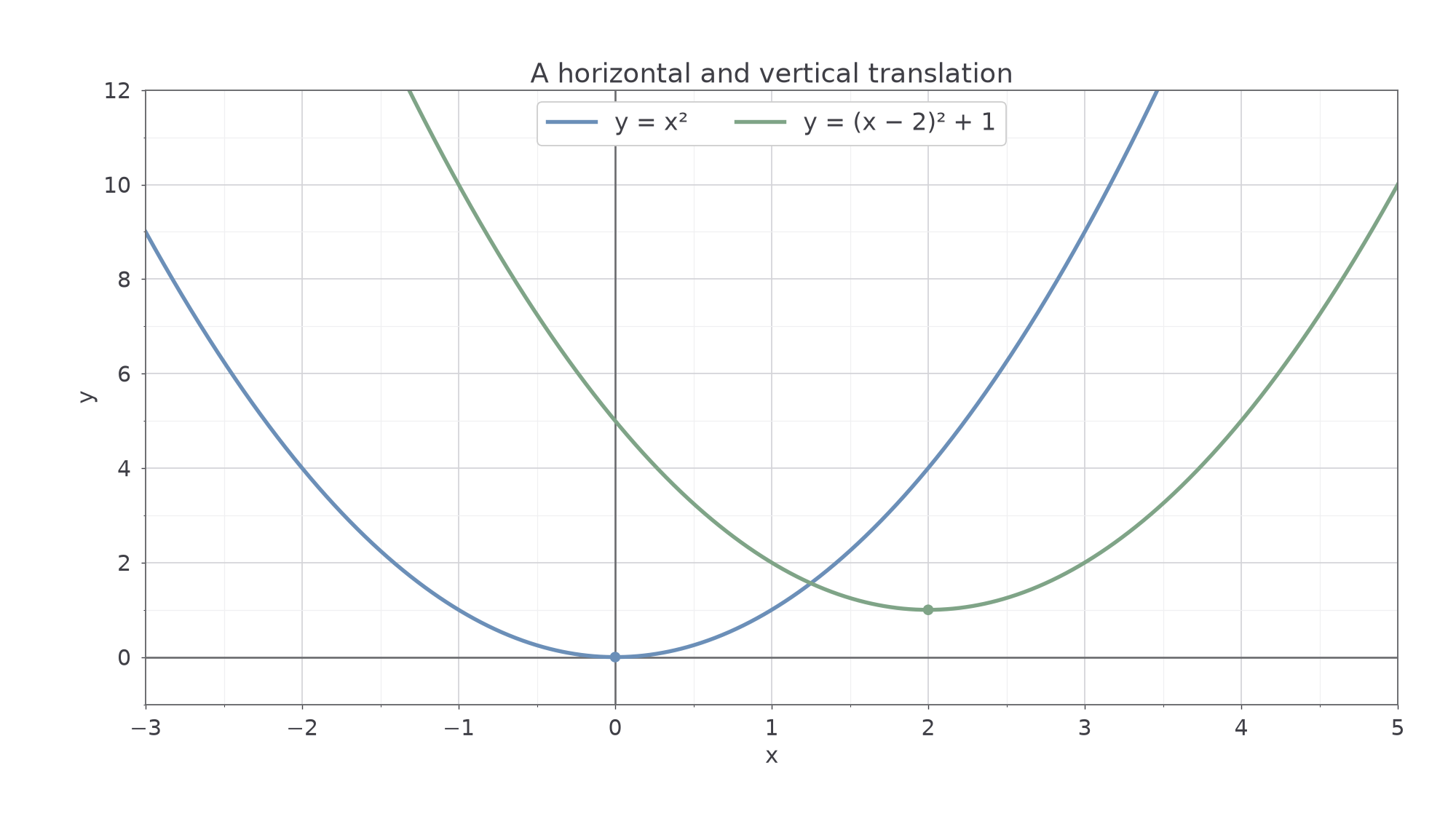
Move a turning point and another known point to check a translation.
Worked example 1: moving a minimum right
Question. For , describe . Find its minimum and the point corresponding to .
Plan. Solve the inside input equation, then add to the output.
Why this step? Keeping the inside input equal to its old value preserves the old squared part.
Answer. Translate right and up; minimum , other point .
Check. and . Its range is .
Change only the sign inside the bracket. The vertical movement stays the same.
Worked example 2: moving a minimum left
Question. For , describe . Find its minimum and the point corresponding to .
Plan. Find the new input which gives each old input.
Why this step? To make , the new input must be , not .
Answer. Translate left and up; minimum , other point .
Check. and .
Inside and outside signs have different jobs.
Watch out
For , writing the minimum as is wrong. The bracket must equal zero: gives , hence .
Use a different inside shift while keeping the upward move.
Scaling and reflecting outputs (Higher)
Multiplying outside the function changes each height. On , an old output of becomes , while an old output of stays zero.
Multiplying outputs
For positive , the vertical scale factor is . If , stretch vertically by and reflect in the horizontal axis. Not in the Higher formulae sheet: learn it.
A factor between zero and one compresses heights towards the horizontal axis. A factor of zero makes all defined outputs zero; it is not a reversible stretch. For sine and cosine, amplitude is the distance from the midline to a peak. Multiplying their outputs by makes amplitude , without changing the period.
[DIAGRAM: asset_slug: m053_vertical; caption: Multiplying cosine outputs changes amplitude or reflects the graph; description: Degree-mode cos x, 2 cos x and negative cos x share a 360 degree period while their output ranges or signs differ; file: m053_vertical.png; recommended_method: matplotlib]
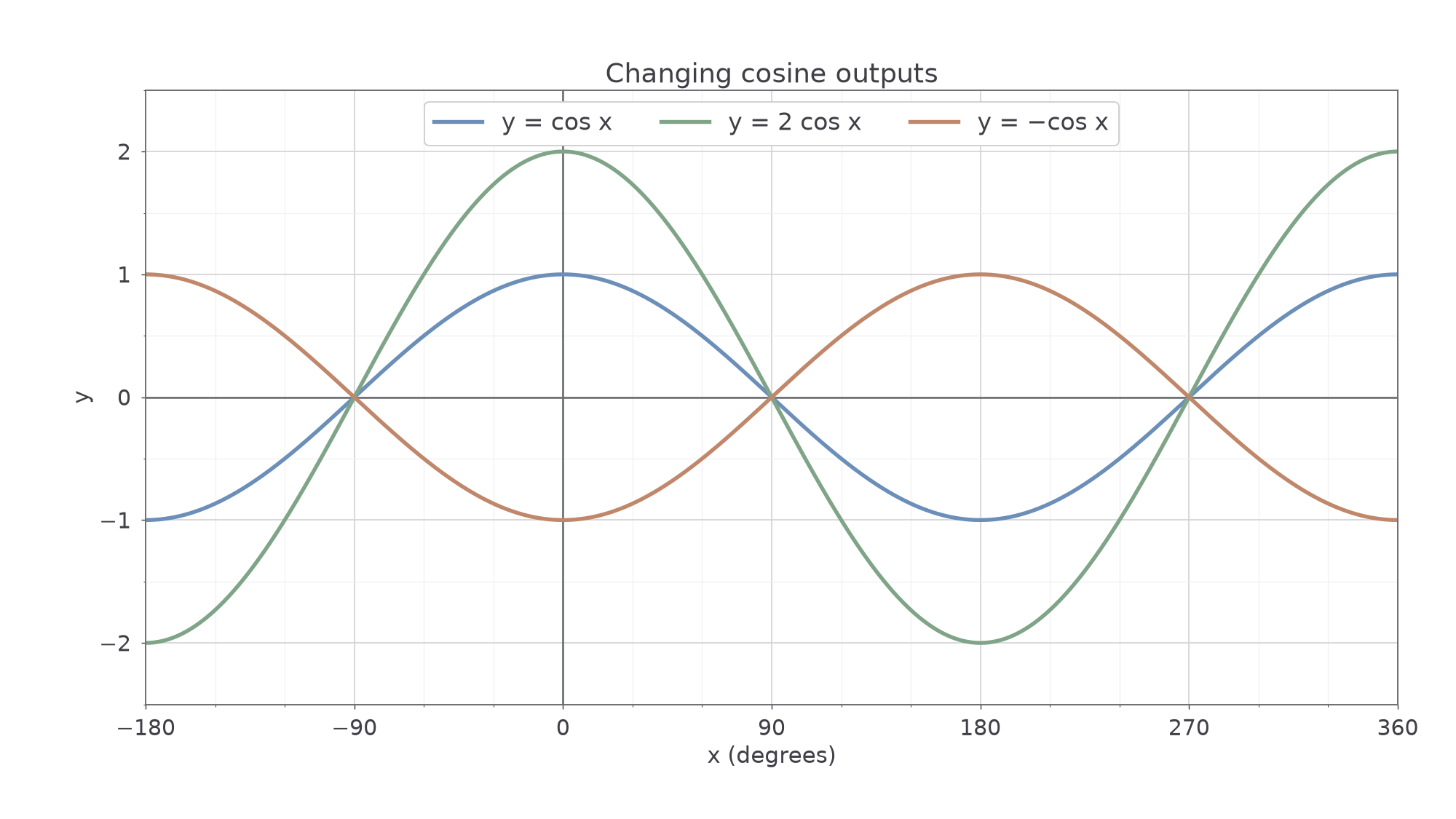
Compare the heights of corresponding peaks, without moving their horizontal positions.
Worked example 3: stretching cosine
Question. Describe from . State its amplitude, period and range, and move the point .
Plan. Multiply outputs by ; leave inputs alone.
Why this step? The multiplication happens after cosine is evaluated, so it cannot shorten a cycle.
Answer. Vertical stretch factor ; amplitude , period , range ; point .
Check. At , the new output is , and at it returns to .
Change only the sign of the multiplier. This adds a reflection but leaves the amplitude unchanged.
Worked example 4: reflecting the stretched wave
Question. Describe from . State its amplitude, period and range, and move .
Plan. Multiply each output by .
Why this step? Negative outputs become positive and positive outputs become negative, reflecting the graph in the horizontal axis.
Answer. Vertical stretch factor and reflection in the horizontal axis; amplitude , period , range ; point .
Check. At , the value is , the reflected original peak.
Similarly, reflects without stretching. For a quadratic, reflects, stretches vertically by , then moves up . Its maximum is , with ; at , its value is .
Watch out
Saying that has amplitude is wrong. Amplitude is a distance, so it is . The minus sign describes reflection.
Apply a new multiplier to the same cosine point.
Continue this lesson.
You’re previewing NovaLearn without an account. Create a free account to read the rest.
Create free account