4.5 - Perpendicular and angle bisectors
Learn to construct two kinds of bisector with a straight edge and compasses, and understand why their arcs locate the correct line. Make the constructions on paper and leave the arcs visible.
Construct a perpendicular bisector
How can you find the exact halfway point of a segment using a ruler with no scale? For an segment, two pairs of compass arcs can locate the midpoint without measuring .
You already know
Every point on a compass arc is the same distance from its centre. A straight edge draws a line through two points; in these constructions its length markings are not used to locate points.
The finished line has to satisfy two conditions. Passing halfway across the segment is insufficient if the line is slanted.
Perpendicular bisector
A line that divides a segment into two equal lengths and meets it at . A perpendicular through another point is not a bisector; a slanted line through the midpoint is not perpendicular.
Use the same compass opening at both endpoints. Make it more than half the segment's length, so that the arcs cross in two places. On a given diagram you can choose a suitable opening by eye: you do not need to measure the half-length first.
[DIAGRAM: asset_slug: m065_perpendicular_steps; caption: Equal-radius arcs above and below AB locate its perpendicular bisector; description: AB is 8 cm and the common compass opening is 5 cm; crossings P and Q lie on the same perpendicular line through midpoint M; file: m065_perpendicular_steps.png; recommended_method: matplotlib]
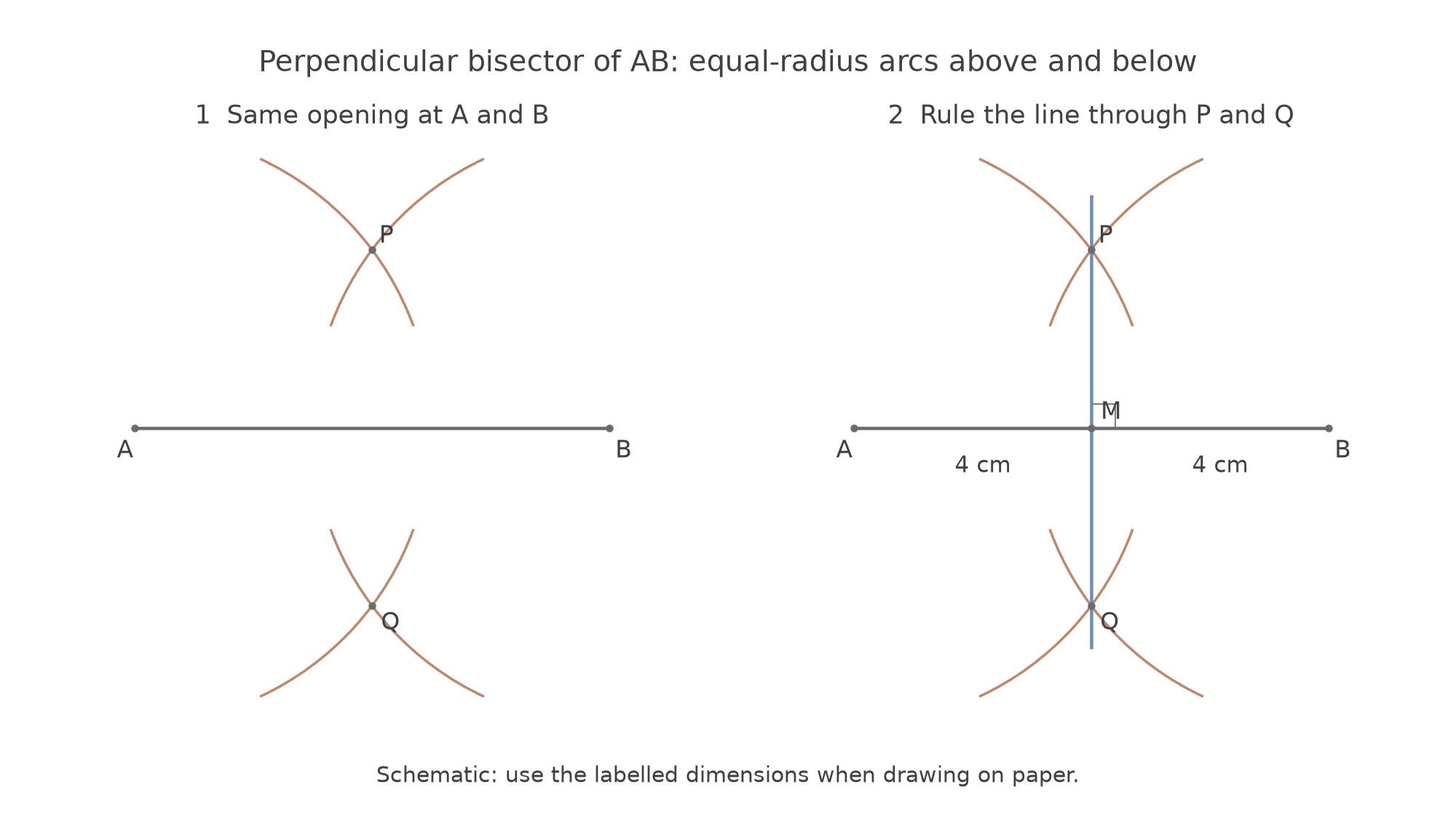
Worked example 1: bisect an eight-centimetre segment
Question. Use a straight edge and compasses to construct the perpendicular bisector of , where .
Plan. Draw equal-radius arcs from both endpoints, then join their two crossings.
With the point at , draw arcs above and below . Keep the opening fixed and repeat from . Label the crossings and ; rule their joining line across . Call the crossing with point .
Why join and ? Each is equally far from and , so both lie on the mirror line between those endpoints.
Answer. Line is the perpendicular bisector: and .
Check. After constructing, measure the halves and the right angle. Keep the locating arcs even after checking.
Change only the common opening to . The arc crossings move further from the base, but the bisector stays in exactly the same place. That is a useful surprising fact: the opening chooses convenient construction points, not a different midpoint.
Worked example 2: use a different compass opening
Question. Construct the perpendicular bisector of the same segment using a opening.
Plan. Repeat the equal-radius construction with larger arcs.
Rule the line through both new crossings, extending it through the segment.
Why does the line stay put? The same equal-distance condition still places it halfway between and .
Answer. The same perpendicular bisector, with different visible locating arcs.
Check. Cover the first construction and repeat on paper. The new line should meet the same midpoint at .
An opening equal to half the segment makes the two circles touch at only one point. A smaller opening makes them miss. Unequal openings break the equal-distance condition and can produce a line that misses the midpoint. These construction steps are not supplied on either tier's formulae sheet.
Watch out
Wrong: use radius at but at . The crossings are no longer equally far from the endpoints. Use one unchanged opening at both centres.
Pearson asks for the line as well as its construction arcs. Two pairs of arcs without the joining line leave the task unfinished.
Exam tip
Make clear arc crossings on both sides of the segment, rule through them and leave the arcs visible. Do not replace the construction with a measured midpoint and a protractor line.
Test the boundary between arcs that cross and arcs that merely touch.
Continue this lesson.
You’re previewing NovaLearn without an account. Create a free account to read the rest.
Create free account