4.6 - Circle angle theorems
This Higher lesson teaches the five circle angle theorems and the meaning of a cyclic quadrilateral. You will identify the relevant arc or chord, calculate unknown angles and give a geometrical reason for each step. The diagrams help you trace the angles; formal proofs of these theorems are not required.
Centre and circumference angles (Higher)
You look across chord from a point on a circle's rim and see an angle of . Can you move to another point on the same side of without changing that angle? We will connect the angle at the rim to an angle at the centre, then use that connection to answer the puzzle.
You already know
Triangle angles total , a straight angle is , and a full turn is . A radius joins the centre to the circumference; a chord joins two circumference points.
Follow the angle's arms back to their endpoints on the circle. Those endpoints identify the arc involved. The vertex tells you whether the angle is at the centre or at the circumference.
Subtended angle
An arc subtends an angle when its endpoints are joined to the angle's vertex. For arc , the angles and have the same endpoints but different vertices. Here is the centre and lies on the remaining circumference.
The matching arc is the one that does not contain the circumference vertex. This detail matters when the centre angle is reflex.
[DIAGRAM: asset_slug: m067_centre_same; caption: Match the same arc before doubling the circumference angle; description: Left panel shows a 68 degree centre angle and 34 degree circumference angles on the same minor arc AB; right panel shows a 112 degree circumference angle matched to a reflex centre angle of 224 degrees; file: centre_and_same_segment.png; recommended_method: matplotlib]
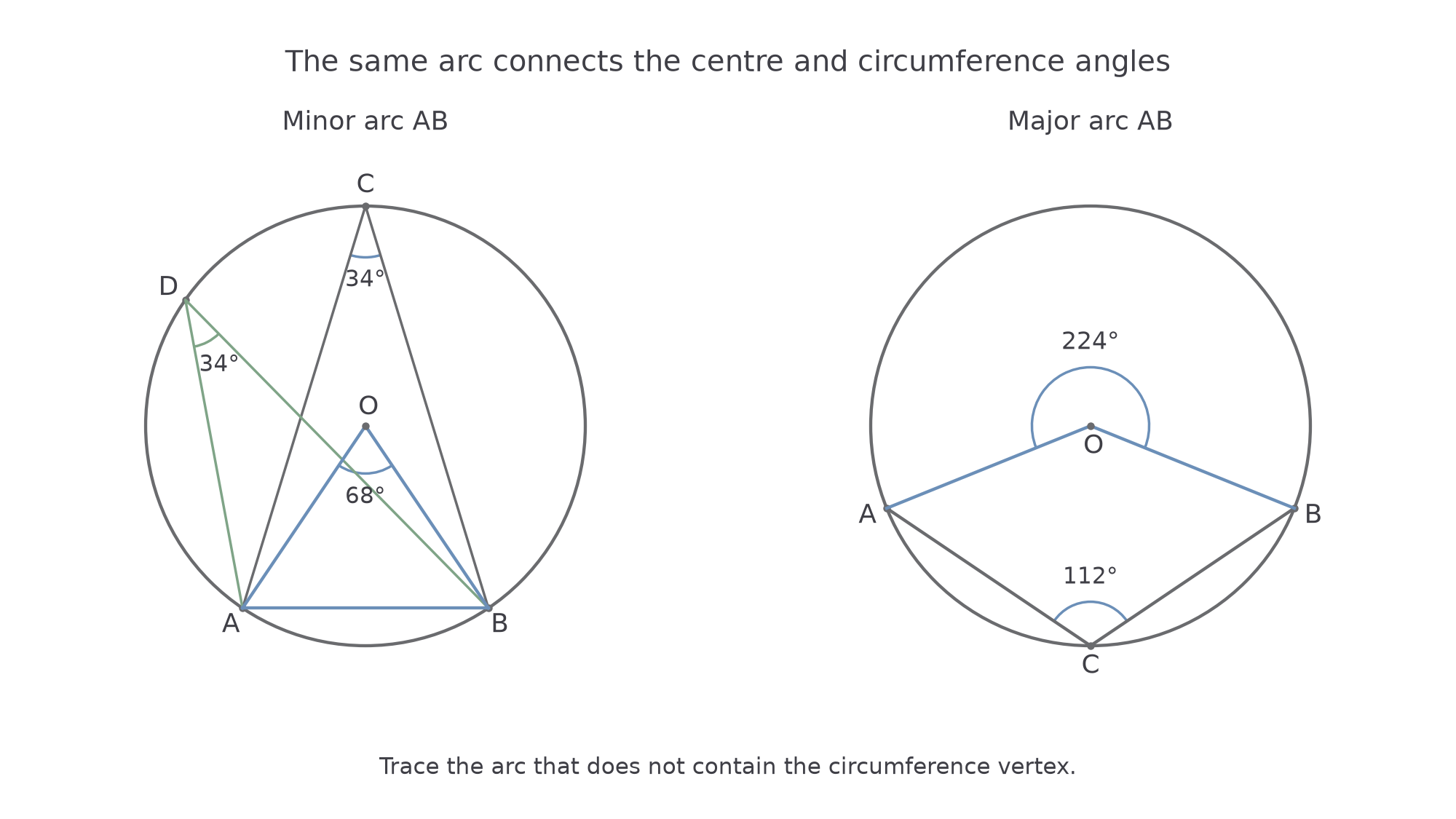
Centre and circumference angles
The angle subtended by an arc at the centre is twice the angle subtended by that same arc at any point on the remaining circumference:
Use the centre angle belonging to that arc, whether non-reflex or reflex. Not in the Higher formulae sheet: learn it.
For a point on the major arc, the angle stands on the minor arc, so the corresponding centre angle is non-reflex.
Worked example 1: double an acute circumference angle
Question. is the centre. Points , and lie on the circle, with on the major arc . Given , find the non-reflex .
Plan. Match the minor arc and double its circumference angle.
Why this centre angle? Both angles stand on the minor arc opposite .
Answer. .
Check. Halving recovers .
Change only the circumference angle to an obtuse one, . This forces the matching centre angle to be reflex, so the relevant arc is now the major arc.
Worked example 2: identify a reflex centre angle
Question. is the centre, and is on the minor arc . Given , find both the reflex and non-reflex angles .
Plan. Double the angle for the intercepted major arc, then subtract from a full turn.
Why not double to get the smaller angle? stands on the major arc, so its matching centre angle exceeds .
Answer. Reflex ; non-reflex .
Check. , and .
You can reverse either calculation by halving the matching centre angle. Identify the arc first; halving whichever centre angle looks smaller is unreliable.
Watch out
Wrong: in the second example. That uses the wrong arc. The angle at is .
Pearson's “Give a reason” needs the relationship, rather than only an arithmetic instruction such as “double it”.
Exam tip
Write “angle at the centre is twice the angle at the circumference on the same arc”, identifying the angles used. A numerical calculation alone does not provide that geometrical reason.
Change the obtuse angle again and trace its major arc.
The angle on a diameter (Higher)
A diameter is a special chord: it subtends a straight angle at the centre. The circumference angle standing on it is therefore half of .
[DIAGRAM: asset_slug: m067_diameter; caption: Diameter AB makes angle ACB a right angle; description: A and B are opposite circumference endpoints through centre O; C is another circumference point; the right angle is at C opposite the diameter; file: diameter_angle.png; recommended_method: matplotlib]
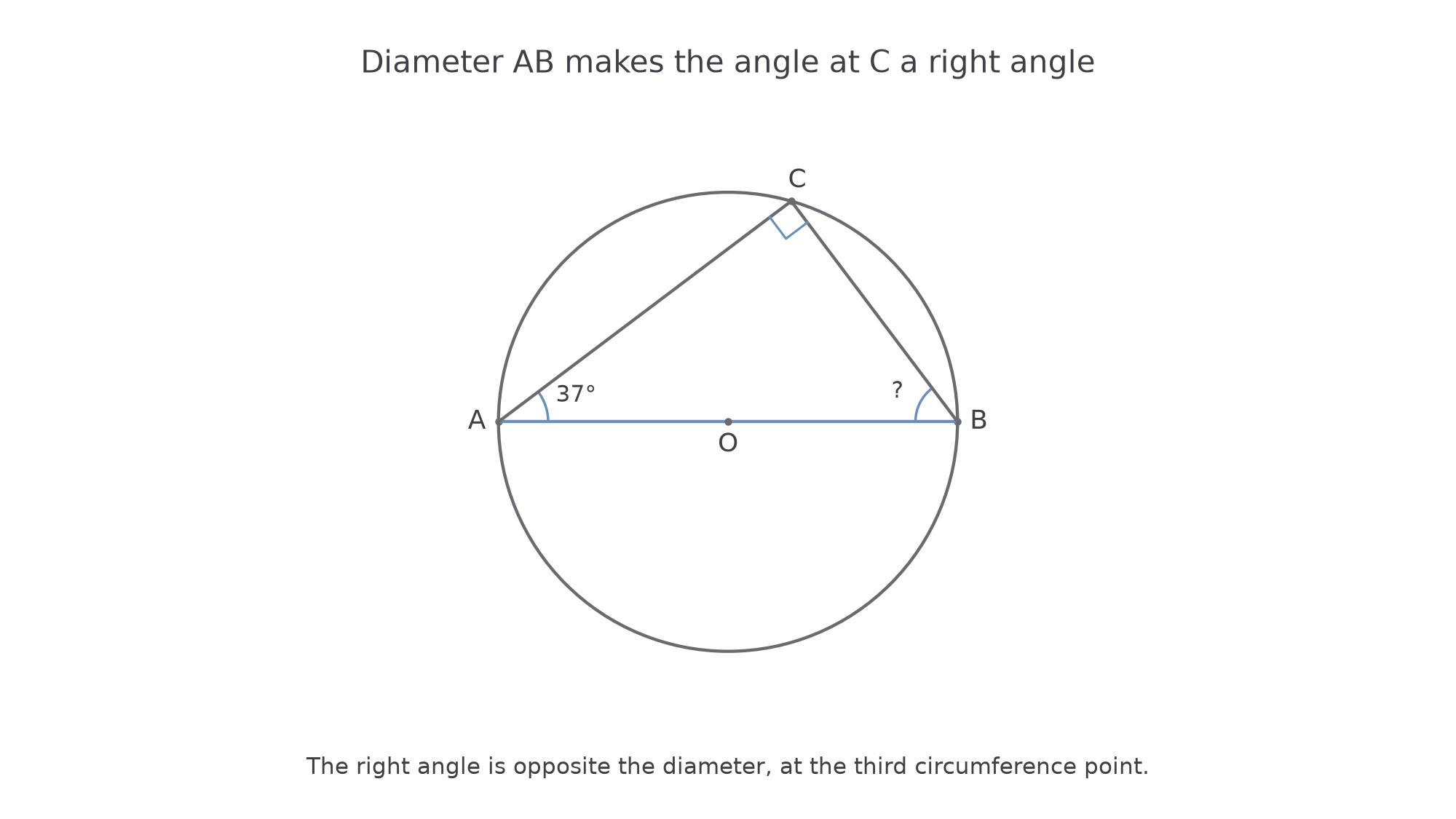
The third point must lie on the circumference, and the stated side must be a diameter. A long-looking chord alone supplies neither condition.
Angle on a diameter
An angle subtended by a diameter at the circumference is a right angle:
Here is a diameter and is a different circumference point. Not in the Higher formulae sheet: learn it.
This gives a useful surprising fact: however moves around either semicircle, the angle opposite the diameter stays . You get many different right-angled triangles from the same diameter.
Worked example 3: finish a triangle on a diameter
Question. is a diameter and lies on the circle. Given , find .
Plan. Use the diameter right angle, then the triangle angle sum.
Why put the right angle at ? Its arms end at the two diameter endpoints and .
Answer. .
Check. , leaving the other at .
Change only the angle at . The angle at stays fixed because the diameter condition is unchanged.
Worked example 4: a different acute angle
Question. is a diameter and lies on the circle. Given , find .
Plan. Keep the right angle at and calculate the remaining angle.
Why does the second acute angle decrease? The two acute angles must still total .
Answer. .
Check. .
If the diagram does not state a diameter or show the chord through the known centre, do not assume a right angle from its appearance.
Watch out
Wrong: because is a diameter. The right angle is opposite , at the third circumference vertex .
Change the acute angle once more and state the circle reason as well as the number.
Angles in the same segment (Higher)
Two circumference angles can have different vertices but the same chord. If their vertices lie on the same side of that chord, the angles are equal.
[DIAGRAM: asset_slug: m067_same_segment; caption: ACB and ADB in the left panel stand on the same chord AB; description: C and D are on the same side of AB and intercept the same minor arc; trace both pairs of arms back to A and B; the right panel shows a different reflex configuration; file: centre_and_same_segment.png; recommended_method: matplotlib]
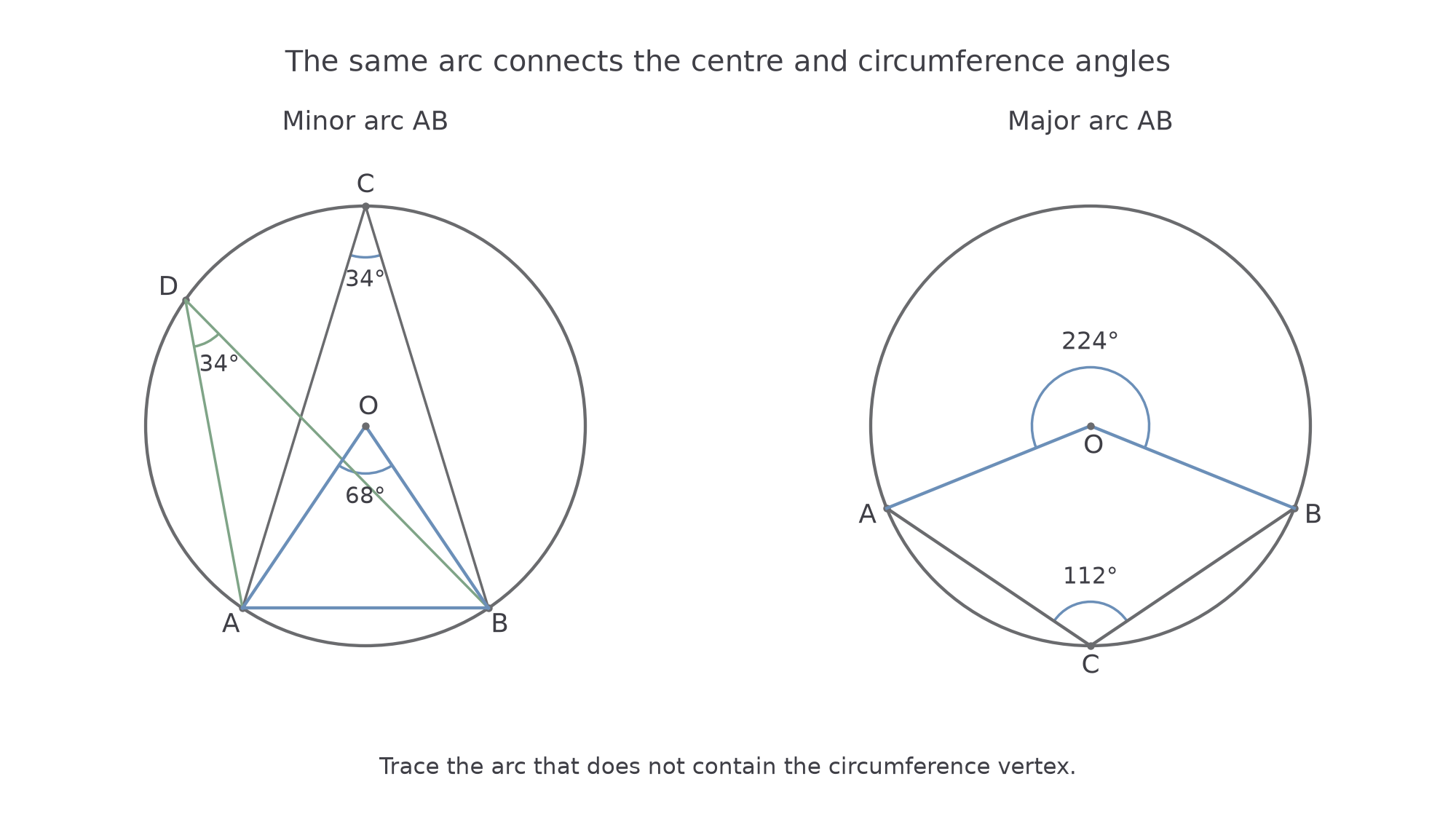
Follow each arm to its circumference endpoint. and both use endpoints and . Their vertices and lie in the same segment. Each angle is half the same centre angle, which explains their equality.
Angles in the same segment
Angles subtended by the same chord at circumference points in the same segment are equal:
The vertices must lie on the same side of chord . Not in the Higher formulae sheet: learn it.
This works even when the triangles overlap or have unequal sides. Equal angles need the common chord and same-side vertices, not matching-looking triangles.
Worked example 5: trace the common chord
Question. Points , , and lie on a circle. Points and are on the same side of chord . Given , find , giving a reason.
Plan. Identify the shared endpoints and transfer the angle using the same-segment theorem.
Why compare these angles? Both sets of arms end at and , and both vertices lie on the same side of .
Answer. , because angles in the same segment are equal.
Check. Both angles would correspond to the same centre angle.
Continue this lesson.
You’re previewing NovaLearn without an account. Create a free account to read the rest.
Create free account