4.11 - Similar figures and length scales
Match the sides and angles of similar figures, use a common length scale, and test whether an enlargement keeps the same shape. The method works even when a figure is turned or reflected.
Corresponding sides and angles
Would a by rectangle be a faithful enlargement of an by rectangle? Looking similar is not enough: we need to match their features and compare their lengths.
You already know
A ratio compares quantities by multiplication. A triangle's angles sum to , and a rectangle has four right angles.
For a turned figure, the side at the bottom may correspond to a side drawn vertically. Match the features by their role in the shape, rather than their position on the page.
Similar figures
Similar figures have equal corresponding angles and corresponding lengths in one common ratio. Corresponding means matching: a vertex matches a vertex, and the side joining two vertices matches the side joining their partners. Congruent figures are similar with length factor .
A surprisingly small square and a very large square can still have exactly the same shape. A square of side and a square of side have length factor , but every corresponding angle is still . Similarity does not require equal size. These similarity properties are not printed on either Foundation or Higher formulae sheet: learn them.
An ordered statement names the matching vertices. If triangle is similar to triangle , read , , . The endpoints then determine the matching sides.
Worked example 1: read the ordered match
Question. Triangles and are similar in that order. Angles , , are , , . State angle and the side corresponding to .
Plan. Pair the vertices in order, then use the matched endpoints.
Why this step? The ordering tells us which features match, even if the figures face different ways.
Answer. and side .
Check. The other angles are and ; .
Change only the order of the second triangle's labels. Swapping two labels changes the correspondence; it does not change the rule about angles.
Worked example 2: a changed label order
Question. Triangles and are similar in that order. Angles , , are , , . State angle and the side corresponding to .
Plan. Read the new order before transferring the angle or side.
Why this step? Side joins the first and third vertices, now and .
Answer. and side .
Check. and , so the matched angles still agree.
The same idea applies to polygons: if matches , then matches . A corresponding angle remains ; there is no angle multiplier.
Watch out
If lengths double, the line is wrong. Similarity scales lengths, while corresponding angles stay equal: .
Read a new ordering for this check; all needed correspondence information is in the question.
One common length scale
One known pair of corresponding lengths supplies the multiplier for every other corresponding length. Multiplication preserves proportions; adding the same amount usually does not.
For example, becoming means multiplying by . A corresponding length must also be multiplied by .
Directed length scale factor
Use the same unit for the two lengths in the ratio. A positive factor above increases size; one below reduces it. Neither result is printed on the Foundation or Higher sheet. Not in the formulae sheet: learn it.
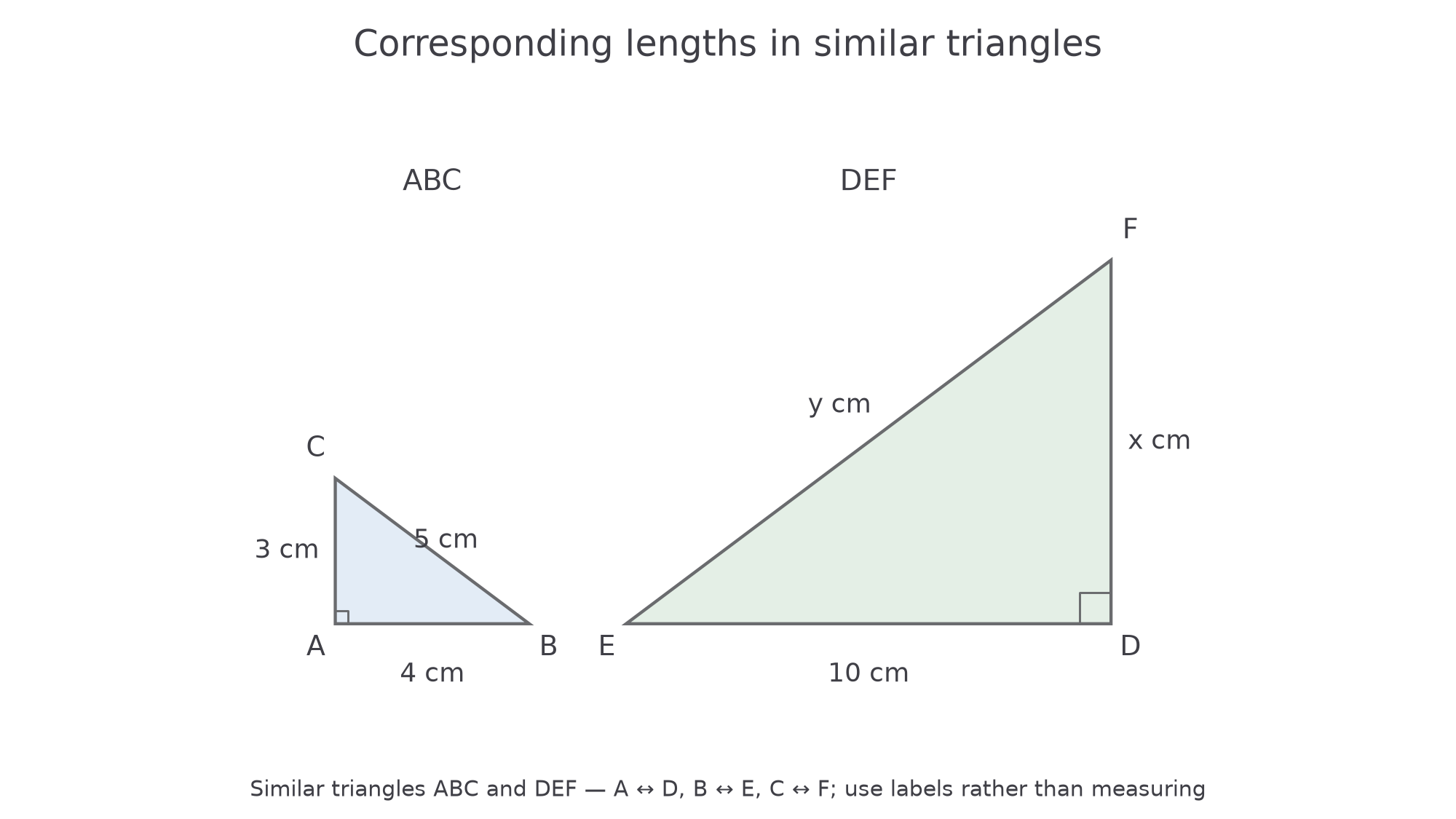
The larger triangle below is reflected. Its labels, rather than its orientation, show that matches , matches , and matches .
[DIAGRAM: asset_slug: m080_similar_triangles; caption: Reflected similar triangles still have matching sides in one ratio; description: Similar right triangles ABC and DEF with A corresponding to D, B to E and C to F. AB is 4 cm, AC 3 cm, BC 5 cm, DE 10 cm, DF x cm and EF y cm. The larger triangle is a reflected 2.5-times copy; no measurement from the image is needed.; file: m080_similar_triangles.png; recommended_method: matplotlib]
Worked example 3: two missing sides
Question. Similar triangles and have matching sides , , . Given , , and , all in centimetres, find and .
Plan. Find the factor from to , then multiply both missing sides by it.
Why this step? Similarity gives one multiplier for all matching lengths, even after reflection.
Answer. , .
Check. .
Change only the given length , from to . The original triangle and all side matches stay fixed.
Worked example 4: a different target size
Question. Similar triangles have the same correspondences as above. The original sides are , , , and now , all in centimetres. Find and .
Plan. Recalculate the common factor using the changed target length.
Why this step? A new target size requires a new common multiplier; the correspondence is unchanged.
Answer. , .
Check. .
A proportion gives the same method. For instance, says the unknown-to-original ratio equals the known ratio.
Watch out
is wrong for Worked example 3. Adding does not preserve the ratio. Correct it to .
For your turn, change only again; use the supplied matching sides.
Continue this lesson.
You’re previewing NovaLearn without an account. Create a free account to read the rest.
Create free account