1.8 - Bounds and accuracy
A rounded measurement hides a range of possible values. Find that range, read its endpoints and, at Higher tier, use it to decide whether a calculation or promise is reliable.
Rounding intervals
A parcel is recorded as , to the nearest kilogram. A carrier accepts parcels below . Is this parcel certain to pass? The displayed number looks safe, but it has lost some information.
You already know
Rounding keeps the nearest stated unit. For positive measurements, a halfway value rounds upwards: rounds to , while rounds to .
Every value between those halfway points rounds to the same recorded value. Imagine sliding along a number line, rather than searching for one hidden decimal.
Lower bound and upper bound
The lower bound and upper bound are the boundaries of the possible values. A rounding interval contains all values that round to the recorded measurement at the stated accuracy.
The rounding step is the gap between consecutive possible recorded values. For the nearest centimetre it is . Each boundary is half a step from the recorded value.
Bounds of a rounded positive measurement
For recorded value , rounding step and true value ,
This uses halfway-up rounding for positive measurements. Not in the formulae sheet: learn it. This applies to Foundation and Higher.
The lower endpoint rounds up to the recorded value, so it is included. The upper endpoint rounds to the next value, so it is excluded.
[DIAGRAM: asset_name: Rounding interval; asset_slug: m018_rounding_interval; caption: All these lengths round to 43 centimetres.; description: Number line from 42 to 44 centimetres with a filled endpoint at 42.5 and an open endpoint at 43.5. The interval between them is shaded and the recorded value 43 is marked.]
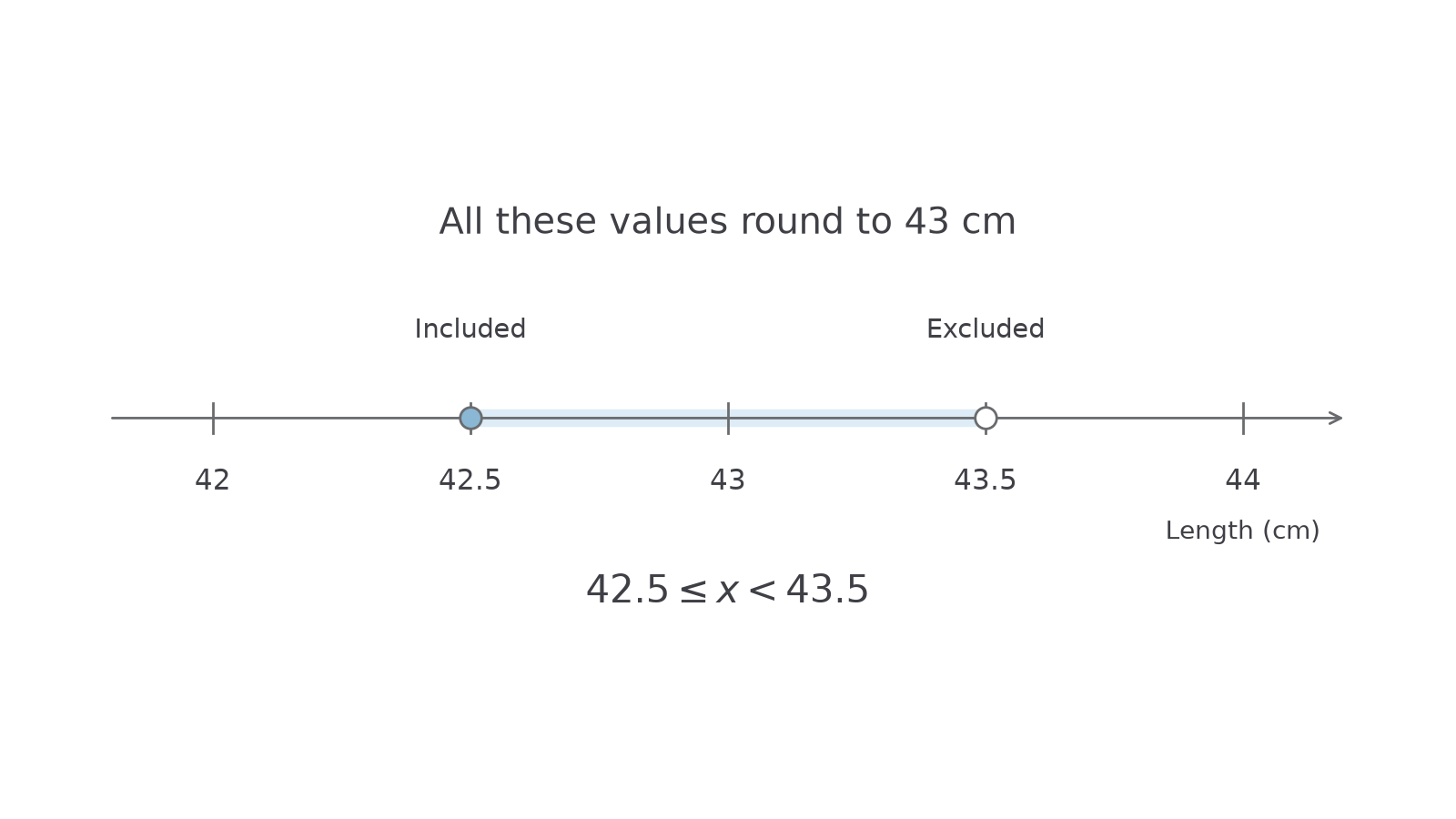
Worked example 1: nearest centimetre
Question. A length is , correct to the nearest centimetre. Write its rounding interval.
Plan. Find half the rounding step, then subtract and add it.
Why these signs? The lower halfway value rounds to , but the upper one rounds to .
Answer. , with in centimetres.
Check. is allowed and rounds to ; is excluded.
Now change only the rounding step. A coarser measurement must leave a wider interval.
Worked example 2: nearest ten centimetres
Question. A length is , correct to the nearest . Write its rounding interval.
Plan. Use half of , rather than half of .
Why use ? The stated accuracy describes the step, even though the recorded value is written without decimals.
Answer. , with in centimetres.
Check. Both and round to to the nearest ten.
A bound need not be a value the measurement can reach. There is no largest allowed decimal below the upper endpoint: you can always get closer.
Watch out
The line is wrong. It rules out possible lengths such as . Use the boundary and a strict sign: .
Use the same halfway idea with a different measurement step.
Reading the stated accuracy
The last retained digit tells you the rounding step; the total size of the number does not.
For one decimal place the step is ; for two decimal places it is . With significant figures, start at the first nonzero digit and locate the final retained digit. Trailing zeros alone do not establish accuracy. An exact count of people has no rounding interval unless the count is stated to be approximate.
Worked example 3: significant figures in a large number
Question. A positive quantity is , correct to two significant figures. Find its bounds.
Plan. Locate the second significant digit before halving its place value.
Why use tens? The final zero is a place holder here; the question retains only the digits and .
Answer. .
Check. rounds to to two significant figures, while rounds to .
Keep two significant figures, but move to a small decimal. Leading zeros locate the digits; they do not count as significant figures.
Worked example 4: significant figures below one
Question. A positive quantity is , correct to two significant figures. Find its bounds.
Plan. Use the place value of the digit .
Why ignore the leading zeros when counting? They set the scale but add no significant digit.
Answer. .
Check. rounds to to two significant figures; rounds to .
There is a neat surprise here: both intervals have the same significant-figure count, but their widths are and . One is times wider. A significant-figure count is about place value, not a fixed absolute error.
Watch out
For to two significant figures, is wrong: is half a hundredth. The final digit is a thousandth, so use .
The endpoint convention can also be written : the square bracket includes , while the round bracket excludes . The inequality is enough for these questions.
Choosing bounds for a calculation (Higher)
To make a calculation small, ask how each input affects it before choosing a boundary.
For independent positive quantities, increasing either input increases a sum or product. Subtracting a larger number makes a difference smaller. Dividing by a larger positive number makes a quotient smaller.
| Expression | Lower boundary | Upper boundary |
|---|---|---|
Here and are the input bounds. These rules are not in the Foundation or Higher formulae sheet. Learn the reasoning, rather than treating the table as a machine. The product and quotient rows need positive inputs, with the divisor bounded away from zero. Repeated occurrences of one variable are not independent measurements.
Worked example 5: a quotient
Question. Independent positive quantities and are correct to the nearest whole number and one decimal place respectively. Find the bounds of .
Plan. List the input intervals, then make the numerator and denominator work in opposite directions.
Why opposite choices? A larger divisor reduces the quotient, while a larger numerator increases it.
Answer. The bounds are and ; .
Check. The recorded-value estimate lies between and . Neither endpoint is attained because each needs an excluded input endpoint.
Now change one structural feature: the divisor is itself a calculation. Optimise that whole divisor first.
Worked example 6: a compound divisor
Question. Find the lower bound of to three decimal places. Independent values , and are correct to the nearest whole number, one decimal place and one decimal place respectively.
Plan. Check that the divisor stays positive, then make it as large as possible.
Why use the lower bound of ? Less is subtracted, so the divisor becomes larger.
Answer. The lower bound is to three decimal places.
Check. , below the recorded-value estimate . Use the exact fraction for comparisons, not its rounded description.
For a positive rectangle, the product row gives its area boundaries directly. For example, lengths recorded as and to the nearest centimetre give area boundaries and .
Watch out
The line is wrong. Subtracting the smallest makes the result larger. Use ; likewise use for a positive quotient.
Write the input bounds before calculating. This keeps a wrong endpoint choice separate from an arithmetic slip.
Guarantees and reliable rounding (Higher)
A guarantee must survive every value in the possible interval, not just the recorded value.
Reliable rounded answer
A rounded answer is reliable when every possible true result rounds to that same answer at the stated accuracy.
First test a simple acceptance rule. Then apply the same whole-interval thinking to the precision of an answer.
Worked example 7: a limit inside the interval
Question. A parcel is to the nearest kilogram. It is accepted only below . Is acceptance guaranteed?
Plan. Compare the whole mass interval with the carrier's limit.
Why find a counterexample? One possible rejected parcel is enough to disprove a guarantee.
Answer. No. A true mass of is possible and would be rejected.
Check. rounds to to the nearest kilogram.
Change only the carrier's limit. The measurement and its uncertainty stay the same.
Worked example 8: a limit above the interval
Question. The same parcel is accepted only below . Is acceptance guaranteed?
Plan. Compare the upper mass boundary with the new limit.
Why use the upper boundary? If even that boundary is below the limit, every smaller possible mass passes.
Answer. Yes, acceptance is guaranteed.
Check. A mass very close to , such as , still passes.
For two uncertain measurements, compare their intervals in the same way. If one interval lies wholly below the other, their order is certain. Overlapping intervals generally cannot establish the order; check endpoint inclusion when boundaries meet.
Reliable rounding asks whether the whole output interval fits inside one rounding interval. Suppose independent and are each correct to one decimal place. Then
The estimate is , but values round to to one decimal place only in . The possible interval extends beyond this: rounds to , while rounds to . So one decimal place is unreliable. Every possible difference does, however, round to to the nearest whole number, because lies inside .
Watch out
The line “, so the true answer is to one decimal place” ignores input uncertainty. Calculate the output bounds first and check whether both extremes round alike. Averaging the bounds does not prove reliability.
This also answers the opening puzzle: a recorded parcel can exceed . The number on the label is not an exact promise.
Quick Recap
- Find the rounding step, then go half a step each way.
- Include the lower endpoint and exclude the upper endpoint for these positive rounding intervals.
- Significant figures determine a place value, not a fixed interval width.
- For calculations, choose bounds by how each input changes the result.
- A guarantee or reliable rounding must hold across the whole possible interval.
The opening parcel is not certain to pass: its true mass can lie above while still rounding to .