6.3 - Conditional probability
Learn how new information changes the group used in a probability calculation. Update a bag after each draw without replacement, combine qualifying routes and restrict those routes when a condition is given. These are Higher methods.
Restricting the sample to a given condition (Higher)
Draw two beads without replacement from a bag of red and blue. Before any information, the chance of both red is . If someone tells you “at least one is red”, should you keep that answer? By the end, you will calculate how the new information changes it.
You already know
A Venn overlap represents both events. A tree path probability multiplies the probabilities at successive branches; different complete routes can be added when they are mutually exclusive.
First consider which people can still be selected after a condition is given. If someone is chosen from learners who own goggles, learners without goggles no longer belong in the denominator.
Conditional probability
Conditional probability is the probability of an event given that another event has occurred. Write for “probability of , given ”. The vertical line means “given”. Restrict to , then find the fraction also in .
For equally likely individuals, count the overlap and divide by the given-condition group. The condition must be possible: an empty group gives no valid denominator.
Conditioning on a counted group
For a person chosen uniformly at random, with ,
This result is absent from both tier sheets; conditioning is Higher content. Not in the formulae sheet: learn it.
The numerator belongs to both events. Reversing which group is given changes the denominator, even when the overlap stays the same.
Worked example 1: given goggles
Question. The table shows learners. One is chosen at random from those who own goggles. Find the probability that this learner swims.
| Swims | Does not swim | Total | |
|---|---|---|---|
| Owns goggles | |||
| No goggles | |||
| Total |
Plan. Keep only the goggles row, then count swimmers within it.
Why divide by ? We already know the learner owns goggles; the other row is excluded.
Answer. .
Check. The nonswimming fraction in that row is , completing the conditional total to .
Change only the direction of the question: now choose from swimmers and ask about goggles. Use the same people and overlap.
Worked example 2: reversing the given group
Question. Among the same learners, swim, and of these own goggles. One is chosen at random from the swimmers. Find the probability that the learner owns goggles.
Plan. Restrict to the swimmers column rather than the goggles row.
Why does the answer change? The same people are now a fraction of , rather than of .
Answer. .
Check. , accounting for all swimmers.
The unconditioned probability of both goggles and swimming is . That asks about selection from all learners, so it is a different question.
Watch out
uses the whole population despite the condition. Replace the denominator by the goggles total: .
A phrase such as “one of the people who belongs to ” gives the condition even without a vertical-line symbol.
Changing counts without replacement (Higher)
Without replacement, a selected object is not returned. Both the total remaining and the count of the selected colour decrease by one. The next probability depends on what was removed.
Start with red and blue beads. Removing red leaves red and blue. Removing blue leaves red and blue. Both remaining bags have total , but different red probabilities.
[DIAGRAM: asset_slug: m096_dependent_tree; caption: Two draws without replacement from four red and three blue beads, with second-stage probabilities updated for the colour removed; description: First branches R 4/7, B 3/7. After R, second R 3/6 and B 3/6. After B, second R 4/6 and B 2/6. Complete paths RR, RB, BR and BB; every outgoing pair sums to one; file: m096_dependent_tree.png; recommended_method: matplotlib]
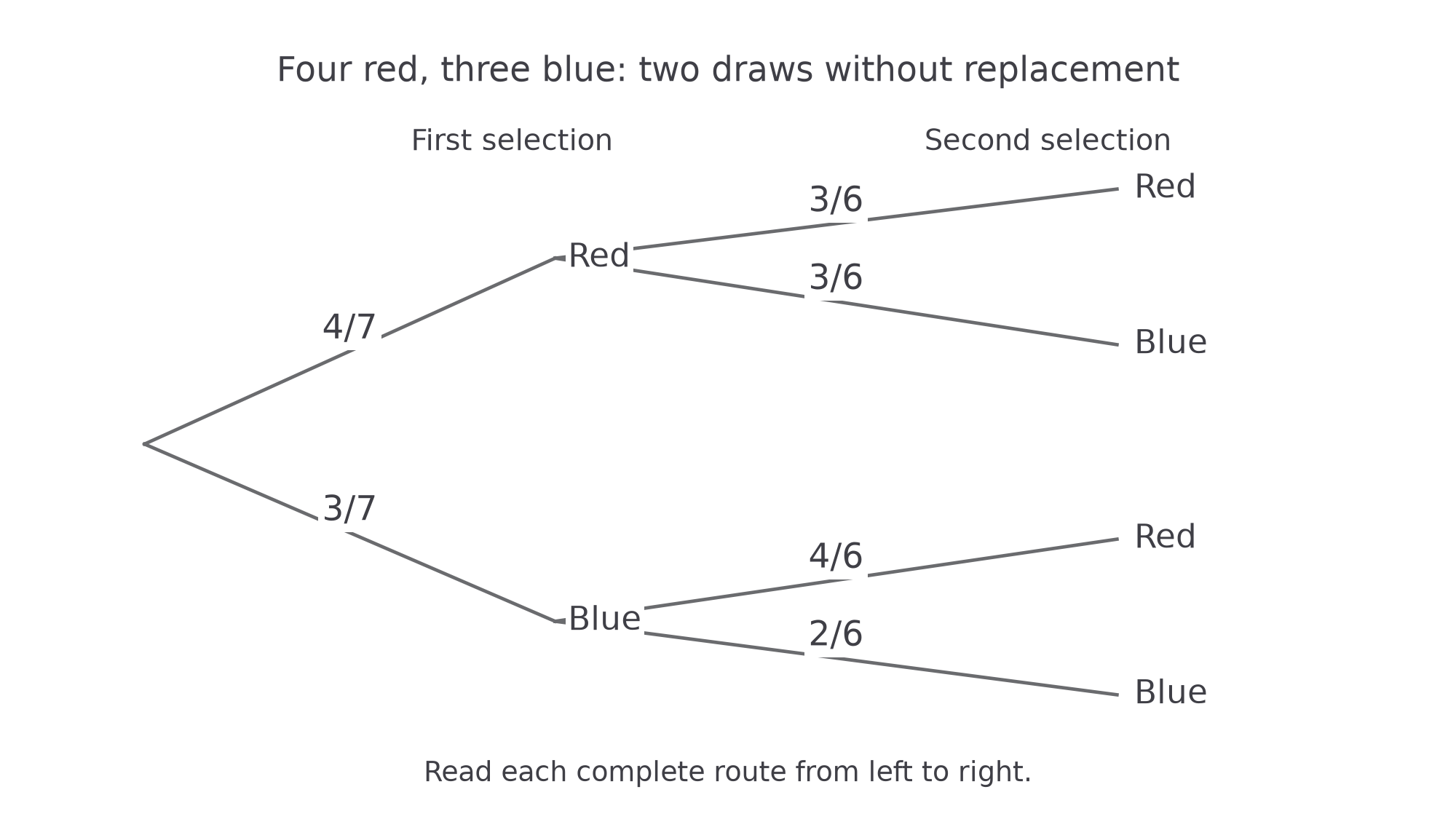
A tree can represent dependence. Multiply the correct branch probabilities in their actual states; multiplication along a path does not require independence when those branches are already conditional.
A path with a conditional second branch
The second factor describes the probability after , rather than an assumed unchanged probability. This rule is absent from both tier sheets. Not in the formulae sheet: learn it.
To draw the tree on paper, place the appropriate remaining-bag pair after each first colour. The two second-stage pairs need not repeat.
Worked example 3: two reds without replacement
Question. A bag contains red and blue beads. Two are drawn at random without replacement. Find the second-stage branch pairs and the probability of both red.
Plan. Update the bag after each possible first colour, then multiply the red-red path.
Why does the second denominator become ? One of the original seven beads is no longer in the bag.
Answer. The second-stage pairs are and ; both red has probability .
Check. Each outgoing pair sums to , and the second red chance after red is , below the original .
Change only the replacement rule: return the first bead and mix again before drawing the second. The original bag composition is restored.
Worked example 4: replacing the first bead
Question. A bag contains red and blue beads. Draw one at random, replace it, mix, and draw again independently. Find the second-stage branch pairs and the probability of both red.
Plan. Use the original composition at both stages because replacement restores it.
Why keep denominator ? The removed bead is back before the second draw.
Answer. Both second-stage pairs are ; both red has probability .
Check. . Also : replacing a red makes a second red more likely than keeping it out.
If the first colour is already given, use its second-stage branch alone. A full path product answers the probability of both results from the start, including uncertainty about the first result.
Watch out
Without replacement, keeps the old total by mistake. Removing one bead changes the second denominator too: .
Read both the replacement instruction and the given condition before deciding which fraction to use.
Continue this lesson.
You’re previewing NovaLearn without an account. Create a free account to read the rest.
Create free account