1.7 - Ratios and sharing quantities
Ratios describe how quantities fit together. You will simplify ratios, connect them to fractions, and share amounts when you know a total or a difference. The key is to work out what one equal part represents.
Simplifying ratios
Amal, Ben and Chen share in the ratio . How much should each person receive? There are three people, but dividing by would ignore the unequal shares. We will build the equal-parts method first.
You already know
Equivalent fractions multiply or divide numerator and denominator by the same nonzero number. An HCF is the greatest factor shared by whole numbers. Also, and .
A ratio works like a recipe. Multiplying every entry by the same positive factor changes the amount, but keeps the recipe unchanged.
Ratio
A ratio compares quantities in a stated order. In red:blue , there are three equal red parts for every five equal blue parts. The counts could be and , or and . The ratio alone does not give the total.
Use common units before comparing measurements of the same kind. For decimal entries, multiply every entry by a power of ten to get whole numbers. For fraction entries, multiply by a common denominator: , after multiplying both entries by .
Equivalent ratios
Divide whole-number entries by their HCF for simplest whole-number form. To write , divide every entry by the first entry, provided it is positive. The value need not be an integer.
Foundation and Higher: Not in the formulae sheet: learn it.
The form requested matters. A simplest whole-number ratio and a ratio may look different while describing the same comparison.
Worked example 1: simplify matching units
Question. Simplify . Also write it in the form .
Plan. Convert to centimetres, cancel the HCF, then make the first entry .
Why convert first? One metre and one centimetre are unequal units, so their raw numbers cannot be compared as equal-sized parts.
Answer. Simplest form ; form .
Check. . Also, .
Change only the second length. The first-unit conversion stays the same, but the HCF and final comparison change.
Worked example 2: change one length
Question. Simplify . Also write it in the form .
Plan. Put both lengths in centimetres, simplify, then divide by the first ratio entry.
Why is a decimal allowed? The form describes how much of the second quantity matches one unit of the first.
Answer. , or in the requested alternative form.
Check. and ; scaling both entries back recovers the original lengths.
Adding the same amount to both entries does not preserve the recipe. For instance, and have different first-to-second fractions.
Watch out
mixes units. Convert first: . Simplification must also act on every entry, including in a ratio with three or more entries.
Now use masses in the same two requested forms.
Ratios and fractions
A fraction's denominator tells you what the comparison is with. A fraction of the whole and a fraction of another share are different questions.
Fractions from a ratio
For first:second , with positive entries,
For a ratio with more entries, add all entries to find the total number of parts.
Foundation and Higher: Not in the formulae sheet: learn it.
The bar shows why the first denominator is the sum. All ten parts belong in the whole, including the red ones.
[DIAGRAM: asset_slug: ratio_parts_whole; caption: Three red parts and seven blue parts make ten parts altogether; description: One bar split into ten equal rectangles. The first three are pale clay and labelled red, the next seven pale blue and labelled blue. Labels below give red as 3 out of 10 of the whole and red compared with blue as 3 to 7; file: ratio_parts_whole.png; recommended_method: matplotlib]
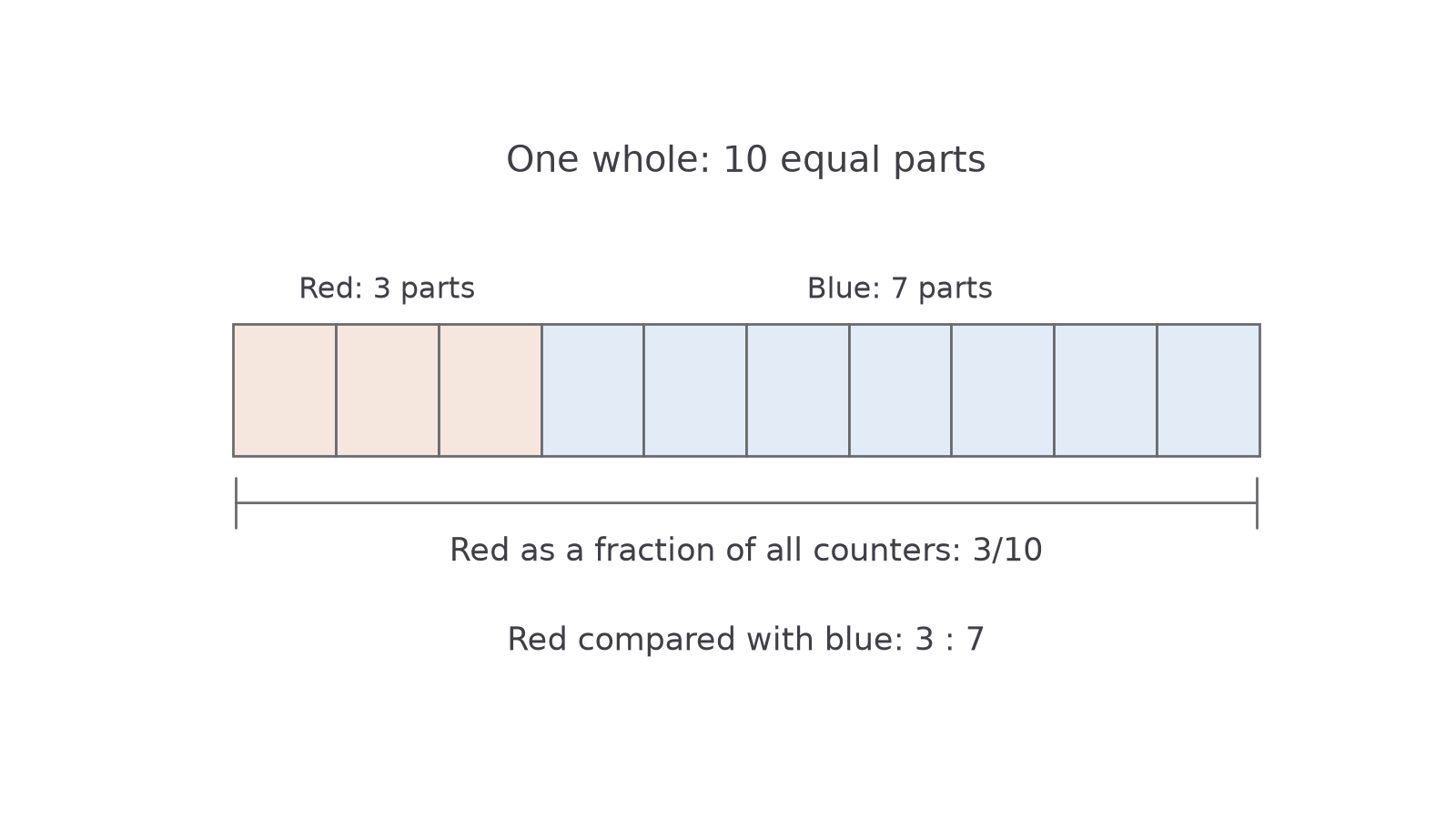
Worked example 3: compare with the correct whole
Question. Red:blue counters are in the ratio . Find the red fraction of all counters, the blue fraction of all counters, and red as a fraction of blue.
Plan. Use total parts for fractions of all counters and blue parts for the red-to-blue comparison.
Why is the last denominator ? That question compares red with blue alone, rather than with the whole bag.
Answer. , , and , respectively.
Check. : the two colours make the whole bag.
Now give the same information as a fraction instead of a ratio. We must reconstruct the other share before writing a part-to-part comparison.
Worked example 4: turn a fraction into a ratio
Question. of some counters are red. All the others are blue. Find red:blue and red as a fraction of blue.
Plan. Find the blue fraction, then compare the two numerators over their common denominator.
Why not write ? The represents all counters, including the three red parts.
Answer. Red:blue , and red is of blue.
Check. , which recovers the given red fraction.
Here is a surprise about ratios. Start with red and blue counters, ratio . Remove of each colour. You get , not . Equal subtraction has changed the mixture.
Watch out
“The red fraction of all counters is ” uses the blue count as the denominator. For red:blue , the correct whole-bag fraction is .
This time the fraction has a different denominator.
Sharing a total
To share a total, count all the ratio parts before finding the size of one part. A person with four parts receives twice as much as someone with two parts.
Sharing a total in a ratio
For total shared in ratio ,
Multiply one part by each entry to find the shares. The same method works with two or more entries.
Foundation and Higher: Not in the formulae sheet: learn it.
If the quantity counts indivisible objects, the shares must be whole numbers. Rounding each share separately would usually change the ratio. Check whether the stated allocation is possible instead.
Worked example 5: answer the opening sharing problem
Question. Share between Amal, Ben and Chen in the ratio .
Plan. Find the value of one of the nine equal parts, then give each person their number of parts.
Why divide by , not ? The people have unequal shares, but the nine ratio parts have equal value.
Answer. Amal , Ben , Chen .
Check. , and dividing all three shares by gives .
Keep the ratio and change only the total. Every share should scale by the same factor.
Worked example 6: change the total
Question. Share between Amal, Ben and Chen in the ratio .
Plan. Use the same nine parts with a new value per part.
Why do all shares increase? The total is larger while the fraction given to each person is unchanged.
Answer. Amal , Ben , Chen .
Check. , and .
A correct total is only half a check. Equal shares could also add to the total, while ignoring the required ratio.
Watch out
gives three equal shares, ratio . The required ratio has parts, so start with .
Try a new three-part ratio.
Sharing from a difference
Sometimes the given amount is the gap between two shares. That amount represents the difference in their parts, rather than all their parts.
One part from a difference
For smaller:larger , with , and difference ,
The total has parts, while the difference has parts.
Foundation and Higher: Not in the formulae sheet: learn it.
Label the given quantity before dividing. “Altogether” points to a sum of parts; “more than” points to a difference of parts.
Worked example 7: find shares from their gap
Question. A and B have savings in the ratio . B has more than A. Find both amounts and their total.
Plan. Match to the three extra parts, then rebuild both shares.
Why divide by ? The describes only B's extra parts.
Answer. A has , B has , total .
Check. , and .
Change only the gap. The number of difference parts stays the same.
Worked example 8: change the known difference
Question. A and B have savings in the ratio . B has more than A. Find both amounts and their total.
Plan. Share the new difference across the same three extra parts.
Why is the total larger than ? That given amount was only the gap between the shares.
Answer. A has , B has , total .
Check. , and .
The same equal-parts idea solved both the opening total problem and these difference problems. What changes is which parts match the given amount.
Watch out
treats the difference as the total. The correct start is . Choose the divisor from the words, rather than automatically adding entries.
Use a new ratio and a new difference.
Quick Recap
- Keep the ratio's order and convert matching quantities to common units.
- Scale every entry by the same factor to make an equivalent ratio.
- Fractions of the whole use the sum of all ratio parts.
- Match a total to total parts, and a difference to difference parts.
In the opening problem, the nine parts are worth each. Amal gets , Ben , and Chen .