1.1 - Factors and multiples
Use number properties to decide which integers divide a total exactly and which values two counting patterns share. You will identify primes, list factors and multiples, and use common values to solve grouping and timing problems.
Odd, even and prime numbers
Two lights flash together now. One flashes every seconds and the other every seconds. When will they next flash together? We will use number properties to find the first shared time, without watching the lights.
You already know
A multiplication and its division facts describe the same relationship: means . “Divides exactly” means the division leaves no remainder.
Pairing objects gives a useful way to distinguish odd from even.
Odd and even integers
An even integer is divisible by . An odd integer is not divisible by . For example, , and are even; , and are odd. The last digit decides: mean even; mean odd.
For instance, , so zero is even. Being odd is different from being prime: is odd but has a factor other than itself and one.
Prime number
A prime number is a positive integer with exactly two positive factors: and itself. A composite number is a positive integer greater than with more than two positive factors. The number is neither: it has only one positive factor.
Here is a useful surprise: is the only even prime. Its positive factors are just and . Every even positive integer greater than has at least the three different factors , and itself, so it is composite.
To check a candidate prime, look for a factor pair other than one times itself. You can stop once the smaller partner would be larger than the larger partner; any later pair would repeat a pair you have already checked. For , , so test only , and . If both partners were at least , their product would be at least .
Worked example 1: checking a prime candidate
Question. Is prime? Give a reason.
Plan. Check for a divisor from to .
Why this step? Any factor pair other than would need a smaller partner below , and none works.
Answer. Yes. The only positive factors of are and .
Check. The possible next smaller partner, , already gives .
Change only the candidate to . The same stopping point works, because is also between and .
Worked example 2: checking a nearby candidate
Question. Is prime? Give a reason.
Plan. Test the same possible small divisors.
Why this step? There cannot be two factors of at least , since their product would exceed .
Answer. Yes. Its only positive factors are and .
Check. Neither the even-number test nor the tested divisions supplies an extra factor.
One genuine extra factor is enough to show a number is composite. For example, , so is not prime even though it is odd.
Watch out
Wrong: “ is prime because it is odd.” Odd numbers can be composite. Right: , giving the three positive factors , so is not prime.
Number-property facts and these tests are absent from both the Foundation and Higher formulae sheets: learn the definitions and how to use them. Now change the candidate once more; the possible small divisors are still , and .
Listing factors and multiples
Factor pairs help you find every exact divisor without guessing.
Factor and multiple
A factor of an integer divides it exactly. A multiple is the result of multiplying a number by an integer. For example, is a factor of , and is a multiple of , because . The number is not a factor of .
Here, factor lists mean positive factors, and positive multiples start with the number itself. Although zero is a multiple of every nonzero integer, it is not a positive multiple.
Start your factor list with and the number. Try the next integers in order, recording both partners whenever division is exact. Stop when the partners meet or cross. For a square number, record the repeated middle factor only once.
A prime factor is a factor that is prime. It is a value, not a count: if divides a number several times, write once in its list of prime factors. Writing a complete product of prime factors comes later.
Worked example 3: factors, prime factors and multiples
Question. List the positive factors and prime factors of . Write its first four positive multiples.
Plan. Find factor pairs, select the primes, then multiply by consecutive positive integers.
Why this step? Every pair has been tested up to the meeting point , so the factor list is complete.
Answer. Positive factors: . Prime factors: . First four positive multiples: .
Check. Every listed factor divides exactly; neither nor any untested smaller partner can add a new pair.
Change only the number to . The pairs now cross rather than meet, so there is no repeated middle factor.
Worked example 4: stopping when pairs cross
Question. List the positive factors and prime factors of . Write its first four positive multiples.
Plan. Use the same factor-pair and repeated-multiple methods.
Why this step? Trying would give , the last pair reversed. The pairs are already complete.
Answer. Positive factors: . Prime factors: . First four positive multiples: .
Check. All eight factors divide exactly, and every multiple is an integer number of copies of .
A factor list and a multiple list run in different directions from the original number.
Watch out
Wrong: “ is a factor of .” A positive factor cannot exceed the positive number it divides. Right: , so is a multiple of .
These factor and multiple methods are not supplied on either tier's formulae sheet. Change the number to for your turn.
Common factors and common multiples
A common value must work for each of the numbers, not just one of them.
Common factor and common multiple
A common factor divides each given number exactly. A common multiple is a multiple of each given number. For example, is a common factor of and , while is a common multiple of them.
Compare complete lists to find shared entries. The factors of are ; the factors of are . Their common positive factors are . For instance, both totals can be shared equally among groups.
For multiples, keep listing until you reach the limit the question gives. The shared positive multiples of and below are . Each is divisible by both numbers; is the next shared value, but is outside the range.
[DIAGRAM: asset_name: Shared multiples of four and six; asset_slug: m002_common_multiples; caption: The positive multiples of four and six below forty share twelve, twenty-four and thirty-six; description: Two aligned horizontal rows show positive multiples of four and six below forty at their true positions. Shared entries twelve, twenty-four and thirty-six have clay highlights and vertical dashed guides linking the rows.]
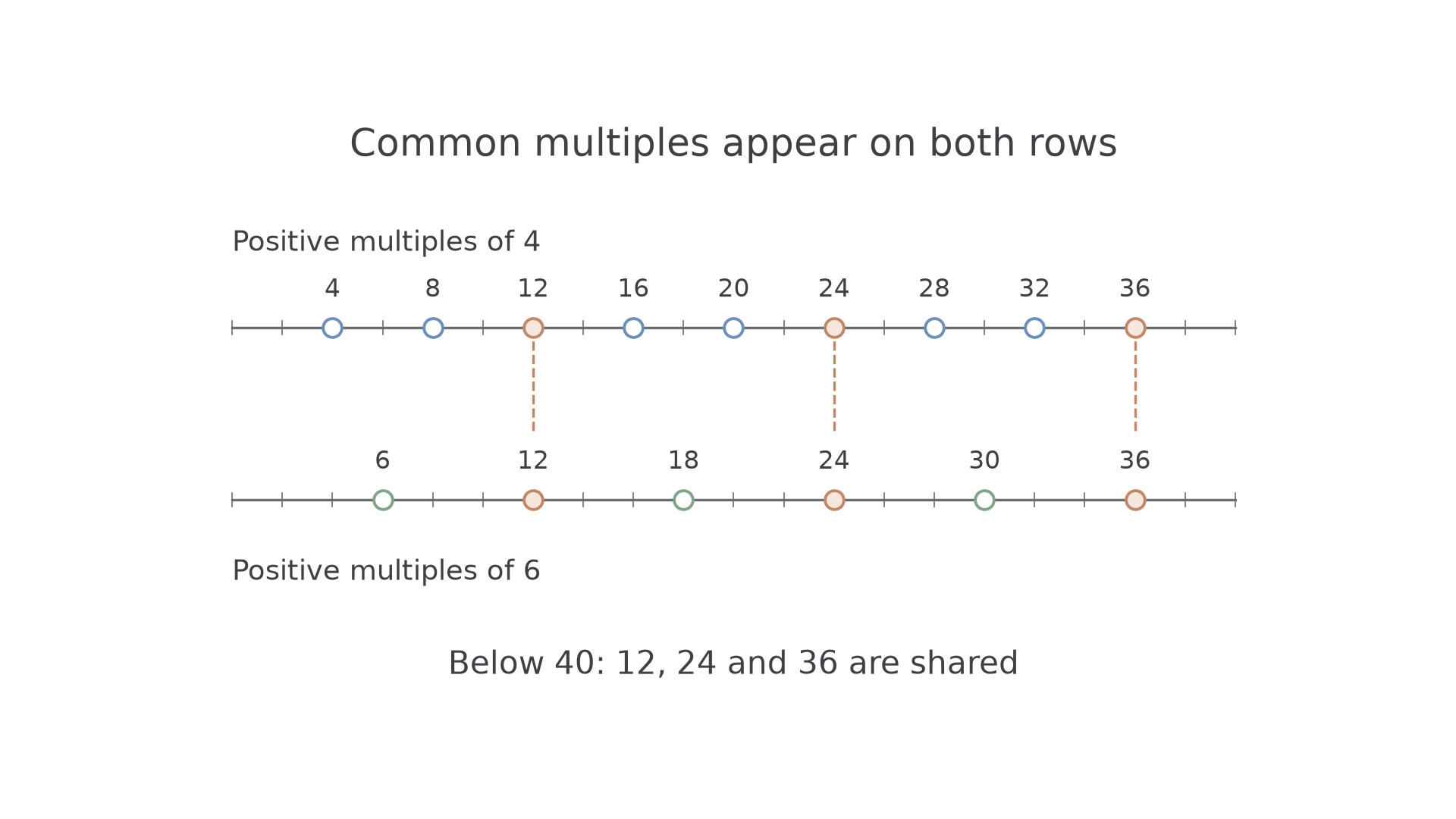
There are only finitely many positive factors of a positive integer, because none can exceed it. There are infinitely many positive multiples: multiplying by the next positive integer always gives another one.
Worked example 5: the next shared flash
Question. Two lights flash together now. One flashes every seconds and the other every seconds. After how many seconds will they next flash together?
Plan. List positive flash times and choose the first shared time.
Why this step? A shared time must contain a whole number of each light's intervals. The first shared positive multiple gives the next coincidence.
Answer. After seconds.
Check. Neither nor is a multiple of , so there is no earlier positive coincidence.
Change only the second light's interval, from seconds to seconds. The method is unchanged.
Worked example 6: a longer second interval
Question. Two lights flash together now. One flashes every seconds and the other every seconds. After how many seconds will they next flash together?
Plan. Compare the positive multiples again.
Why this step? Being a flash time for just one light is insufficient; both rows must contain the time.
Answer. After seconds.
Check. The earlier flash of the second light is at seconds, and is not a multiple of .
The opening question is now answered: the lights with intervals of and seconds next flash together after seconds. A starting coincidence at zero is different from the next one.
Watch out
Wrong: the next shared time is seconds. Adding the intervals does not make a common multiple: divides exactly by neither nor . Right: choose , which is in both multiple lists.
Look at what the numbers must do in the situation before deciding which list to use.
Problem-solving
For equal groups with no leftovers, look for common factors. For repeating events that happen together, look for common multiples. These methods are absent from both tier formulae sheets.
For your turn, change the second interval only, to seconds.
Quick Recap
- Even integers divide by ; odd integers do not. Zero is even.
- A prime has exactly two positive factors. The number is not prime, and is the only even prime.
- Factor pairs make a complete factor list; prime factors are the prime entries in it.
- Common factors divide each number; common multiples contain whole copies of each number.
The lights flashing every and seconds next flash together after seconds.