4.10 - Solids, nets and surface area
Recognise common solids and describe their faces, edges and vertices, including hidden features. You will unfold solids into nets and add rectangle and triangle areas to find how much material covers their surfaces.
Recognising solids
How much card covers a closed box measuring by by , and how much would removing its lid save? We will unfold its surfaces to answer. First, recognise the shape you are covering.
You already know
A rectangle has area , a square has area , and a triangle has area , using perpendicular height. These area results are absent from both tier formula sheets.
A solid occupies three dimensions. Its name depends on its structure, rather than the direction it faces or how it is drawn.
| Solid | Features that identify it |
|---|---|
| Cube | Six congruent square faces; all edges have equal length. |
| Cuboid | Six rectangular faces, with opposite faces congruent. A cube is a special cuboid. |
| Prism | Two congruent, parallel polygonal ends and a constant cross-section along its length. A right prism has rectangular connecting faces. Name it by its ends, such as triangular prism. |
| Pyramid | One polygonal base and triangular side faces meeting at one apex. Name it by its base, such as square-based pyramid. |
| Cylinder | Two congruent parallel circular ends joined by a curved surface. |
| Sphere | Every point on its one continuous curved surface is the same distance from its centre. |
| Cone | One circular base and a curved surface narrowing to a single apex. |
[DIAGRAM: asset_slug: m077_named_solids; caption: Cube, cuboid, prism, pyramid, cylinder, sphere and cone; description: Seven separate schematic solid drawings with generous margins. Dashed polygon segments show hidden edges. Circular dashed curves show hidden rims on cylinder and cone. The sphere's dashed equator is an illustrative line, not an edge.; file: m077_named_solids.png; recommended_method: matplotlib]
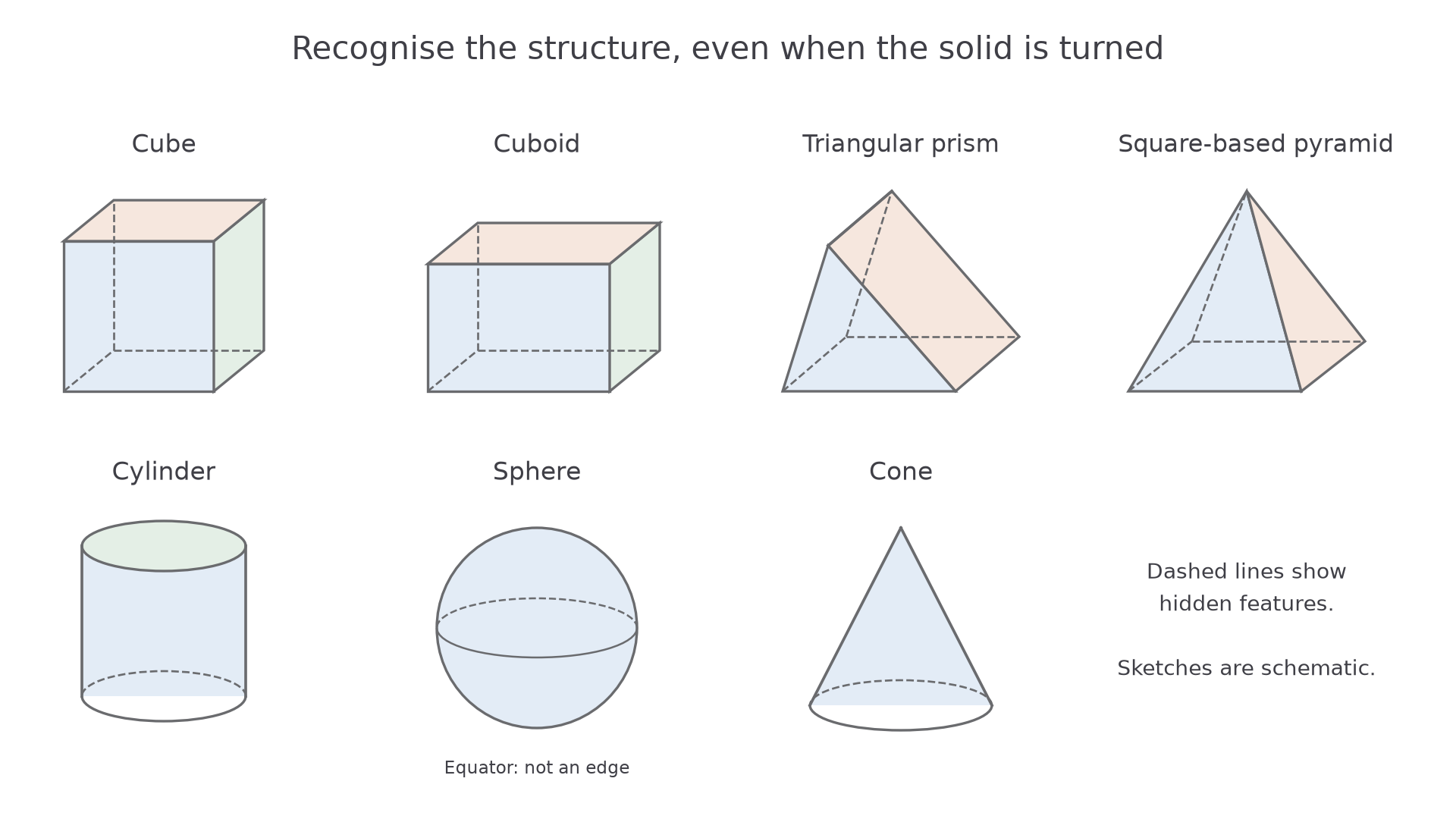
A cross-section is the flat shape exposed by a slice through a solid. In a prism, slices parallel to its ends stay congruent all the way along. A triangular prism has two triangular ends joined by three rectangles. It is not a pyramid: the sides do not meet at one common apex.
A cylinder has a similar constant-cross-section property, but its ends are circles rather than polygons. Call it a cylinder. A cone has a circular base; a pyramid has a polygonal base. Turning either solid sideways does not change its name.
Congruent faces
Congruent faces have the same shape and size. They may face different directions. Two rectangles of different widths are not congruent merely because both are rectangles.
Look for the ends and how they connect, rather than relying on the outline of a perspective picture.
Key idea
A prism keeps its cross-section along its length; a pyramid narrows from a polygonal base to one apex.
Use the defining features to name two curved solids.
Faces, edges and vertices
A picture shows only some of a solid's surfaces and edges. The features at the back still belong to the solid, even when they are hidden.
Face, edge and vertex
For a solid made of flat polygons, a face is a flat surface region, an edge is a line segment where two faces meet, and a vertex is a corner where edges meet. The plural of vertex is vertices. A solid made entirely of flat polygonal faces is a polyhedron.
A rectangular region on a cuboid is a face, not an edge. The line where two rectangles meet is an edge. Dashed lines often show hidden edges in a perspective drawing.
Count in organised groups. A triangular prism has two triangular ends and three rectangular sides, giving faces. Its edges are around the two ends and joining corresponding vertices: altogether. The ends each have vertices, giving vertices.
| Solid | Faces | Edges | Vertices |
|---|---|---|---|
| Cube or cuboid | |||
| Triangular prism | |||
| Square-based pyramid |
For the square-based pyramid, count one square base and four triangular faces. There are four base edges and four edges reaching the apex. The four base corners plus the apex give five vertices. Counts describe the complete solid, not just the visible marks in the drawing.
Curved solids need careful wording. A cylinder has two flat circular faces, one curved surface, two circular rims and no vertices. A cone has one flat circular face, one curved surface, one circular rim and one apex, also called its vertex. A sphere has no flat faces, edges or vertices. A drawn equator on a sphere is not a physical edge.
Key idea
Distinguish a flat face from a curved surface, and a straight edge from a circular rim. Some descriptions call a curved surface a “face” or a rim a “curved edge”; stating which kind you mean makes your count clear.
Imagine turning the solid to see the back before deciding how many features it has.
Cuboid nets and area
Unfolding the box turns the surface-area problem into a collection of flat area calculations. Include each required surface exactly once.
Net and surface area
A net is a flat arrangement of faces that folds to make a solid without overlapping faces. Matching edges must have matching lengths. Surface area is the sum of the areas of the surfaces on the outside of the solid.
Six rectangles alone do not guarantee a cuboid net: they must meet in an arrangement that closes properly when folded. Fold lines show joins between faces, not extra surfaces to add.
[DIAGRAM: asset_slug: m077_cuboid_net; caption: A cuboid net with three matching pairs of rectangular faces; description: A complete foldable 8 by 5 by 3 centimetre cuboid net. The central 8 by 5 face has 8 by 3 walls above and below and 3 by 5 walls at left and right. The other 8 by 5 face attaches beyond the upper wall. Matching pairs have matching pale fills.; file: m077_cuboid_net.png; recommended_method: matplotlib]
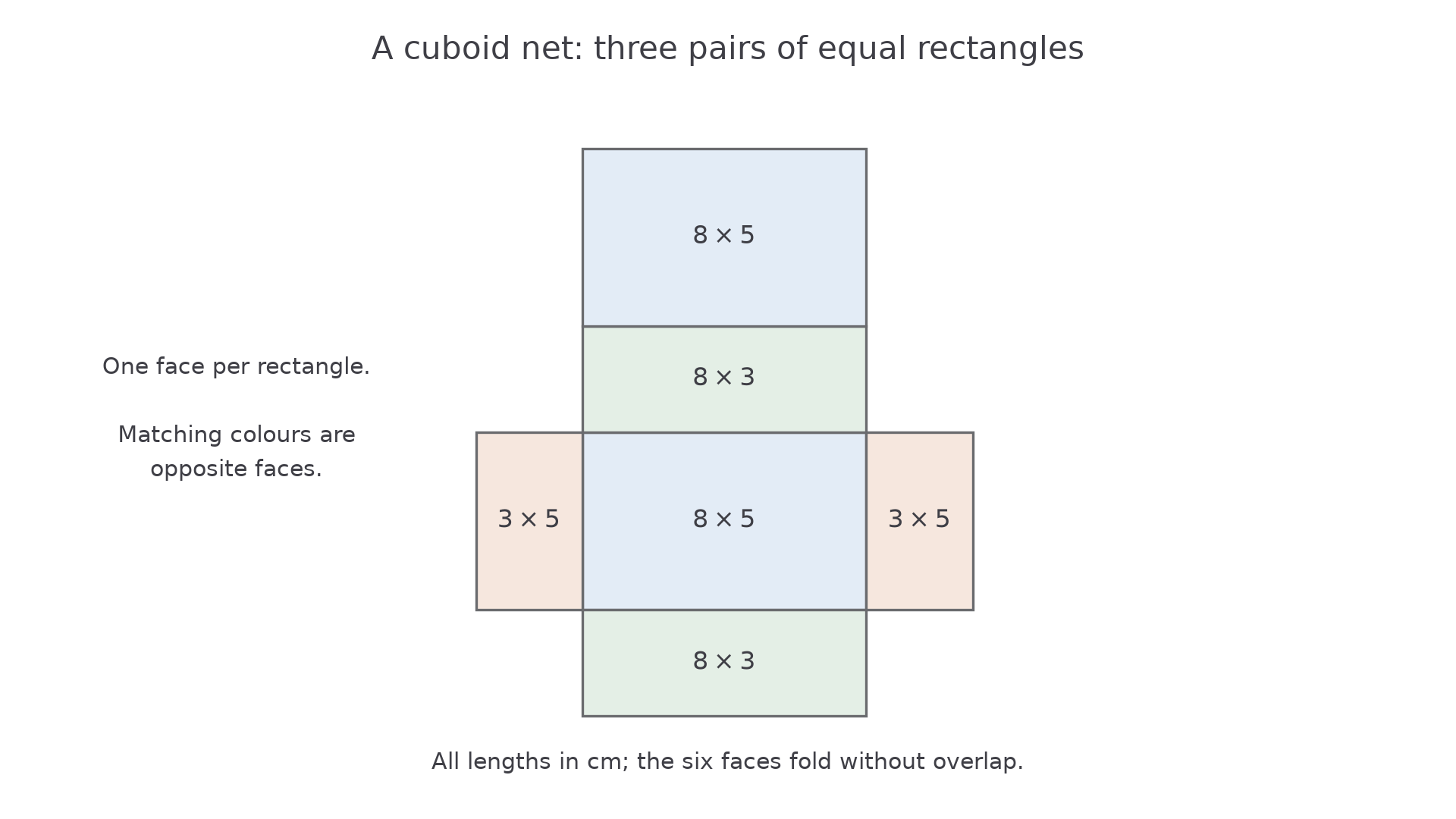
A closed cuboid has three pairs of opposite rectangular faces. A cube is the special case in which all six are equal squares.
Cuboid and cube surface areas
For a closed cuboid with edge lengths ,
For a cube of side , . These results are absent from both tier sheets; reconstruct them by counting faces. Not in the formulae sheet: learn it.
Use the net to answer the opening box question.
Worked example 1: the closed box
Question. Find the surface area of a closed by by cuboid.
Plan. Find the three different rectangular areas and include two of each.
Why double all three products? A closed cuboid has a matching opposite face for every face type.
Answer. of surface area.
Check. The net gives individual areas , whose sum is .
Change only whether the top is present. Keep base by and vertical height .
Worked example 2: the open-topped box
Question. Find the area of material in the base and four walls of this open-topped box. Ignore thickness and overlaps.
Plan. Remove one by face from the closed-box total.
Why subtract one face, not two? The base is still needed to hold the box's contents.
Answer. , saving compared with the closed box.
Check. Directly, .
Continue this lesson.
You’re previewing NovaLearn without an account. Create a free account to read the rest.
Create free account