1.7 - Proportional reasoning
A known price, recipe or scale can help you find an unknown amount. You will find a value for one unit, recognise direct proportion, and use ratio parts and map scales. You will also check when a constant-rate model is reasonable.
The unitary method
Six identical notebooks cost . Can you find the price of fourteen without guessing? Fourteen is not a whole-number multiple of six, so finding the price of one is a useful bridge.
You already know
Equivalent ratios scale every entry by the same factor. Dividing a total into equal groups finds the amount in one group: .
This works only when each unit has the same value. Identical notebooks at a fixed price meet that condition. A bulk discount or fixed delivery fee would change the model.
Unitary method
The unitary method finds the amount for one unit, then multiplies by the required number of units. It relies on a constant amount per unit.
You can instead use one scale factor from the old quantity to the new one. Finding one first often makes the units and direction easier to see.
Finding an unknown at a constant rate
The known number of units is positive, and the rate stays constant.
Foundation and Higher: Not in the formulae sheet: learn it.
Keep a unit beside your intermediate answer. “Pounds per notebook” tells you what the division has found.
Worked example 1: find a price through one unit
Question. Six identical notebooks cost . Work out the cost of fourteen at the same price per notebook.
Plan. Find the price of one notebook, then multiply by fourteen.
Why divide by first? The pays for six equal-priced units.
Answer. Fourteen notebooks cost .
Check. Twelve notebooks cost ; two more cost , giving .
Change only the number you want to buy. The unit price stays the same, even when the required quantity is smaller than six.
Worked example 2: find a smaller quantity's price
Question. Six identical notebooks cost . Work out the cost of five at the same unit price.
Plan. Use the unchanged price per notebook.
Why is the cost below ? Five units cost less than six at a positive fixed unit price.
Answer. Five notebooks cost .
Check. Adding one notebook's recovers the given .
Always name what the division means. Dividing the quantities in the opposite order gives units per pound, which would need a different final operation.
Watch out
uses the scale factor backwards for fourteen notebooks. The correct calculation is .
Try a new product and a smaller required quantity.
Recognising direct proportion
Before scaling, check that the relationship really has a constant rate. Two quantities increasing together is not enough.
Direct proportion
Two quantities are in direct proportion when multiplying one by any positive factor multiplies the other by the same factor. For positive inputs, output divided by input is constant. For example, is direct proportion; is not.
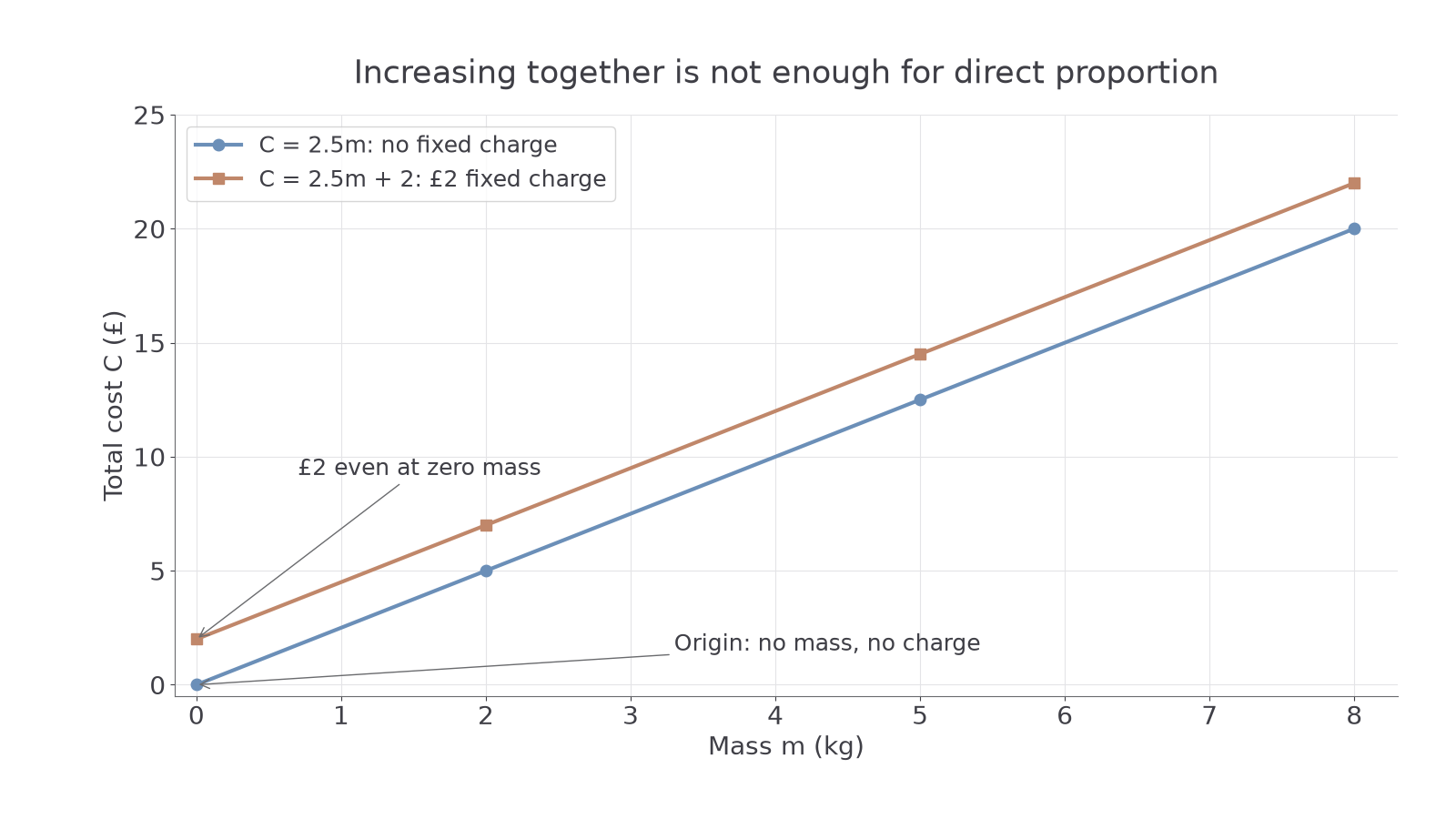
In a direct-proportion model, zero input gives zero output. A fixed charge breaks this: there is still a charge when the quantity itself is zero.
Constant ratio test
Use nonzero inputs. A direct-proportion graph is a straight line through the origin.
Foundation and Higher: Not in the formulae sheet: learn it.
The graph compares an unchanged price per kilogram with the same price plus a fixed charge. Both lines rise, but only one passes through the origin.
[DIAGRAM: asset_slug: direct_proportion_fixed_fee; caption: A fixed charge changes a proportional price model; description: Exact graphs of cost C equals 2.5 times mass m and cost C equals 2.5 times m plus 2, for masses from zero to eight kilograms. The proportional graph passes through zero cost at zero mass. The fixed-charge graph begins at 2 pounds and has a changing cost per kilogram; file: direct_proportion_fixed_fee.png; recommended_method: matplotlib]
Worked example 3: test a table
Question. Masses of , and cost , and . Do the entries fit direct proportion?
Plan. Divide each cost by its matching mass and compare the unit prices.
Why divide matching pairs? Direct proportion requires the same rate at every listed input.
Answer. Yes. Every entry has rate per kilogram, so the table fits direct proportion.
Check. Multiplying by gives , and multiplying by gives .
Now change only the pricing rule by adding a fixed charge to every purchase. The variable price per kilogram is unchanged.
Worked example 4: recognise a fixed-charge model
Question. After a fixed charge is added, masses of , and cost , and . Are total cost and mass directly proportional?
Plan. Compare total cost per kilogram at the listed masses.
Why has the rate changed? The same fixed charge is spread across different quantities.
Answer. No. The total cost per kilogram is not constant.
Check. Four times the first mass is , but , not the listed .
This gives a useful surprise: you can pay more in total but less per kilogram. Here the total rises from to , while the average rate falls from to per kilogram.
Watch out
“Both columns increase, so they are directly proportional” is not a valid test. Compare output/input: . A few matching entries support a model; they do not prove a real shop will keep that rate for every possible order.
Check the rates in a different setting.
Unknown ratio quantities
A recipe may give one ingredient's mass rather than the total. Match that mass to its own ratio entry. Then find one part and scale to the other entries.
One part from a known share
If corresponds to ratio entry ,
Multiply by the required entry to find an unknown share.
Foundation and Higher: Not in the formulae sheet: learn it.
This differs from sharing a total only in what the known amount represents. Write the ingredient name beside its ratio entry before dividing.
Worked example 5: find an ingredient mass
Question. Flour:sugar by mass. A recipe uses of sugar. Find the flour mass and the total mass of these two ingredients.
Plan. Match the sugar to two parts, then find five flour parts.
Why divide by , rather than ? The given mass belongs to sugar alone, not to the whole mixture.
Answer. Flour ; combined mass .
Check. , after dividing both entries by .
Change only which ingredient has a known mass. Keeping the same recipe lets you check the direction carefully.
Worked example 6: the known ingredient changes
Question. Flour:sugar by mass. A recipe uses of flour. Find the sugar mass and the total mass of these two ingredients.
Plan. This time match to five parts.
Why is the unknown smaller now? Sugar has fewer parts than the known flour share.
Answer. Sugar ; combined mass .
Check. , and .
The number alone does not tell you the divisor. The label attached to it does.
Watch out
treats a single ingredient as the total. For of flour in a recipe, start with per part.
Use a known first share in a new ratio.
Scales and word problems
A map scale is a ratio of lengths in the same unit. A scale of means on the map represents in reality.
Length scale
A length scale compares a diagram length with the corresponding actual length. At scale , one diagram unit represents of the same actual unit. It does not mean one centimetre represents metres.
For a map-to-real calculation, multiply by the scale number. For real-to-map, first convert into the map's unit, then divide. For a route with several pieces, put all actual distances in the same unit before adding them.
Using a scale
At scale ,
The two lengths must use the same unit in these equations.
Foundation and Higher: Not in the formulae sheet: learn it.
Use the stated lengths in a question. A printed figure may be labelled “not accurately drawn”; measuring it would not replace the supplied data.
Worked example 7: go from map to reality
Question. A map has scale . A route is long on the map. Find its actual length in metres.
Plan. Scale up in centimetres, then convert to metres.
Why multiply before changing the unit? The scale compares centimetres with centimetres.
Answer. The actual route is .
Check. One map centimetre represents , and .
Now reverse the direction while keeping the scale and the same route. The calculation must recover the map length.
Worked example 8: go from reality to map
Question. A route is long in reality. Find its length in centimetres on a map of scale .
Plan. Convert the actual length to centimetres, then divide by the scale number.
Why divide? The diagram is smaller than the actual route.
Answer. The map length is .
Check. .
The unitary method, a known ratio share and a map scale all use the same idea: connect a known quantity to equal units, then scale. The opening notebooks therefore cost , assuming the unit price stays constant.
Watch out
attaches the wrong unit. Starting with centimetres gives , which is .
Try the reverse calculation for a different real distance on the same scale.
Quick Recap
- Find one unit, then multiply by the required number of units.
- Direct proportion has a constant output/input ratio and a graph through the origin.
- A known share matches its own ratio entry, rather than the sum of entries.
- A scale compares matching units; multiply to reach reality and divide to reach the map.
The opening fourteen notebooks cost , because each costs .