4.6 - Circles, chords and tangents
Circle vocabulary helps you choose the right geometrical property. Foundation and Higher share the terms, chord bisection and tangent properties; the final two sections add Higher intersecting chord products. You will calculate lengths and angles and explain which features make each property valid.
Circle language
A circular window has radius . A straight crossbar lies from its centre. Can you find the crossbar's length without measuring it? Naming the radius, chord and perpendicular correctly will unlock the calculation.
You already know
Pythagoras' theorem applies to a right-angled triangle: the hypotenuse squared equals the sum of the other two squared lengths. Triangle angles total ; quadrilateral angles total .
A circle is a boundary, rather than the whole filled-in disc. We use different words for its centre, straight lengths, curved parts and enclosed regions.
Circle
The set of points at a fixed distance from a point called its centre. That fixed distance is the radius. Every radius of the same circle has equal length.
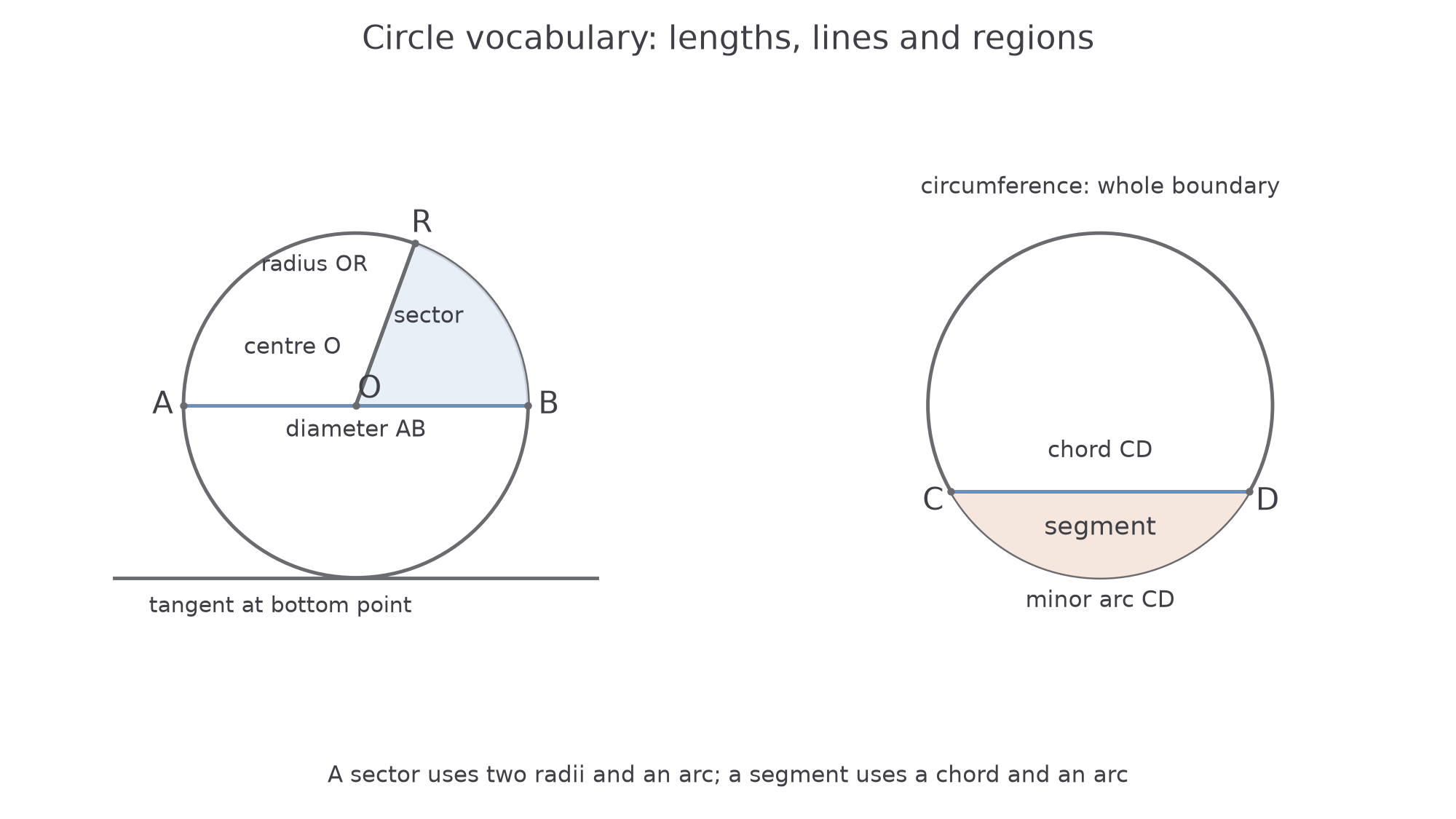
Read the diagram alongside these definitions. A sector and a segment are regions; a radius and a chord are straight segments.
[DIAGRAM: asset_slug: m066_circle_vocabulary; caption: Circle terms distinguish straight lengths, curved boundaries and regions; description: The left circle has centre O, radius OR, diameter AB, a sector and a tangent; the right shows a chord, its minor arc and the segment between them; file: circle_vocabulary.png; recommended_method: matplotlib]
| Term | Meaning |
|---|---|
| Circumference | The complete curved boundary; also its length when a length is requested. |
| Chord | A straight segment joining two points on the circumference. |
| Diameter | A chord through the centre; its length is twice the radius. |
| Tangent | A straight line touching a circle at exactly one point. |
| Arc | Part of the circumference; normally a shorter minor arc or a longer major arc between two endpoints. |
| Sector | A region bounded by two radii and an arc. |
| Segment | A region bounded by a chord and an arc. |
A diameter is a chord, but a chord need not be a diameter. A sector's straight boundaries meet at the centre; a segment's straight boundary joins two circumference points. A line crossing the circle at two points is not a tangent.
Radius and diameter
Here and are lengths in the same unit. Not in the formulae sheet at either tier: learn it.
Two radii placed end to end across the centre make one diameter.
Worked example 1: radius to diameter
Question. A circle has radius . Find its diameter.
Plan. Double the centre-to-boundary distance.
Why double? A diameter goes from one boundary point through the centre to the opposite boundary point.
Answer. .
Check. Half of is .
Change only which length is given. The same-sized circle now comes with its diameter instead of its radius.
Worked example 2: diameter to radius
Question. A circle has diameter . Find its radius.
Plan. Halve the boundary-to-boundary distance through the centre.
Why halve? The centre divides the diameter into two equal radii.
Answer. .
Check. .
The units describe a length, so use centimetres rather than square centimetres.
Watch out
Wrong: “Every chord is a diameter.” A diameter must pass through the centre. The chord in the right-hand picture does not, so it is not a diameter.
Try the reverse length calculation and distinguish a curved boundary from a filled region.
A perpendicular to a chord
Join the centre to the crossbar at a right angle. This splits the crossbar into equal halves, making a right triangle whose hypotenuse is a radius.
[DIAGRAM: asset_slug: m066_chord_bisector; caption: A perpendicular from centre O bisects chord AB at M; description: OA is a radius and OM is perpendicular to AB; triangle OMA is right-angled at M and AM equals MB; the figure is schematic; file: chord_bisector.png; recommended_method: matplotlib]
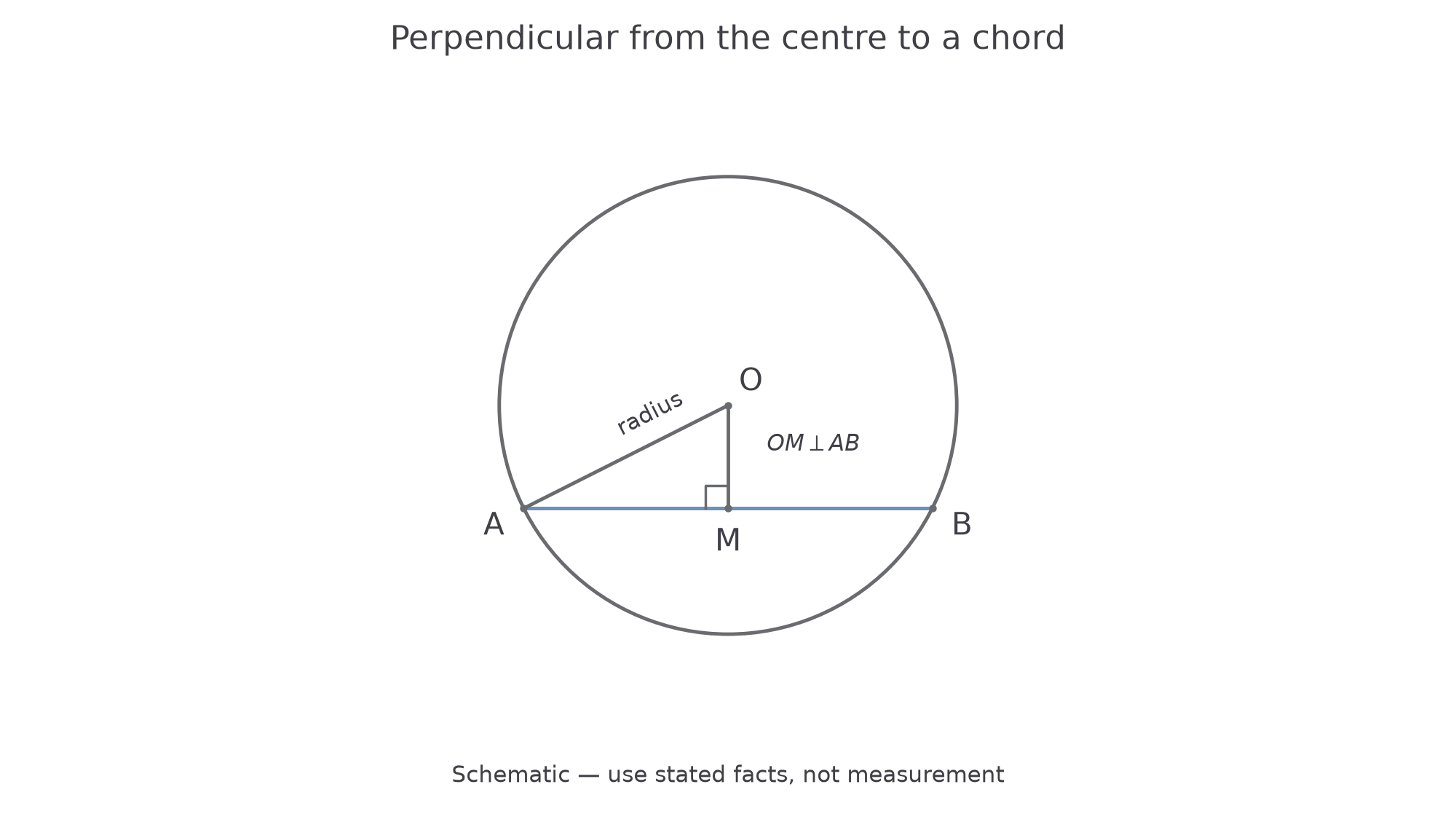
Equal radii make triangle isosceles. Its perpendicular from the top divides it into matching right triangles, so the two halves of the chord are equal.
Perpendicular and chord midpoint
If is the centre and , then
Conversely, the line joining to the midpoint of a non-diameter chord is perpendicular to that chord. These properties and Pythagoras' theorem are not in either tier's formulae sheet: learn them.
The converse starts with an equal split and concludes a right angle. It needs a non-diameter chord: the midpoint of a diameter is itself, so a centre-to-midpoint segment would have zero length. A line merely passing through the centre need not bisect another chord.
Worked example 3: calculate the crossbar
Question. A circle has centre and radius . Its chord meets perpendicular at , with . Find .
Plan. Use Pythagoras for half the chord, then double it.
Why double at the end? Pythagoras has found , only one half of .
Answer. The crossbar is long.
Check. , and is shorter than the diameter.
Change only the radius from to , keeping the chord from the centre. The smaller circle leaves a shorter chord.
Worked example 4: change the radius
Question. The radius is now , with and . Find to one decimal place.
Plan. Calculate the new half-chord and double it.
Why keep the root until the end? Rounding the half-chord early can change the rounded whole-chord answer.
Answer. to one decimal place.
Check. , and the chord is shorter than the diameter.
A useful surprising fact follows: the longest chord is a diameter. In the right triangle, , so the half-chord is largest when the distance from the centre is zero. The chord then runs through the centre and has length .
Watch out
Wrong: . That calculation gives . Correct: .
Change only the perpendicular distance again and keep the half-chord separate from the whole chord.
Tangent lengths and right angles
Two tangents drawn from one external point create equal lengths and two right angles. Mark both facts before choosing an equation.
[DIAGRAM: asset_slug: m066_tangents; caption: Tangents PA and PB meet radii OA and OB at right angles; description: O is the centre, P is external and A and B are the tangent contact points; PA equals PB; file: tangents.png; recommended_method: matplotlib]
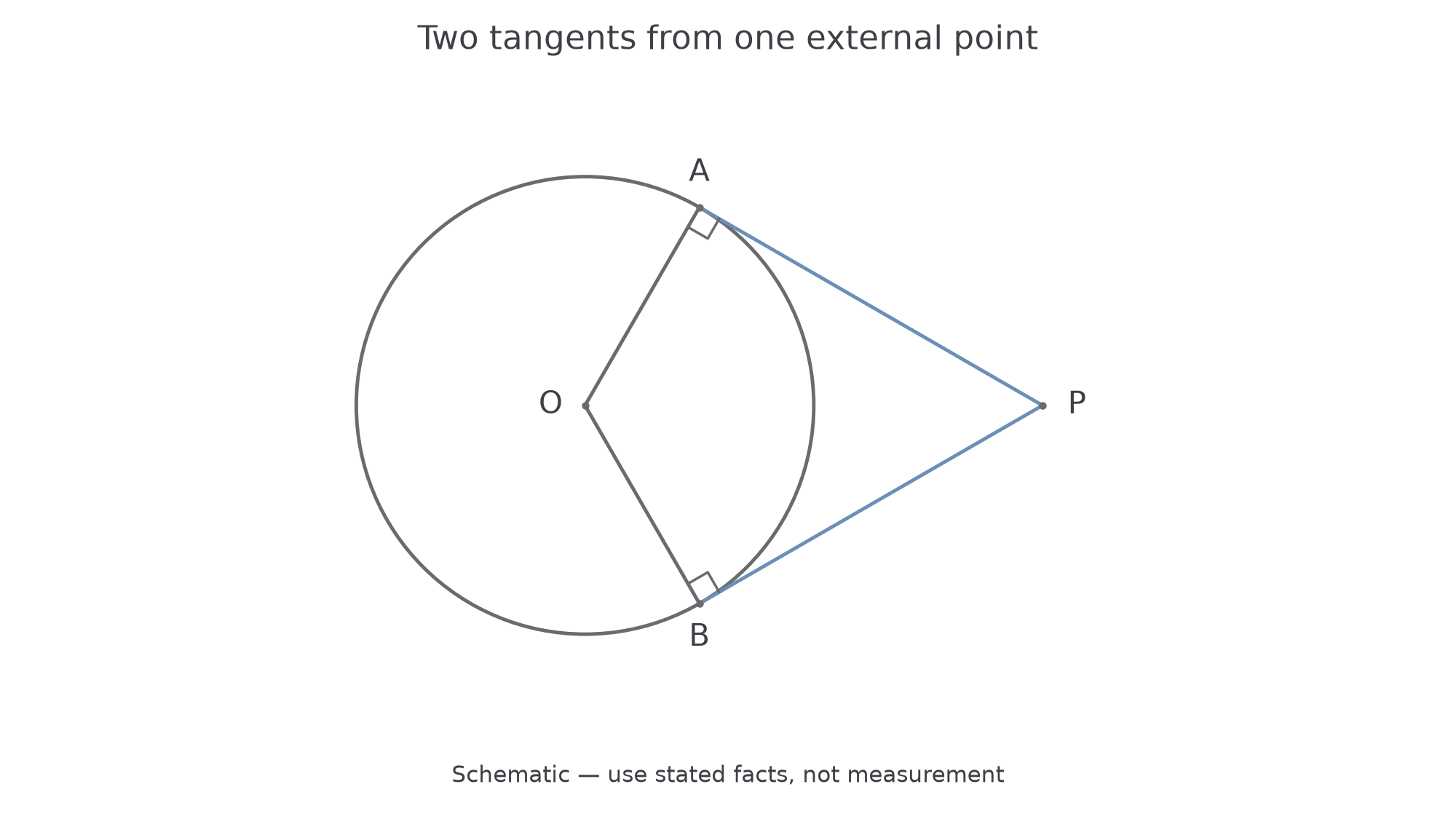
The right triangles and have equal radii and share hypotenuse . Their matching sides give equal tangent lengths. This concerns the segments from to the contact points, not unlimited tangent lines.
Tangent properties
For tangents and from the same external point to the same circle,
The perpendicular is at each point of contact. Not in the formulae sheet at either tier: learn it.
Use equal tangent lengths to form a linear equation when the lengths are expressions.
Worked example 5: equal tangent expressions
Question. Tangents and have lengths and . Find and the tangent length.
Plan. Equate the two segments from , solve and substitute.
Why equate the expressions? They measure tangent segments from the same external point.
Answer. ; each tangent segment is .
Check. , positive and equal to .
Change only the constant in . The equality still applies, but its solution changes.
Worked example 6: change one tangent expression
Question. Tangents from have lengths and . Find and their common length.
Plan. Set the new expressions equal, then check both lengths.
Why check positivity? A valid physical segment cannot have zero or negative length here.
Answer. ; each segment is .
Check. , agreeing with the other expression.
Continue this lesson.
You’re previewing NovaLearn without an account. Create a free account to read the rest.
Create free account