4.4 - Measuring, estimating and bearings
You will read scales, calculate elapsed times and choose sensible estimates. You will also measure angles to the nearest degree and describe directions using three-figure bearings. Each skill starts by choosing the correct unit, starting point or zero.
Reading measuring instruments
A night bus leaves at and arrives at the next day. How long is the journey? Reading a clock, like reading a ruler, means understanding its scale rather than just subtracting the printed digits. We will return to the bus shortly.
You already know
You can subtract two readings and divide a total into equal parts. , , and .
On a measuring scale, labels tell you the value of equal gaps. Count intervals, not tick marks: six ticks enclose five gaps.
Reading an equally spaced scale
Follow the increasing direction on the scale. For Foundation and Higher: Not in the formulae sheet: learn it.
A ruler's physical edge may not be its zero mark. Place the starting endpoint at zero, or subtract the readings at both endpoints. For a thermometer or balance, follow the increasing labels even when some are negative. For a liquid measure, keep the vessel upright and read at eye level; when instructed, read the bottom of the curved surface, or meniscus. Looking from above or below can shift the apparent reading: this is parallax.
[DIAGRAM: asset_slug: instrument_scales; caption: Ruler, thermometer and jug scales with pointers; description: Ruler labelled in centimetres with object endpoints 1.2 and 4.7. Thermometer has one-degree gaps and pointer 6 degrees C. Jug has five equal gaps between 200 and 400 mL with pointer at the fourth above 200. Use labels, not physical screen dimensions; file: instrument_scales.png; recommended_method: matplotlib]
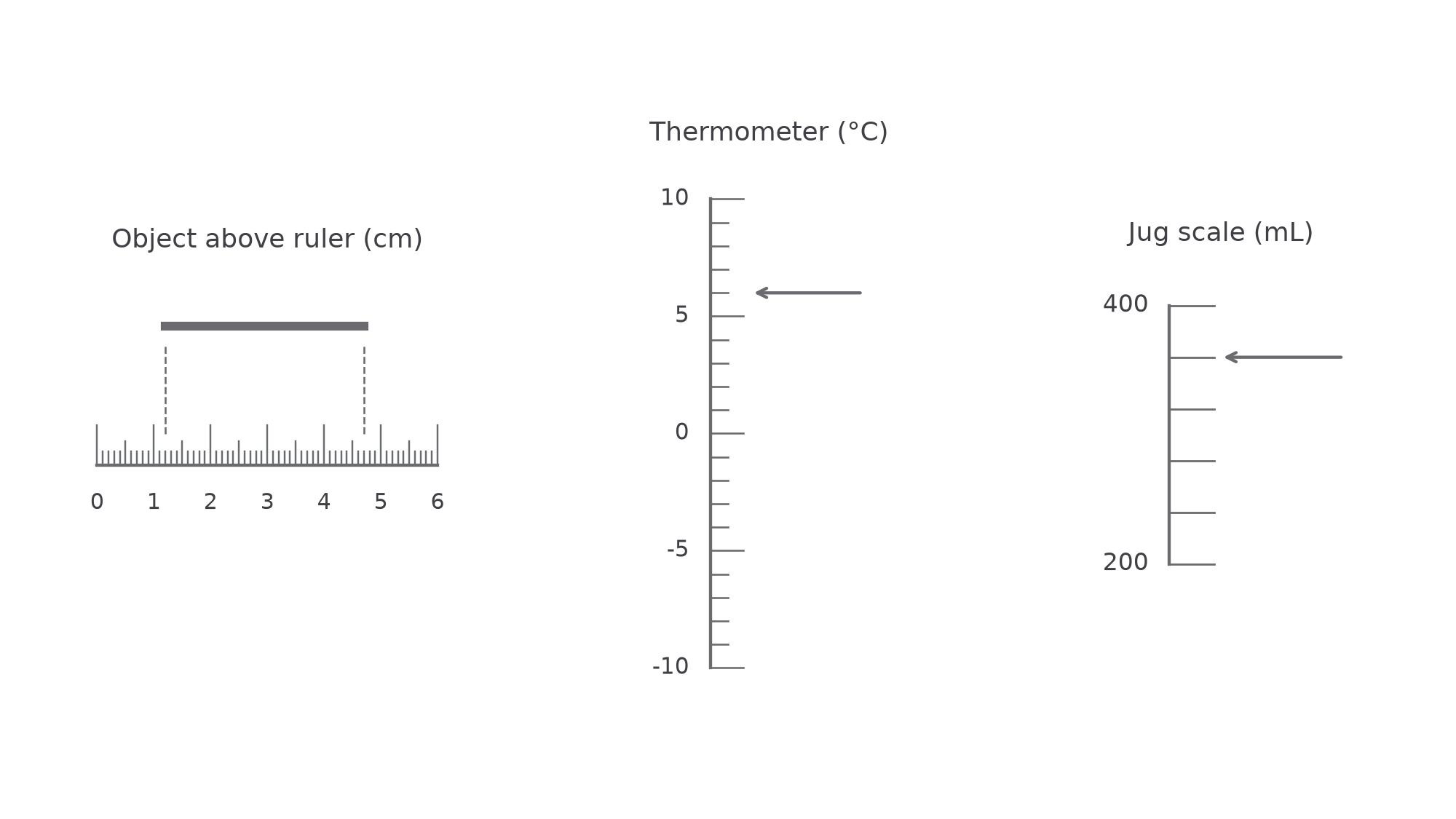
The ruler gives length . The thermometer's gap is , so its pointer reads . These are labelled scales: enlarging the picture does not change the readings. Do not measure screen centimetres with a physical ruler.
Worked example 1: read the jug scale
Question. A jug has five equal intervals between and . The pointer is four intervals above . Find the volume.
Plan. Find one interval, then count upwards from the lower label.
Why start at ? The pointer's interval count starts there, not at zero.
Answer. .
Check. One further interval gives , the upper label.
Change only the pointer position, from four intervals to three above the same lower label.
[DIAGRAM: asset_slug: jug_variations; caption: Jug scales with changed pointer positions and labels; description: First panel repeats the 200 to 400 mL scale with pointer four intervals above 200. Second uses the same scale with pointer three intervals above 200. Third has five intervals from 100 to 250 mL and pointer two intervals above 100; file: jug_variations.png; recommended_method: matplotlib]
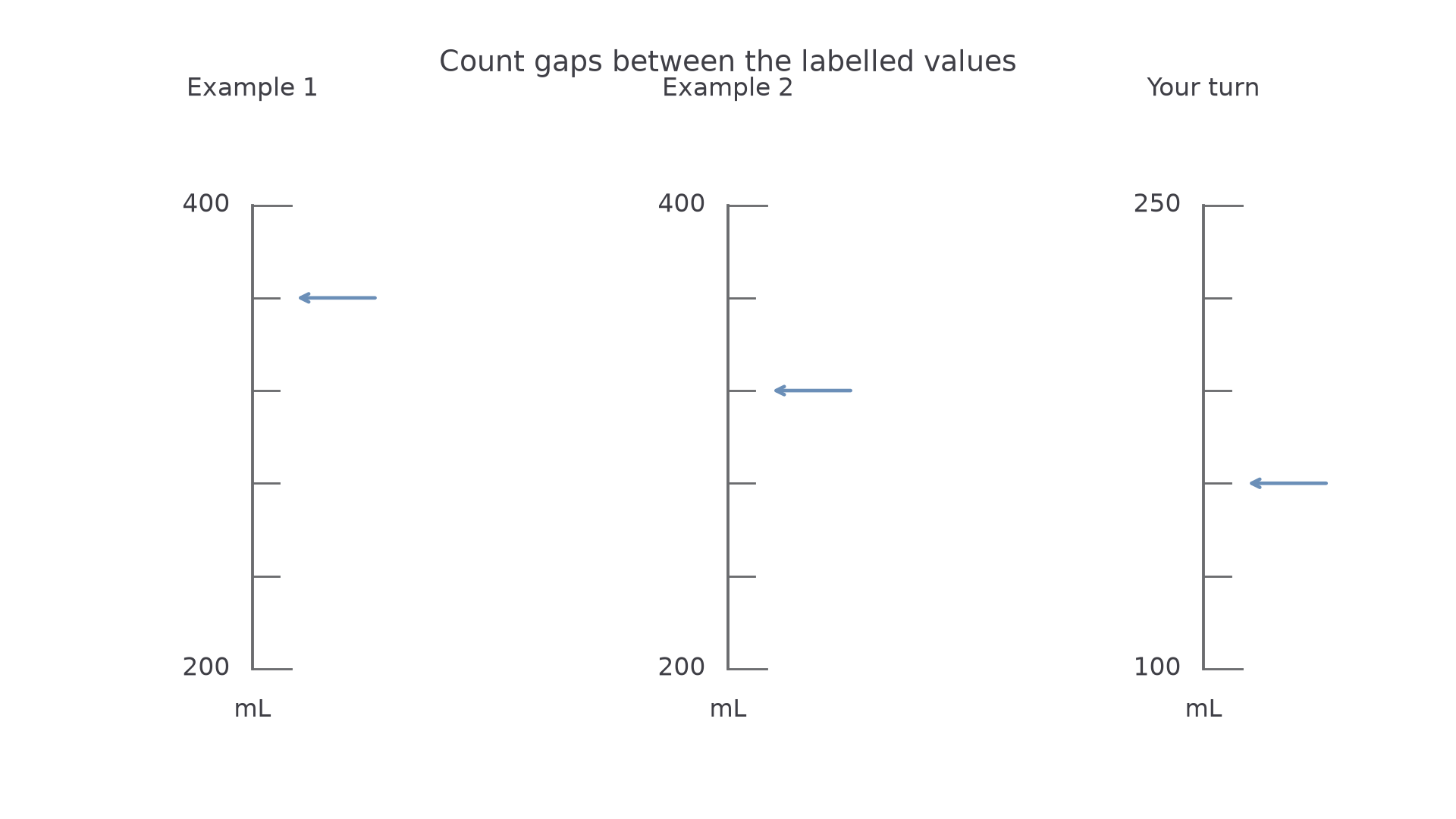
The spacing value stays fixed in the middle panel.
Worked example 2: move the pointer
Question. The same scale has a pointer three intervals above . Find the volume.
Plan. Keep the interval value and change only the number of intervals counted.
Why keep ? Moving a pointer does not change the scale's labels or spacing.
Answer. .
Check. Two further intervals give .
If the labels change instead, recalculate the interval value before counting. The unit is part of the reading.
Watch out
The line counts six ticks instead of five gaps. The correct calculation is .
Use the final panel, with its new labels, for this check.
Time intervals and clock notation
A clock uses groups of sixty minutes, not hundredths of an hour. For the bus, count forwards through midnight instead of subtracting the smaller arrival hour from the departure hour.
Clock notation
The 12-hour clock uses am and pm. The 24-hour clock runs from to . Midnight is , or am; noon is , or pm.
For afternoon and evening times other than pm, add twelve to the hour: pm becomes . At am use hour zero. Minutes do not change. These clock conventions and the -minute conversion are absent from both tier formulae sheets: learn them.
Worked example 3: the night bus
Question. A bus leaves at and arrives at the next day. Find the journey time in hours and minutes.
Plan. Count to midnight, then from midnight to arrival.
Why split at midnight? The clock restarts at zero, but elapsed time keeps increasing.
Answer. hours minutes.
Check. minutes, and . The endpoints are pm and am.
Change only the arrival time to the next day.
Worked example 4: a later arrival
Question. A bus leaves at and arrives at the next day. Find its journey time.
Plan. Keep the first interval to midnight, then use the new arrival time.
Why carry sixty minutes? An hour contains sixty minutes, so hours minutes becomes hours minutes.
Answer. hours minutes.
Check. Arrival is minutes later than in Example 3; the duration also increases by minutes.
The same forward-counting method works during a day. From pm to pm is minutes to pm, then hours minutes: hours minutes altogether. For a journey lasting several days, include every complete day named in the question.
Watch out
The line is wrong. The correct decimal conversion is hours, because minutes are sixtieths of an hour.
Read “next day” carefully before doing the next subtraction.
Choosing sensible estimates
An estimate needs the right scale before it needs extra decimal places. Think about the object, choose a familiar comparison, then check the unit.
Estimate
An estimate is an approximate value chosen for a purpose. It is supported by a sensible reference or calculation; it is not an unexplained guess.
A long stride gives a rough metre reference, a large drink carton a rough litre reference, and a minute contains sixty seconds. Objects vary: these comparisons are aids, not definitions or exact measurements of every object.
| Measure | A useful comparison |
|---|---|
| Length | A room may be a few metres; a road journey many kilometres |
| Mass | A small food item may weigh tens or hundreds of grams; an adult's mass is better expressed in kilograms |
| Capacity | A drink container may hold hundreds of millilitres, rather than hundreds of litres |
| Time | Crossing a classroom takes seconds; a lesson takes tens of minutes |
| Angle | Compare a turn with a quarter turn or a half turn |
There is no formula-sheet entry for choosing an estimate on either tier. The justification comes from the scale and your comparison.
Worked example 5: estimate a doorway height
Question. Which is a sensible height for an ordinary classroom doorway: , or ? Explain.
Plan. Compare each choice with the height needed for people to walk through.
Why use a person as the reference? A doorway is designed for people to pass through upright.
Answer. About is sensible.
Check. It is taller than many people but remains a room-sized length. It is an estimate, not the measured height of every doorway.
Keep the object and physical choices the same. Change only the unit from metres to centimetres.
Worked example 6: the same estimate in another unit
Question. Which doorway height is sensible: , or ? Explain.
Plan. Convert to familiar metre lengths before comparing.
Why convert first? A larger printed number may describe exactly the same physical height in a smaller unit.
Answer. , because it is , a sensible doorway height.
Check. The selected physical height agrees with Example 5.
Continue this lesson.
You’re previewing NovaLearn without an account. Create a free account to read the rest.
Create free account