4.10 - Cones and spheres
Use the supplied cone and sphere formulae, distinguish curved from total surface area, and find the exposed surfaces of joined solids. Choosing the right height and counting the right surfaces matter as much as substitution.
Volume of a right circular cone (Higher)
A cone of radius and height is joined to a hemisphere of radius . Can we add their volumes and their total surface areas in the same way? We will build the two measures separately.
You already know
A cylinder's volume is . A radius is half a diameter. Pythagoras connects the three sides of a right-angled triangle.
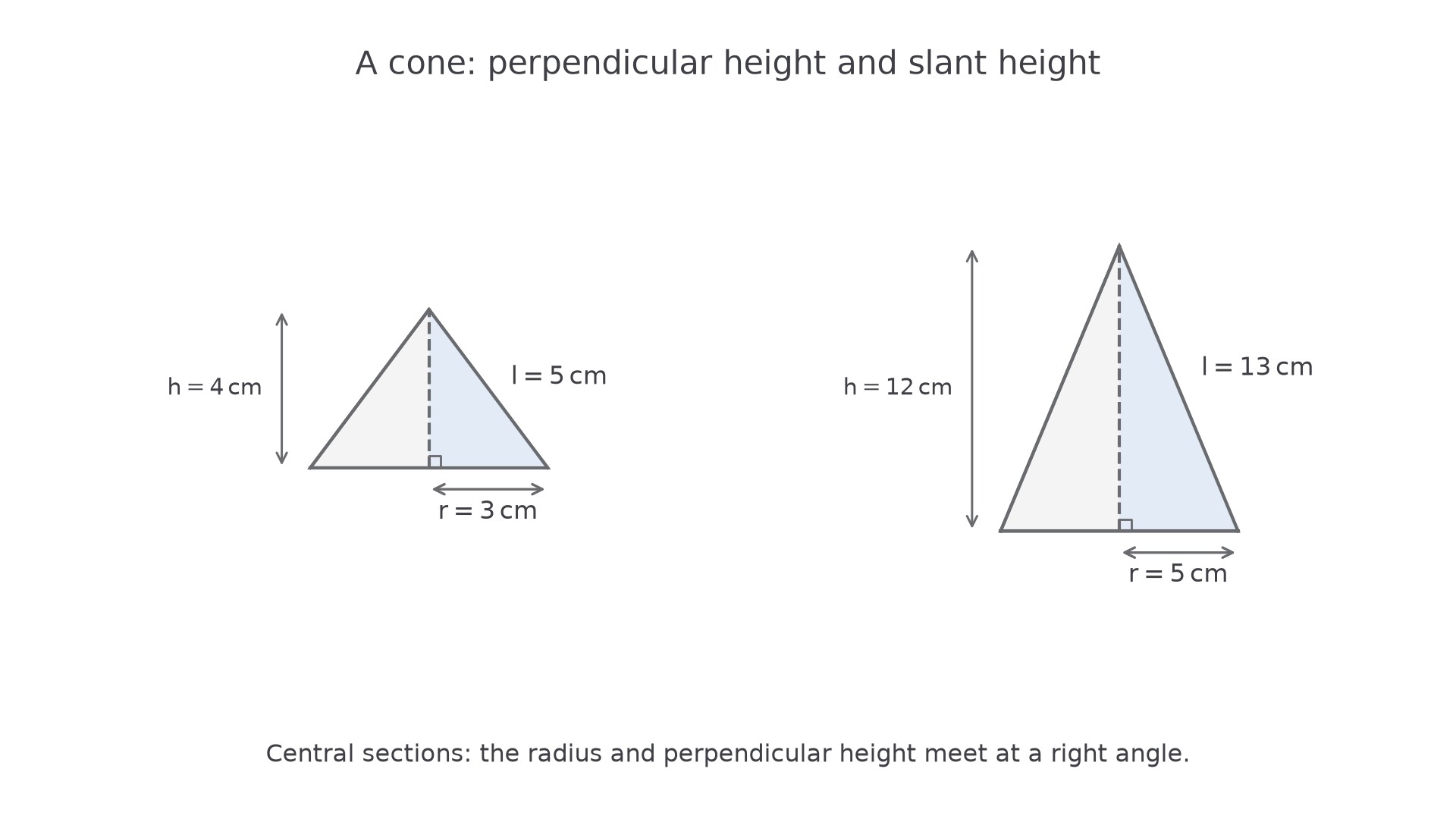
A right circular cone has a circular base and a vertex directly above its centre. Its perpendicular height, , goes from the vertex to the base centre. Its slant height, , runs along the surface to the rim. The central right triangle has sides , and hypotenuse .
[DIAGRAM: asset_slug: m079_cone_heights; caption: Perpendicular height and slant height occupy different sides of a right triangle; description: Two schematic right circular cones show radius/perpendicular height/slant height 3/4/5 cm and 5/12/13 cm. Both central triangles satisfy l squared equals r squared plus h squared. Dashed vertical lines show perpendicular heights.; file: m079_cone_heights.png; recommended_method: matplotlib]
Volume of a right circular cone
Use perpendicular height , not slant height. This result is supplied on the Higher sheet; it is absent from the Foundation sheet and is Higher content. In the formulae sheet.
The base area is , but the cone tapers towards its vertex. Its volume is one third of a cylinder with the same base and perpendicular height. It is not half the cylinder: the taper changes the width in two directions.
Worked example 1: a cone's volume
Question. A cone has radius and perpendicular height . Find its volume exactly and to three significant figures.
Plan. Use the given perpendicular height in the cone-volume formula.
Why this step? The factor accounts for the cone's taper.
Answer. , approximately .
Check. The matching cylinder holds ; the cone holds one third of it.
Change only the perpendicular height from to . The same circular base now supports a taller cone.
Worked example 2: the height changes
Question. A cone has radius and perpendicular height . Find its volume exactly and to three significant figures.
Plan. Keep the base area fixed and substitute the new height.
Why this step? With the radius fixed, volume contains only one factor of height.
Answer. , approximately .
Check. Doubling the height has doubled to .
A central cross-section helps you identify the height, even when the cone is drawn tilted on the page.
Watch out
For the -- cone, uses the slant height. Correct it to .
Change only the perpendicular height once more for this check.
Curved and total cone area (Higher)
Surface area measures material along the cone, so it uses slant height. An open conical shade has a curved surface; a solid cone also has a circular base.
Curved surface area of a cone
Here is slant height. This result is on the Higher sheet; it is absent from the Foundation sheet and is Higher content. In the formulae sheet.
For a cone with a base, add , giving . This total-area result is not printed on either tier sheet: build it by counting surfaces. There is one base, not two.
If only perpendicular height is given, find the slant height first. Pythagoras gives ; use the positive root because it is a length. Pythagoras is not printed on either tier sheet: learn it. To find perpendicular height from slant height instead, use , with .
Worked example 3: find the slant height
Question. A cone has radius and perpendicular height . Find its exact total surface area.
Plan. Find the slant height by Pythagoras, then add curved area and one base.
Why this step? The height is inside the cone; measures along its surface.
Answer. .
Check. , as a hypotenuse should be, and the total exceeds the curved area by .
Change only the form of the height information: the same cone is described using its slant height. Pythagoras is no longer needed.
Worked example 4: slant height supplied
Question. A cone has radius and slant height . Find its exact total surface area.
Plan. Use the supplied slant height directly and include the base.
Why this step? The letter in already matches the given measurement.
Answer. .
Check. This describes the same cone as Worked example 3, so the total agrees.
Before entering numbers, say which surface each term measures. That prevents a correct formula being used for the wrong task.
Watch out
uses perpendicular height in the curved-area formula. Replace by to get .
Change only the slant height in the next question.
Spheres and hemispheres (Higher)
A sphere is a solid whose surface points are all the same distance from its centre. That distance is its radius. It has no flat base to add.
Sphere measures
These results are supplied on the Higher sheet; neither is on the Foundation sheet, and both are Higher content. In the formulae sheet.
Continue this lesson.
You’re previewing NovaLearn without an account. Create a free account to read the rest.
Create free account