3.3 - Gradients and equations of straight lines
A straight line has one constant steepness, even if you measure it using different-sized steps. You will find that gradient and connect it to the equation of the line. The Higher parts use two coordinates and find equations of parallel and perpendicular lines.
Gradient from a graph
One ramp rises units over a horizontal run of ; another rises over a run of . Is the second ramp steeper? Comparing the rises alone is not enough. We need the rise for each unit across.
You already know
Coordinates give horizontal and vertical positions. Read each axis scale before measuring a change; equal-looking squares may represent different numerical amounts.
A line's gradient is its vertical change per unit horizontal change. A rising line has a positive gradient when read from left to right; a falling line has a negative one. A horizontal line has gradient zero. A vertical line has no finite gradient because its horizontal change is zero.
Gradient from a graph
The horizontal change must be nonzero. Not in the Foundation or Higher formulae sheet: learn it.
Choose two well-separated, clear grid intersections on the line and make a right-angled step between them. Use coordinate units, not just numbers of squares. On one straight line, larger steps multiply both changes by the same factor, so their quotient stays the same.
[DIAGRAM: asset_slug: m048_gradient_triangle; caption: A falling straight line with a horizontal change of six units and vertical change of minus three; description: Exact line y equals minus one half x plus 2 with points A minus 2 comma 3 and B 4 comma 0, a horizontal run of 6 and a downward change of minus 3; file: m048_gradient_triangle.png; recommended_method: matplotlib]
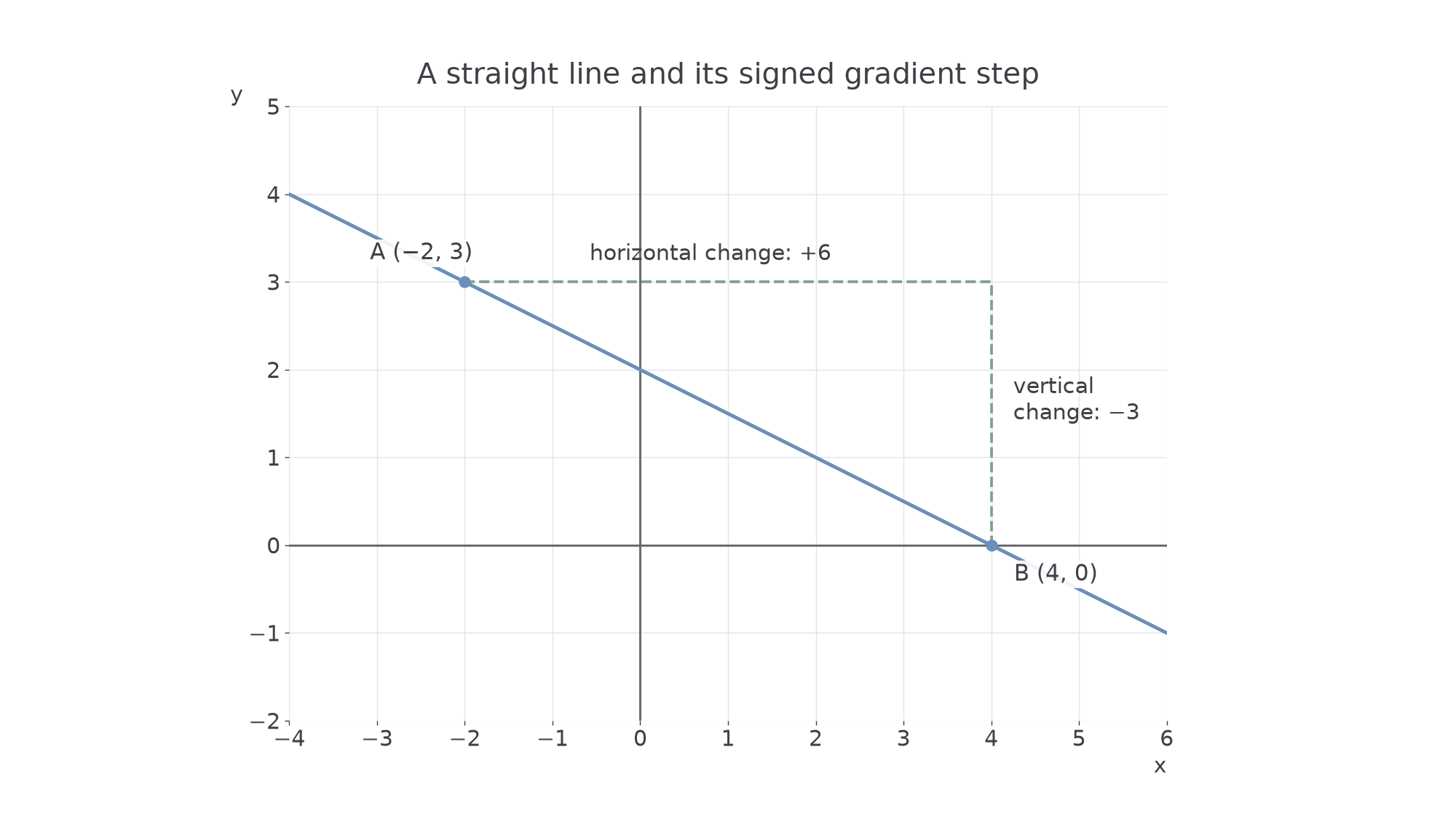
The horizontal step in the diagram goes right, so it is positive. The vertical step goes down, so it is negative.
Worked example 1: a falling line
Question. Find the gradient of the line in the diagram using its marked step: units right and units down.
Plan. Divide the signed vertical change by the horizontal change.
Why? A negative vertical change is needed to describe a line that falls as you move right.
Answer. The gradient is .
Check. Each -unit move right goes unit down, so the sign and size fit the diagram.
Change only the direction of the vertical movement next. The step has the same dimensions, but an upward step gives a positive gradient.
Worked example 2: a rising line
Question. A straight line rises coordinate units while moving units right. Find its gradient.
Plan. Use the same ratio with a positive vertical change.
Why? Steepness includes direction: an upward and a downward line cannot have the same signed gradient.
Answer. The gradient is .
Check. A doubled step rises over a run of , and too.
That check answers the ramp puzzle: doubling both dimensions keeps the same steepness. It also explains why your choice of a larger gradient triangle does not change the result.
Watch out
The line in example 1 divides the wrong way round. Gradient measures vertical change per horizontal unit, so .
Keep the sign as you try another falling line.
Gradient and y-intercept in an equation
The equation tells you the gradient without drawing the line. In , increasing by increases by . The constant fixes where the line meets the vertical axis.
Straight-line equation
The gradient is and the y-intercept is . This form describes nonvertical straight lines. Not in the Foundation or Higher formulae sheet: learn it.
At the -axis, , so vanishes and . A horizontal line has . A vertical line cannot be written in this form with a finite gradient.
Worked example 3: read the equation
Question. State the gradient and the coordinates of the y-intercept of .
Plan. Match the coefficient and constant to .
Why? The intercept is on the vertical axis, so its first coordinate must be zero.
Answer. Gradient ; y-intercept .
Check. At , , a rise of from the intercept in one horizontal unit.
The next equation is presented differently: is not yet on its own. Rearrange first, because the coefficients in the original layout do not directly give the gradient.
Worked example 4: rearrange before reading
Question. State the gradient and y-intercept of .
Plan. Make the subject, then read and .
Why? The gradient is the coefficient of only when the coefficient of is .
Answer. Gradient ; y-intercept .
Check. At , , and the rearranged equation gives .
You can also build an equation from its gradient and intercept: gradient through gives . Reversing the order of its terms, , changes no points on the line.
Watch out
Reading as the gradient of is wrong. Rearranging gives , so the gradient is , including its sign.
When coordinates of an intercept are requested, write a point such as . The single number only gives its height.
Continue this lesson.
You’re previewing NovaLearn without an account. Create a free account to read the rest.
Create free account