1.10 - Everyday number and metric units
Convert metric measurements without changing what they represent. Use compatible units for calculations, distinguish length from area and volume, then decide how many whole containers an event needs.
Mass and length
An event needs of concentrate for each of people. It comes in bottles. How many bottles should you buy, and how much will be left? Getting the units right is the first step; choosing a whole bottle count is the last.
You already know
Multiplication finds a total from equal amounts. Division finds how many equal amounts fit. Decimal place value lets you multiply or divide by powers of ten without changing the quantity's meaning.
A unit is a fixed amount used for measurement. The same length has a larger numerical value in a smaller unit: is , not a longer piece of string.
Metric length and mass
Here means tonne. Not in the formulae sheet: learn it. These conversions are absent from both tier sheets.
Multiply to express a measurement in smaller units; divide to express it in larger units. Before adding or subtracting, make the units match.
Worked example 1: adding masses
Question. Work out in kilograms.
Plan. Convert grams to kilograms, then add like units.
Why divide by ? Each kilogram groups grams together.
Answer. .
Check. In grams, , which is .
Change only addition to subtraction. The unit conversion stays exactly the same.
Worked example 2: subtracting masses
Question. Work out in kilograms.
Plan. Convert to a common unit before subtracting.
Why not subtract directly? It counts grams, whereas counts kilograms.
Answer. .
Check. .
Lengths follow the same logic: . Carry the unit, so a correct number does not become an incorrect measurement.
Watch out
The line mixes units. Convert first: .
Now make a subtraction in kilometres.
Area units
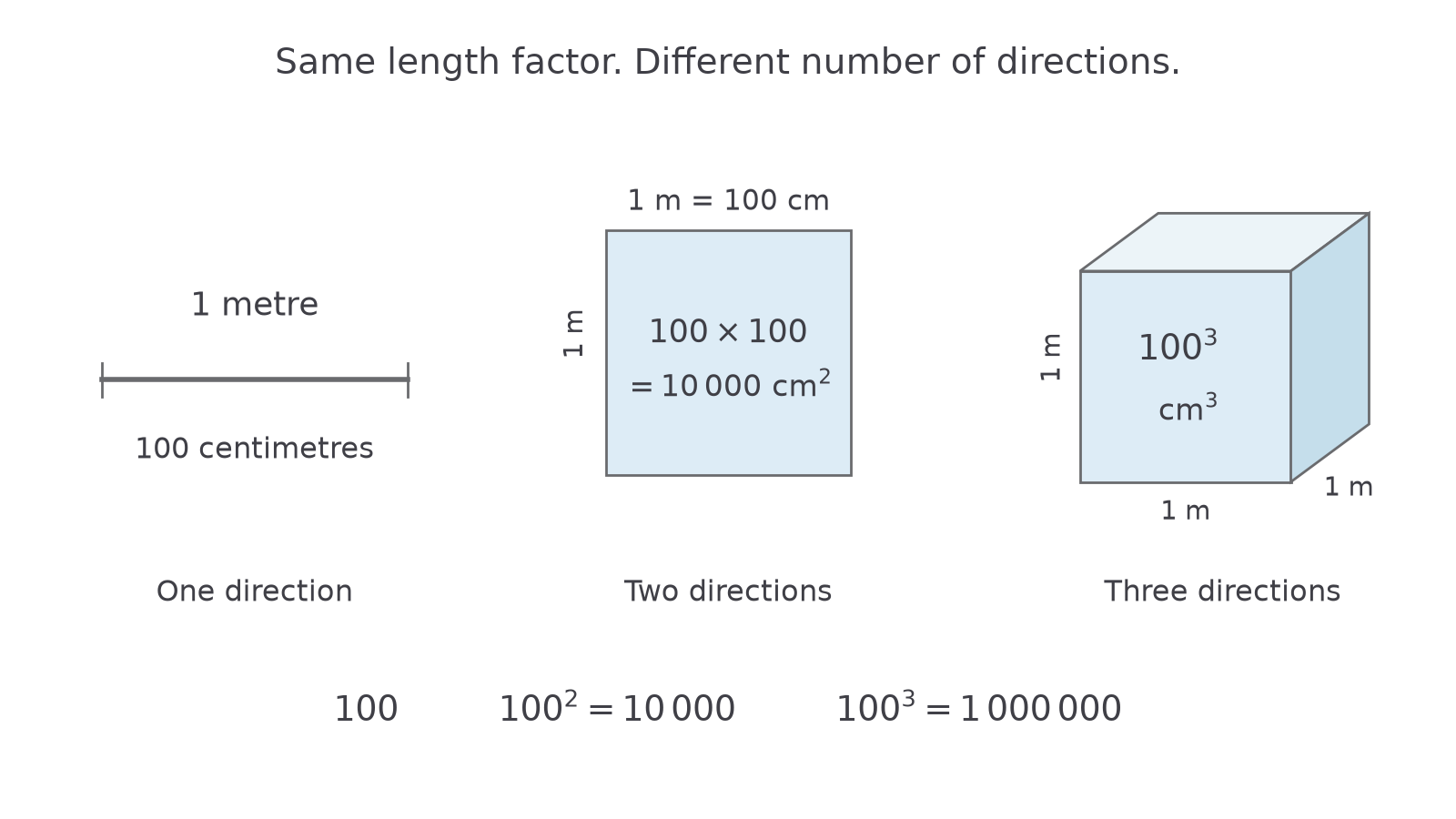
A square metre contains many more than a hundred square centimetres, because its unit conversion acts in two directions.
Square unit
A square centimetre, , is the area of a square with sides . It measures area, not length: and describe different quantities.
Along each side of a square metre fit centimetres. There are rows, each containing little squares. That gives square centimetres.
[DIAGRAM: asset_name: Length area and volume scales; asset_slug: m020_unit_dimensions; caption: Use a length conversion twice for area and three times for volume.; description: Three panels show a 1 metre line labelled 100 centimetres, a square with 1 metre sides labelled 100 by 100 square centimetres, and a cube with 1 metre edges labelled 100 by 100 by 100 cubic centimetres.]
Metric area conversions
Also . Not in the formulae sheet: learn it. Neither tier sheet supplies unit conversions.
The direction still matters. Converting to smaller square units increases the number; converting to larger square units decreases it.
Worked example 3: into smaller square units
Question. Convert to square centimetres.
Plan. Square the metre-to-centimetre factor, then multiply.
Why square the factor? Each row becomes times as long in unit counts, and there are times as many rows.
Answer. .
Check. It is less than a whole square metre's .
Change only the conversion direction. The same factor must now be a divisor.
Worked example 4: into larger square units
Question. Convert to square metres.
Plan. Group square centimetres into sets of .
Why divide? A larger unit needs a smaller numerical count for the same area.
Answer. .
Check. Multiplying by returns .
The same reasoning gives . Shape does not matter: these are unit conversions, whether the area is a square or an irregular patch.
Watch out
The line uses only the length factor. Use : the answer is .
Apply the same direction choice to a new area.
Volume units
Volume adds a third direction, so its conversion uses the length factor three times.
A cubic centimetre, , is the volume of a cube with edges. A cubic metre holds layers of such cubes. Surprisingly, it contains a million cubic centimetres, although a metre contains only a hundred centimetres.
Metric volume conversions
Not in the formulae sheet: learn it. Neither tier sheet supplies these conversions.
Use the third panel of the diagram to see the extra factor. Area counts one layer; volume counts all the layers.
Worked example 5: into smaller cubic units
Question. Convert to cubic centimetres.
Plan. Cube the length factor and multiply by it.
Why not square the factor? A volume includes depth as well as length and width.
Answer. .
Check. , recovering the cubic metres.
Change only the conversion direction. The number now becomes smaller.
Worked example 6: into larger cubic units
Question. Convert to cubic metres.
Plan. Divide by the number of cubic centimetres in one cubic metre.
Why divide by a million? We are counting groups of a million little cubes.
Answer. .
Check. The result is below one cubic metre, as is below a million.
Between millimetres and centimetres, the length factor is , so the cubic factor is . For example, .
Watch out
The line uses the area factor. For volume use .
Read the exponent on the unit before choosing any factor.
Capacity and volume
A bottle's capacity and a liquid's volume can describe the same amount using different units.
Capacity
Capacity is the volume a container can hold. Litres and millilitres measure volume; they do not measure mass. A litre of two different materials need not have the same mass.
The bridge between the unit systems is exact: a millilitre is a cubic centimetre.
Capacity and cubic units
Not in the formulae sheet: learn it. These conversions are absent from both tiers' sheets.
The last relationship follows by dividing a million cubic centimetres by a thousand cubic centimetres per litre. Thus .
Worked example 7: combining capacities
Question. Work out in litres.
Plan. Express both amounts in litres before adding.
Why choose litres? They are the requested final unit, so only one conversion is needed.
Answer. .
Check. , the same volume.
Change only addition to subtraction. The unit bridge is unchanged.
Worked example 8: remaining capacity
Question. Work out in litres.
Plan. Convert millilitres to litres, then subtract.
Why not subtract from ? The numerical values count units of different sizes.
Answer. .
Check. .
You can go from cubic centimetres to litres through millilitres, which makes the conversion easy to check.
Watch out
The line is wrong. A cubic metre holds litres; one litre is .
Use the bridge before subtracting a new pair of amounts.
Whole packs and surplus
A purchase may need a whole-number decision even when the division gives a decimal.
The surplus is the amount bought minus the amount needed. When you need enough supply, buy the next whole pack above a fractional result. When you fill complete portions from a fixed supply, count only the complete portions that fit. The context decides the direction. These decisions and the total-need relationship are not on either tier's formulae sheet.
Worked example 9: enough bottles
Question. Each of people needs of concentrate. It is sold in bottles. Find the smallest number to buy and the surplus.
Plan. Calculate total need, divide by bottle size, then check the whole-number choice.
Why choose six? Five bottles supply only , which is not enough.
Answer. Buy bottles; is left.
Check. , but . Six is sufficient and minimal.
Change only the bottle size. This time the required amount fills whole bottles exactly.
Worked example 10: an exact fit
Question. The same event needs , but bottles hold . Find the smallest number to buy and the surplus.
Plan. Divide by the new size and test the supply.
Why not add another bottle? The exact whole-number result already supplies all that is needed.
Answer. Buy bottles, with no surplus.
Check. Five bottles supply , too little; six supply exactly enough.
A pack calculation may also involve cost. Once the whole-pack count is settled, multiply that count by the price per pack, rather than charging for the fractional requirement.
Watch out
The line “ bottles rounds to , so always round normally” is unsafe. A requirement of bottles also needs , because is too few. For enough supply, round a fractional count upwards.
The opening event needs six bottles and leaves . Now make the decision with mixed capacity units.
Quick Recap
- Convert to common units before arithmetic.
- For area, square the length conversion factor; for volume, cube it.
- , and .
- Whole-pack decisions depend on the situation; enough supply requires rounding a fractional pack count upwards.
- Surplus is the actual amount bought minus the amount needed.
The opening event needs : buy six bottles and keep the surplus.