3.3 - Tangents and graph intersections
A curve's gradient changes from place to place, and a line can meet a curve more than once. You will estimate local gradients with tangents, read all relevant intersections and turn equality of graph outputs into an equation. Drawing and algebra will help you check each other.
Estimating a tangent gradient (Higher)
How can you measure a curve's steepness at just one point? On , the graph near points in a definite direction even though the whole curve is not straight. A tangent captures that direction.
You already know
A straight line has gradient equal to vertical change divided by horizontal change. Read actual coordinate values from the axes: their scales need not be the same.
A tangent is a straight line following a smooth curve's direction at a chosen point. The curve's gradient there is its tangent's gradient. A line joining two different curve points gives an average gradient over an interval instead. A tangent can meet another part of the curve; its local direction at the chosen point is what matters.
To draw one, mark the point. Place a ruler through it and rotate it until the line matches the curve's direction very close to that point. Draw a long tangent. Choose two widely separated, clearly readable points on the tangent; they need not lie on the curve.
Gradient from a tangent
Use two distinct points on the drawn tangent, taking both differences in the same order. Not in the Higher formulae sheet: learn it. This lesson is Higher only.
Longer coordinate differences reduce the effect of a small reading error. Rising tangents have positive gradient, falling tangents negative gradient, and horizontal tangents zero gradient. An answer from a drawn tangent is an estimate.
[DIAGRAM: asset_slug: m054_tangent_example; caption: A tangent to y equals x squared at P, with two tangent points for calculating its gradient; description: Exact curve y=x squared, tangent y=4x-4 at (2,4), labelled tangent points (1,0) and (3,8), axes with numeric scales; file: m054_tangent_example.png; recommended_method: matplotlib]
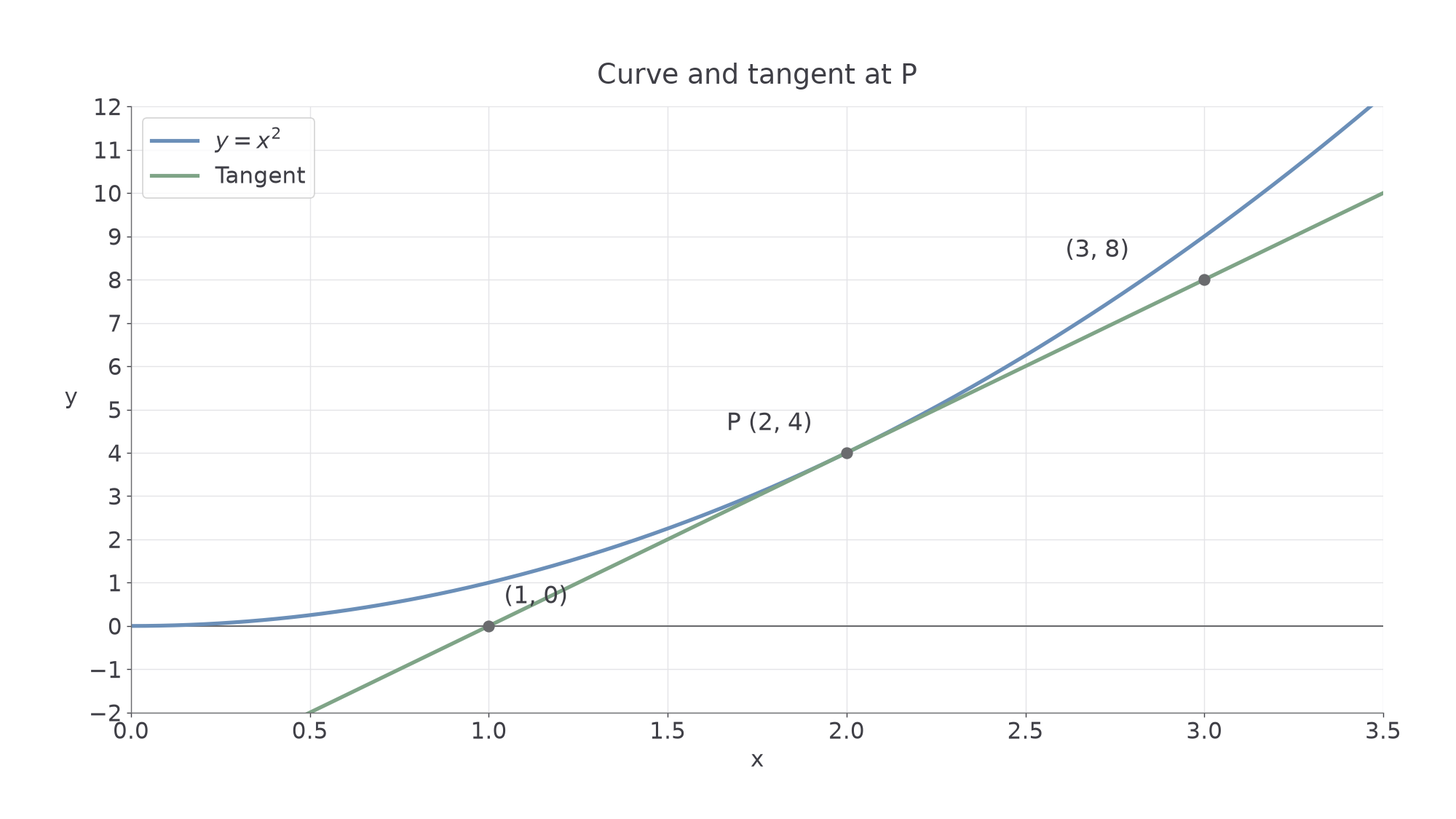
The line follows the curve near ; its other marked points are chosen to make the gradient calculation reliable.
Worked example 1: reading a tangent
Question. The tangent at is read through and . Estimate the curve's gradient at .
Plan. Calculate the gradient using the two tangent points.
Why this step? The curve's local direction is the tangent's direction, so its gradient comes from that line.
Answer. The gradient is approximately .
Check. It is positive, as the tangent rises from left to right. The line also passes through .
Change only the selected points on the same tangent. Its gradient must stay unchanged.
Worked example 2: choosing different tangent points
Question. The same tangent is read through and . Estimate the gradient at .
Plan. Use the new coordinate differences on the same line.
Why this step? Every pair of distinct points on one straight tangent gives its constant gradient.
Answer. Approximately , agreeing with the first estimate.
Check. Both points satisfy the drawn line's equation .
At , the curve gives , but the tangent gives . Replacing a tangent reading with a curve value changes the calculation.
Watch out
mixes the curve point with tangent point . Use two tangent points: .
For quantities, gradient units are output units divided by input units. Metres against seconds gives metres per second.
Reading all graph intersections (Higher)
An intersection is a point on both graphs: the same input produces the same output. Read its horizontal and vertical coordinates as one pair. Search the entire requested interval, including contacts where the graphs touch without crossing.
[DIAGRAM: asset_slug: m054_intersections_example; caption: The line y equals x plus two intersects the parabola y equals x squared twice; description: Exact graphs on common scaled axes with intersections (-1,1) and (2,4) identified; file: m054_intersections_example.png; recommended_method: matplotlib]
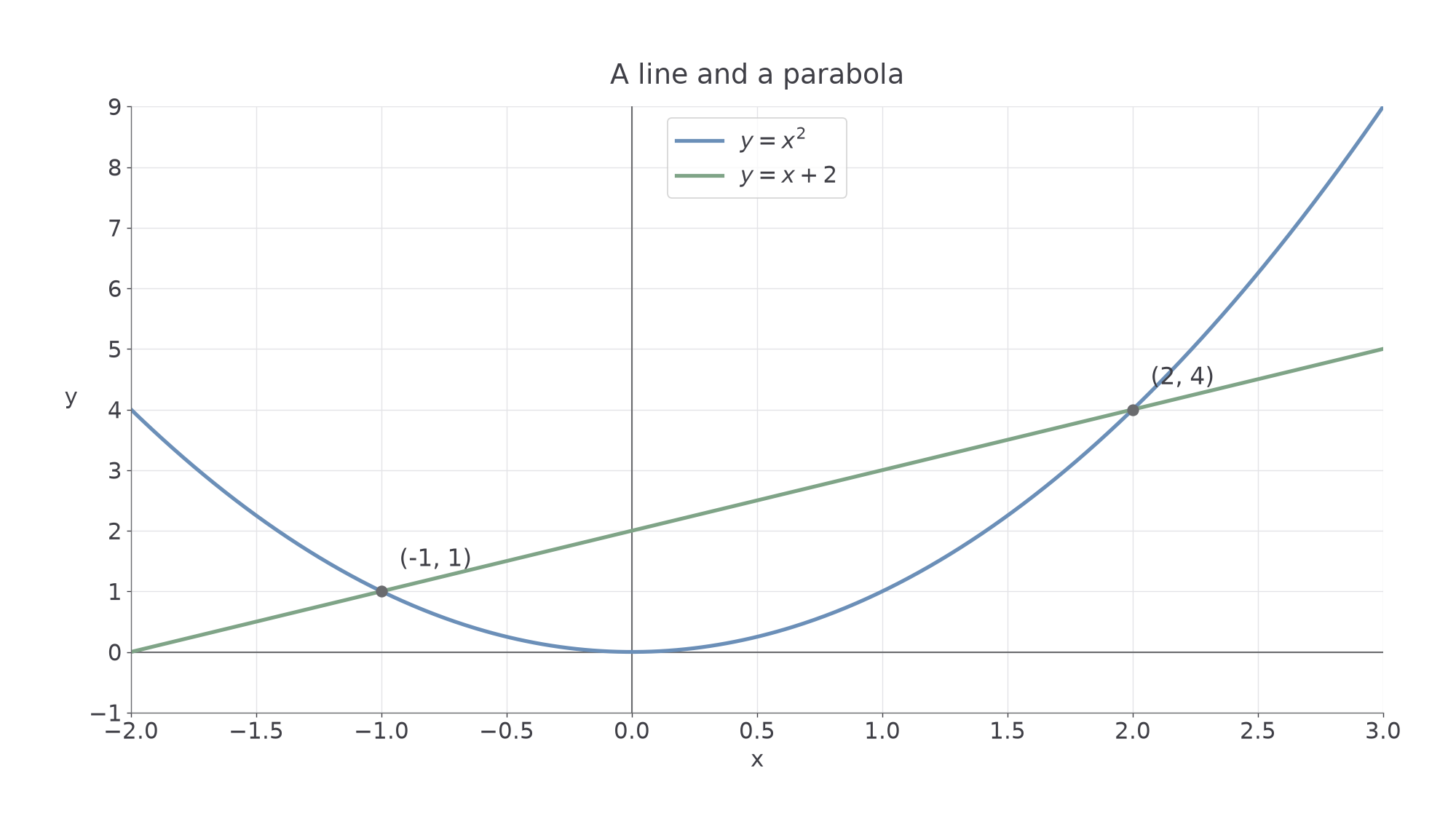
For the two graphs shown, the equality is . If asked for its solutions, report the horizontal coordinates. If asked for intersection points, report both coordinates. Equality of graph outputs is not an additional formula on the Higher formulae sheet; it follows from the meaning of an intersection.
Continue this lesson.
You’re previewing NovaLearn without an account. Create a free account to read the rest.
Create free account