4.9 - Circumference, circle area and semicircles
Use radius and diameter to find circular lengths and areas. You will distinguish the curved arc from a semicircle's complete boundary, then measure shapes made by joining semicircles to rectangles.
Circumference
A circular mat of radius is cut into two semicircles. Does edging both new pieces need more ribbon than edging the original circle? We will find the extra length after learning what each boundary contains.
You already know
Perimeter measures a boundary in length units. Area measures a region in square units. Joining shapes can hide an edge inside the combined region.
For a circle, we give its perimeter a special name: circumference. A radius joins the centre to the circle. A diameter is a chord through the centre, equal to two radii, so .
Pi
The number is the ratio of circumference to diameter for every circle: . It is approximately , but a rounded decimal is not its exact value.
A circle with twice the diameter has twice the circumference. Whether it is a tiny button or a large wheel, the same ratio gives the boundary length.
Circumference
Use for diameter or for radius, with positive lengths. This result is absent from both Foundation and Higher sheets. Not in the formulae sheet: learn it.
Keep in an exact answer. Use the calculator's key when a rounded answer is requested.
Worked example 1: given the diameter
Question. A circle has diameter . Find its circumference exactly and to decimal place.
Plan. Use , since the diameter is already given.
Why omit an extra factor of ? The diameter already spans two radii.
Answer. , approximately .
Check. Radius gives .
Change only what the given length represents: is now the radius.
Worked example 2: given the radius
Question. A circle has radius . Find its circumference exactly and to decimal place.
Plan. Use , or double the radius to obtain the diameter.
Why does the answer double? The diameter is twice the diameter in the first example.
Answer. , approximately .
Check. , as required.
A boundary calculation is a length calculation, so use centimetres rather than square centimetres.
Watch out
For diameter , treats the diameter as a radius. Correct it to .
Now identify a new given diameter before choosing the formula.
Circle area
To cover a circular region, use its area rather than its boundary length. For example, a disk of radius has area , because its radius is squared.
Circle area
The formula uses the radius. If a diameter is given, halve it first. This result is absent from both Foundation and Higher sheets. Not in the formulae sheet: learn it.
You can picture a circle cut into many thin sectors, rearranged alternately to resemble a rectangle. As the pieces become thinner, its height approaches and its base approaches half the circumference, . Their product is . This explains why the radius appears twice.
Worked example 3: area from a diameter
Question. A circle has diameter . Find its area exactly and to decimal place.
Plan. Halve the diameter, square the radius, then multiply by .
Why square , not ? The area formula is defined using the radius.
Answer. , approximately .
Check. , the same result.
Change only the diameter from to . Predict the area change before calculating.
Worked example 4: doubling a diameter
Question. A circle has diameter . Find its area exactly and to decimal place.
Plan. Find the new radius and use its square.
Why is the area four times as large? Doubling the radius multiplies its square by .
Answer. , approximately .
Check. , matching the squared scale change.
Decimal radii follow the same rule: radius gives area . The radius need not be a whole number.
Watch out
For diameter , is four times too large. Halve first: . The wrong radius was doubled, and squaring doubled it in both directions.
Think “fence” for circumference and “covering” for area. The requested units provide another useful check.
Semicircle perimeter and area
Cutting a circle along a diameter creates two equal regions and a new straight boundary on each piece. That straight edge is why a semicircle's perimeter is more than half a circumference.
Semicircle
A semicircle is half a circular region, bounded by a half-circle arc and a diameter. An arc alone is a curved line, not the whole semicircular region.
The two regions have equal areas, but each new boundary contains both a curve and a straight edge.
[DIAGRAM: asset_slug: m075_semicircle_boundary; caption: Semicircle boundary compared with its area; description: The curved edge is pi times radius and the straight diameter is twice radius. The region is half pi radius squared. A centre dot and radius dimension distinguish radius from the full diameter; file: m075_semicircle_boundary.png; recommended_method: matplotlib]
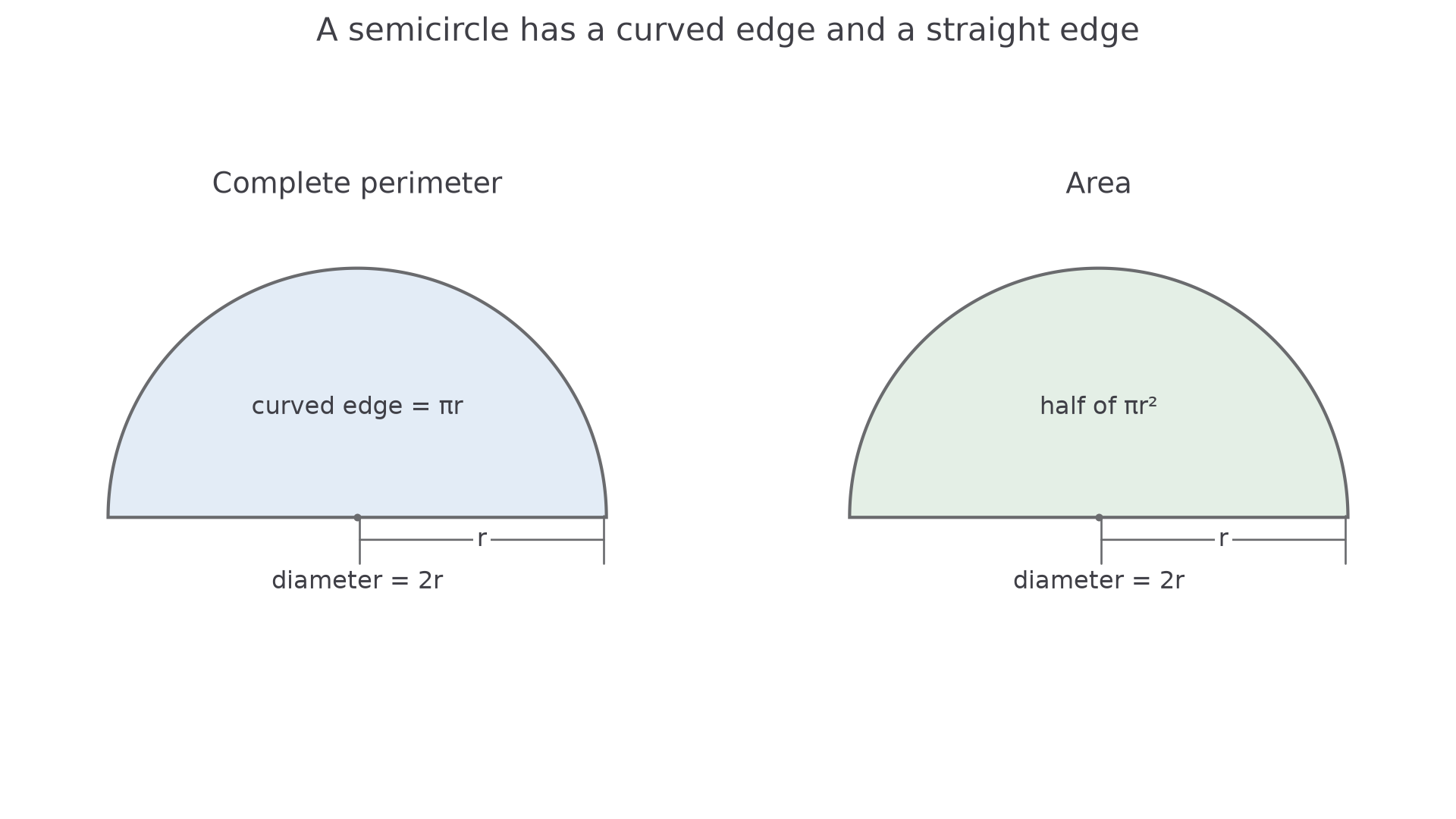
Use half the circumference for the curve and half the circle area for the region.
Continue this lesson.
You’re previewing NovaLearn without an account. Create a free account to read the rest.
Create free account