2.8 - Linear inequalities and number lines
Describe sets of possible values with inequalities, solve linear inequalities and show the answers on number lines. Learn how endpoint circles and negative division change what your answer means.
Inequality symbols and solution sets
A game allows values satisfying . How many choices does that give: five, or infinitely many? The answer depends on whether the game allows only integers or any real number.
You already know
Integers are whole numbers, including zero and negative whole numbers. A real-number interval also contains fractions and decimals between its endpoints.
An equation usually asks for a value at which two expressions are equal. An inequality asks for values in an order relationship.
Inequality symbols
means strictly less than ; means strictly greater than . The symbols and allow equality too. Thus is true, but is false. “At most” means ; “at least” means .
A double inequality joins two conditions with “and”. Read as “ is at least , and is less than ”. Its solution set contains every permitted value. These symbols and their meanings are not in either tier's formulae sheet: learn them.
Worked example 1: an integer restriction
Question. Write all the integers satisfying .
Plan. Check each endpoint, then list the integers between them.
Why stop at ? The next integer is the excluded upper endpoint.
Answer. : five integers.
Check. Each is at least and below ; the next integers outside, and , fail.
Now change only the upper sign so that equality is allowed there too.
Worked example 2: allowing the upper endpoint
Question. Write all the integers satisfying .
Plan. Keep the earlier list and check the newly included endpoint.
Why does one line under a symbol matter? It changes whether the endpoint belongs to the set.
Answer. : six integers.
Check. and fail the lower and upper conditions respectively.
Without the word “integers”, a finite list would leave out permitted values such as .
Watch out
The wrong statement “ means only ” silently restricts to integers. also satisfies the inequality. Give an integer list only when that restriction is stated.
Use both endpoint meanings in this check.
Open and closed number-line endpoints
A number line shows the whole real solution set, including values between its labelled ticks. Its endpoint circles tell you whether the bounds themselves belong.
Open and closed endpoints
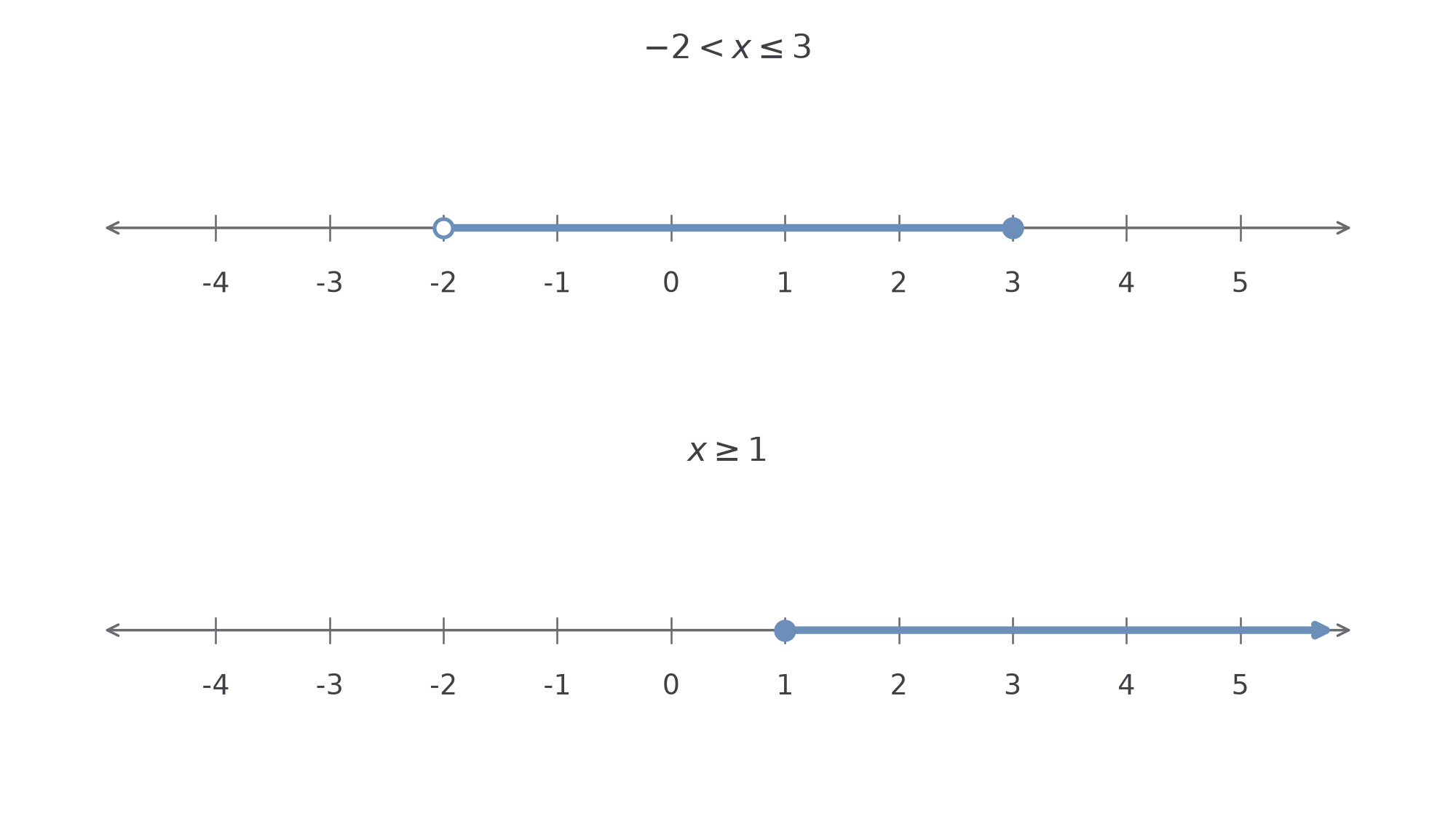
An open circle excludes an endpoint, matching or . A filled circle includes an endpoint, matching or . Join allowed values with a segment; use an arrow for a set continuing indefinitely.
An arrow at the edge of the page is not another endpoint. The two number lines show a bounded interval and an unbounded ray.
[DIAGRAM: asset_slug: m039_number_line_conventions; caption: An open lower and closed upper endpoint for minus 2 less than x at most 3, and a rightward ray for x at least 1; description: Two exact number lines, open at minus 2 and closed at 3 with the interval between, then closed at 1 with a rightward ray; file: m039-number-lines.png; recommended_method: matplotlib]
Worked example 3: representing an interval
Question. Represent on a number line.
Plan. Test the two bounds, then mark the allowed interval.
Why join the circles? Both conditions must hold, so the solution is the segment between the bounds.
Answer. An open circle at , a filled circle at , and the segment between them, as in the top number line.
Check. is excluded, is included, and lies on the allowed segment.
Change only the lower sign from strict to inclusive. The segment stays in the same place.
Worked example 4: changing one circle
Question. Represent on a number line.
Plan. Check the new lower condition and keep the unchanged upper condition.
Why fill both circles? Each bound now satisfies its equality condition.
Answer. Filled circles at and , joined by a segment.
Check. Both endpoints and every value between them pass; and fail.
For , there is no upper bound: fill the circle at and draw a rightward ray, as in the lower diagram. For , use an open circle and a leftward ray. These conventions are required at both tiers and are not in either formulae sheet.
Watch out
The wrong instruction “fill the circle for ” would include , yet is false. Use an open circle. Circle style controls inclusion; ray direction controls which side is allowed.
On paper, make the representation before describing it in words.
Continue this lesson.
You’re previewing NovaLearn without an account. Create a free account to read the rest.
Create free account