2.8 - Quadratic inequalities
Find where a quadratic expression is positive, negative or zero, then give its complete solution set. Use factor signs, graphs and number lines to choose the intervals and include the correct endpoints.
Critical values and sign intervals (Higher)
Why does have negative solutions when is positive? For example, , but fails. Finding the boundary values alone will not tell us the complete answer.
You already know
Factorisation finds the roots of a quadratic equation. A product of two numbers with the same sign is positive; a product of opposite signs is negative. Open number-line circles exclude endpoints and filled circles include them.
Start by moving every term to one side. For , we need to know where that whole expression is negative, not just where it is zero.
Critical values
The real roots of the corresponding equality. They split the number line into intervals on which a quadratic has a constant sign. For , the critical values are and , not the factors and .
Between roots, neither factor can change sign without passing through zero. Test one value in each interval, or determine each factor's sign directly.
Worked example 1: a negative product
Question. Solve .
Plan. Factorise, locate the critical values and select intervals with opposite factor signs.
| Interval | Sign of | Sign of | Product |
|---|---|---|---|
| Negative | Negative | Positive | |
| Negative | Positive | Negative | |
| Positive | Positive | Positive |
Why choose the middle interval? Only there are the factor signs opposite, giving a negative product.
Answer. . Both endpoints are excluded because the inequality is strict.
Check. At , the expression is , allowed. At and , it is , excluded.
The curve is below the axis exactly on that middle interval. The open circles show that zero itself is not negative.
[DIAGRAM: asset_slug: m041_quadratic_signs; caption: A positive-leading quadratic is negative between minus 2 and 3, with open endpoints for a strict inequality and filled endpoints in a separate inclusive example; description: Exact plot y equals x squared minus x minus 6 and number-line representations of minus 2 less than x less than 3 and 1 at most x at most 5; file: m041-sign-intervals.png; recommended_method: matplotlib]
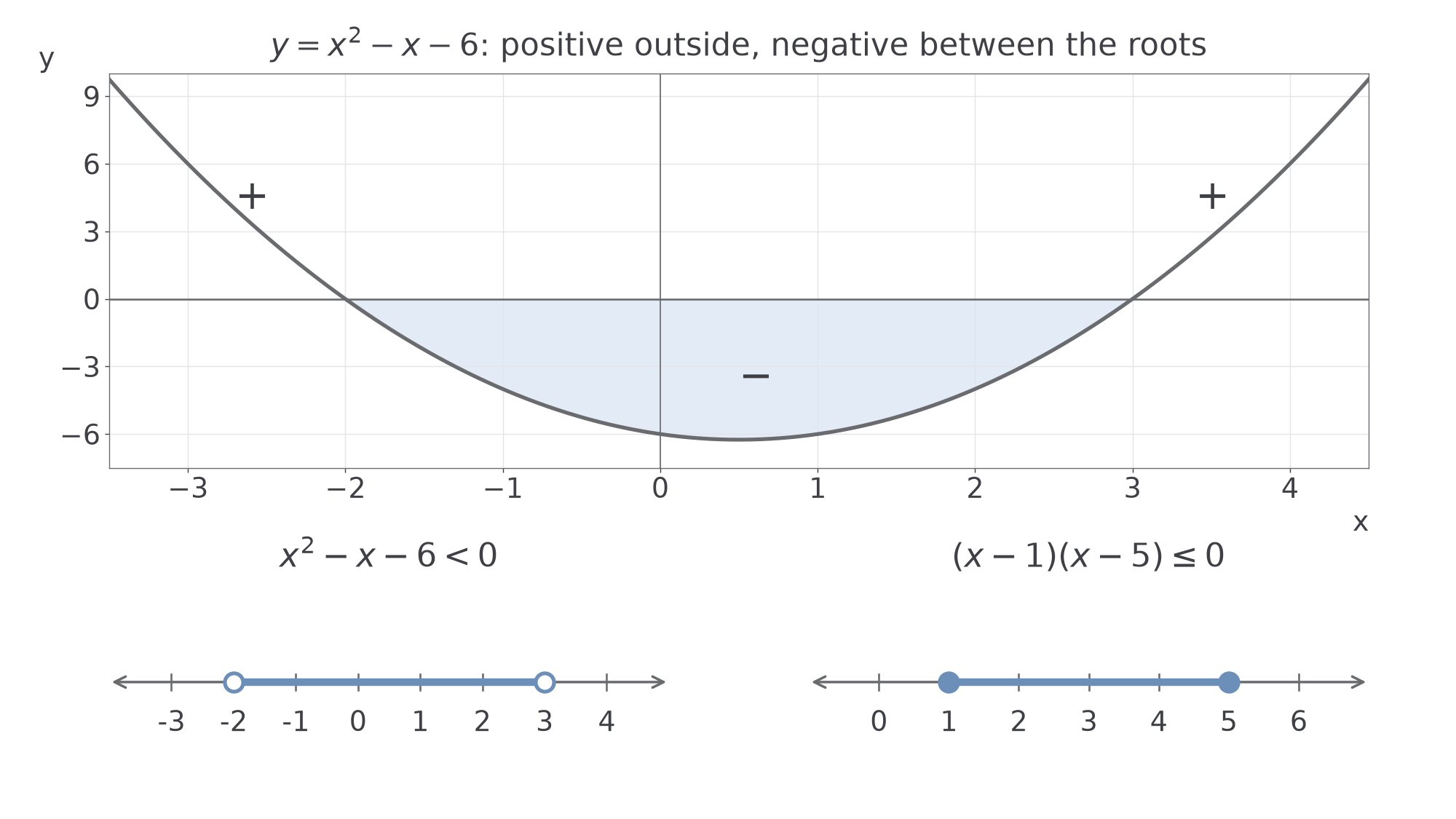
Change only the comparison sign. The roots stay the same, but we now need a positive product.
Worked example 2: a positive product
Question. Solve .
Plan. Use the same roots and choose the intervals where the factors have the same sign.
Why are there two intervals? Both negative factors and both positive factors give a positive product.
Answer. or .
Check. and give ; gives and fails. The roots give zero and fail too.
For a positive-leading quadratic with two distinct roots, the sign is positive outside and negative between them. The leading sign and the distinct-root condition matter. This sign rule is not in the Higher formulae sheet: learn it. The quadratic formula is supplied there if you need it to find the critical values.
Watch out
The wrong step “divide by to get ” assumes is positive. It is negative for , so division would reverse the sign there. Use a sign table rather than divide by a factor of unknown sign.
Now use new critical values to select the positive intervals.
Endpoint inclusion and number lines (Higher)
Choose the sign intervals first, then decide whether zero is allowed. A strict comparison excludes the roots; an inclusive comparison includes them. That last decision determines the number-line circles.
For two distinct roots, the inside set is one segment. The outside set needs two separate outward rays. An arrow continues without a final endpoint.
Worked example 3: including the inside endpoints
Question. Solve and represent the answer on a number line.
Plan. Find the roots, choose the negative interval and include zero at its endpoints.
Why fill both circles? accepts the zero product at either root.
Answer. . Draw filled circles at and , joined by a segment.
Check. gives , and the roots give , all allowed. gives , excluded.
The lower-right number line shows that inclusive interval. Its formula is different from the curve above it, so read each labelled example separately.
[DIAGRAM: asset_slug: m041_inclusive_number_line; caption: The lower-right number line uses filled circles at 1 and 5 and shades the interval between them; description: Exact filled-endpoint example of 1 at most x at most 5 for a nonpositive product, alongside the earlier strict-sign example; file: m041-sign-intervals.png; recommended_method: matplotlib]
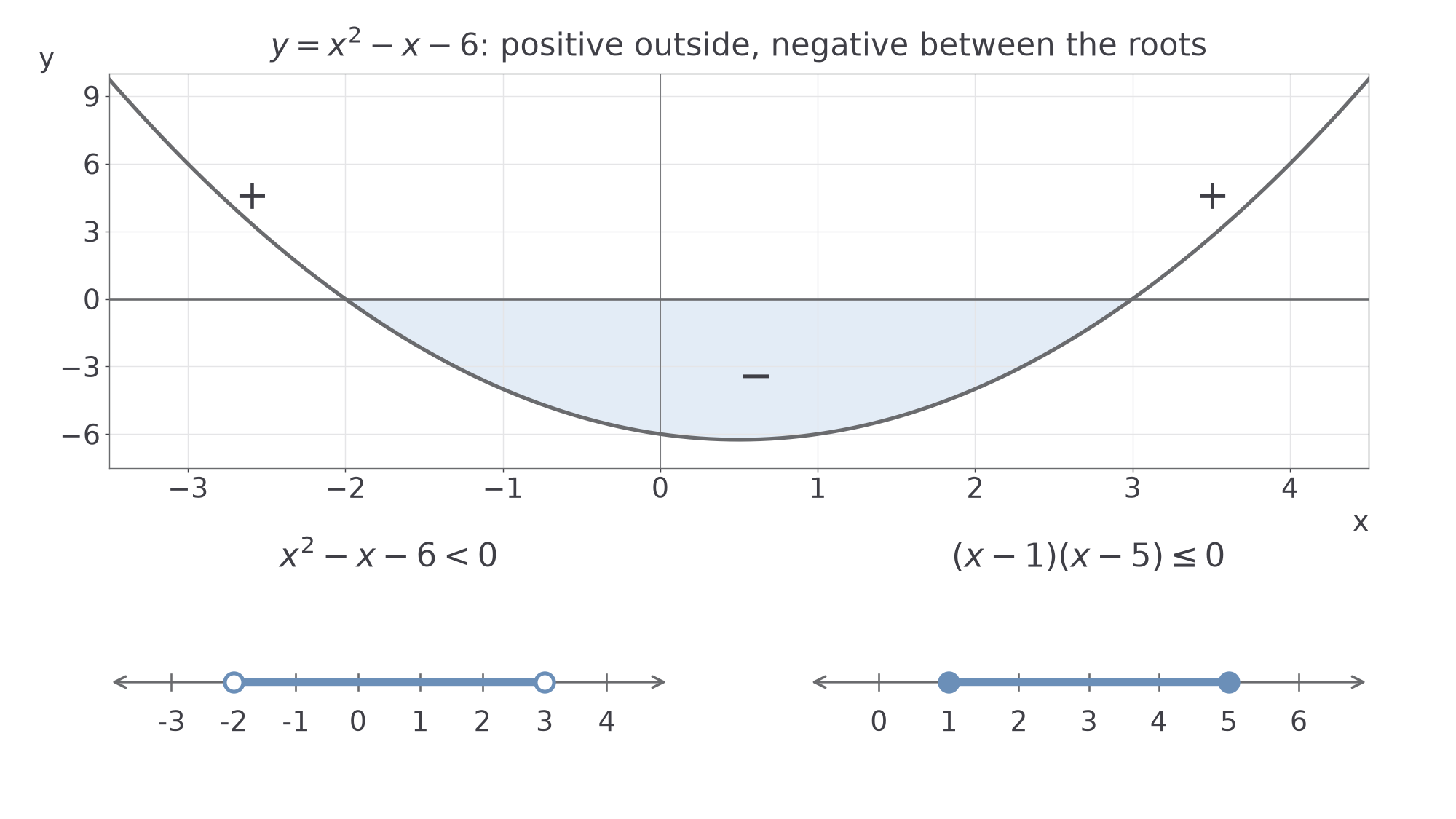
Change only the direction of comparison. Equality is still allowed, but we now select the outside intervals.
Continue this lesson.
You’re previewing NovaLearn without an account. Create a free account to read the rest.
Create free account