4.9 - Arc lengths and sector areas
Use a central angle as a fraction of a full turn to find an arc length or sector area. You will include the straight edges in a sector's perimeter and work backwards to find an unknown angle or radius, using degrees throughout.
Arc length from an angle (Higher)
A fan-shaped sheet has radius and central angle . Its curved edge is long. Is that enough ribbon to edge the whole sheet? We will trace its complete boundary after finding out how the angle controls the curve.
You already know
A full turn is . A circle has circumference and area . Both circle formulae are absent from either tier's sheet.
An arc is part of a circle's circumference. Equal central angles cut equal arc lengths from the same circle. A angle selects one quarter of a circumference; the same fraction idea works for other angles.
Sector
A sector is a circular region bounded by two radii and the arc between them. A region bounded by an arc and a chord instead is not a sector.
For , the fraction of a full circle is . A major sector uses a reflex angle greater than ; a minor sector uses the smaller angle. Read which region is named rather than automatically choosing the smaller one.
[DIAGRAM: asset_slug: m076_sector_boundary; caption: A sector with two radii and an 80 degree arc; description: OA and OB are equal radii of 6 centimetres, angle AOB is 80 degrees, and arc AB is the curved edge. The two radial edges also belong to the whole boundary; file: m076_sector_boundary.png; recommended_method: matplotlib]
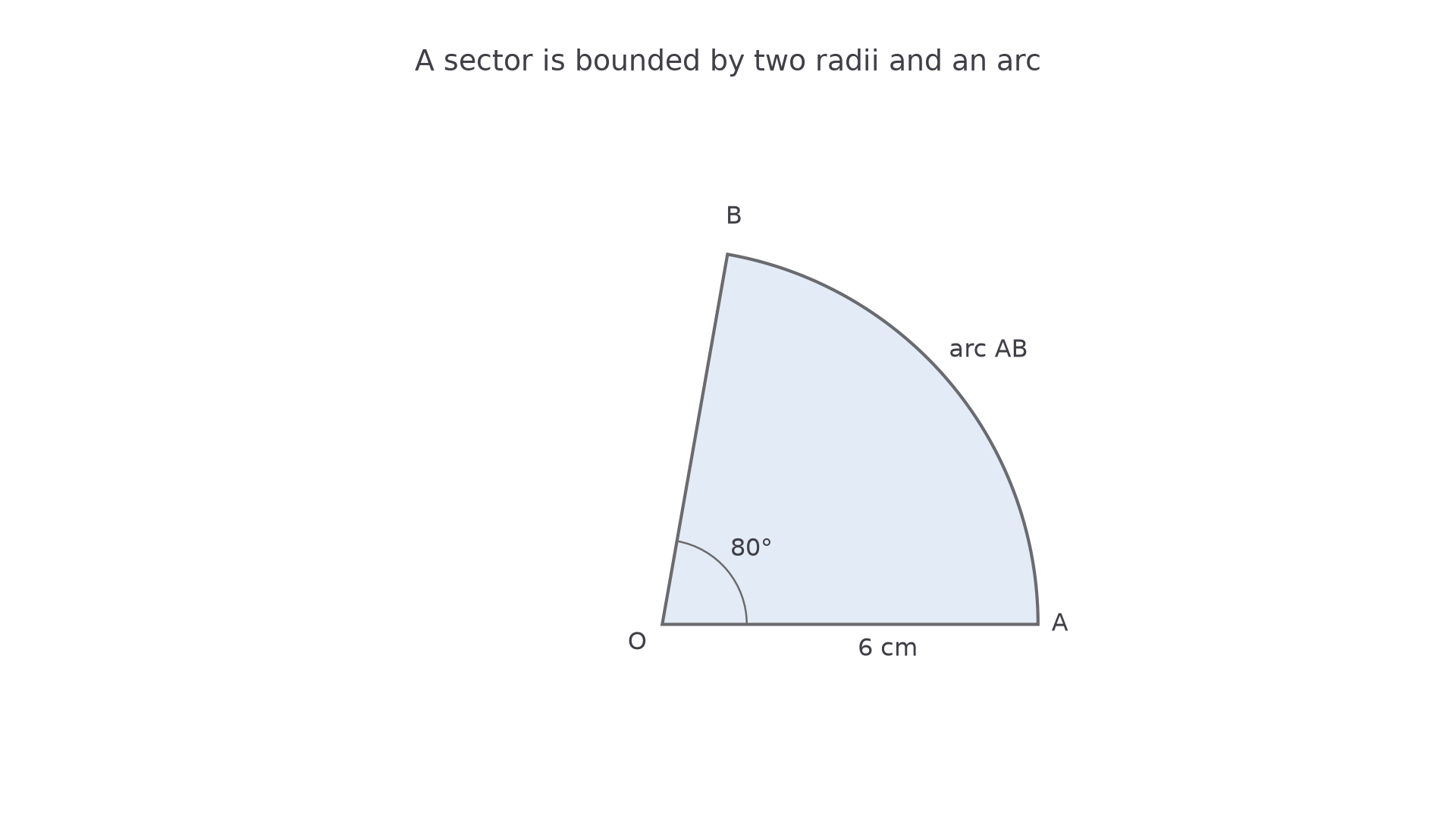
The angle fraction multiplies the full circumference to give the curved length.
Arc length in degrees
Here and is the sector angle in degrees. Arc length and sector formulae are absent from both tier sheets; this sector content is Higher. Not in the formulae sheet: learn it.
Start with the curve on the opening sheet.
Worked example 1: the fan's curved edge
Question. A sector has radius and angle . Find its arc length exactly.
Plan. Multiply the full circumference by the fraction .
Why use circumference? The requested measurement follows a curved boundary, so it is a length.
Answer. .
Check. , the same fraction as .
Change only the angle from to . This names the remaining major sector of the same circle.
Worked example 2: the long arc
Question. A sector has radius and angle . Find its arc length exactly.
Plan. Use the reflex angle to select the long arc.
Why use ? The question asks for the major sector, so the smaller angle selects the wrong arc.
Answer. .
Check. , the full circumference.
The fraction must be between zero and one for a sector smaller than a full circle.
Watch out
reverses the fraction and produces more than a full circumference. Correct it to . Keep this fraction exact until the end.
All angles here use degrees. Radian measure is not needed for this course.
Sector area (Higher)
A sector's region is the same fraction of the circle as its arc is of the circumference. The fraction stays the same, but the quantity it multiplies changes.
Sector area in degrees
Use the angle of the required region in degrees and a positive radius. This formula is absent from both tier sheets; sector area is Higher content. Not in the formulae sheet: learn it.
Equal central angles divide a circle into equal regions. That is why the angle fraction applies to area as well as arc length. The result now uses square units.
Worked example 3: area of a major sector
Question. A major sector has radius and angle . Find its area exactly.
Plan. Find the full circle area and take the fraction .
Why is this more than half the circle? The selected angle is more than .
Answer. .
Check. The missing fraction is , whose area is . The two areas sum to .
Change only the angle to the remaining , keeping the radius .
Worked example 4: the remaining region
Question. A sector has radius and angle . Find its area exactly.
Plan. Use the smaller fraction of the same full circle area.
Why has only the fraction changed? The circle's radius, and therefore its full area, stay fixed.
Answer. .
Check. and , so the two sectors complete the circle.
Here is a useful surprise: radius with angle has area , equal to the major sector in example . Doubling a radius multiplies area by four, while quartering the angle divides it by four. Very different sectors can cover the same area.
Watch out
uses the arc-length formula, so its result is a length. For area, use and square units.
Check that the selected angle describes the shaded or named region; the diagram may show the other angle more prominently.
Sector perimeter (Higher)
Trace from the centre along one radius, around the arc, and back along the other radius. A sector has three boundary pieces, even when its angle is reflex.
Sector perimeter
This applies when both radial edges are exposed. It is absent from both tier sheets; sector perimeter is Higher content. Not in the formulae sheet: learn it.
Continue this lesson.
You’re previewing NovaLearn without an account. Create a free account to read the rest.
Create free account