1.5 - Set notation and counting elements
You will use algebra to define sets, distinguish elements from subsets, and count overlapping groups without counting anyone twice. Set sizes help you solve practical problems even when no list of names is available. Start with membership, complements and Venn regions, then add a careful counting method.
Algebraically defined sets (Higher)
Can people produce club membership totals of , and without a mistake? Those totals add to . The answer depends on who belongs to more than one club; you will resolve it in the last part.
You already know
In a Venn diagram, the overlap belongs to both sets. Inequalities such as exclude the endpoint, while includes it.
Sometimes a rule is shorter than a list. In , read the colon as “such that”. The variable names a candidate; the words and inequalities decide whether it belongs.
Set-builder notation and set size
Set-builder notation describes a set by a rule for its elements. The notation means the number of elements in the finite set . For example, is a set, while is a number.
State the domain, such as integers. A real-number interval would include numbers between the integers too. Neither set-builder notation nor set-size rules are supplied on the Higher formulae sheet; they are not Foundation requirements.
Worked example 1: list an integer-defined set
Question. List and state .
Plan. Decide which endpoints are allowed, list the integers between them, then count.
Why start at ? The strict inequality rules out , and is the next integer.
Answer. , .
Check. Every listed number satisfies both inequalities; the neighbouring integers and do not.
Change only the lower inequality from strict to inclusive. One extra integer now qualifies.
Worked example 2: include an endpoint
Question. List and state .
Plan. Include both endpoints, then list and count the integers.
Why count zero? It is an integer and satisfies both bounds, so it is an element like any other.
Answer. , .
Check. This list contains exactly the earlier five elements plus .
The set and its size answer different questions.
Watch out
Writing confuses a number with a set. Write and . Braces belong around the elements, not around the count.
Try new bounds. Read each endpoint separately before you list anything.
Elements and subsets (Higher)
A single shared member does not make one set part of another. Compare with : every member of belongs to . That is a stronger statement than saying the two sets overlap.
Subset
A set is a subset of if every element of belongs to . Use in this course. A proper subset has at least one element of missing; for example, is a proper subset of .
To establish the relationship, check all elements of the smaller set. To disprove it, one counterexample is enough. For instance, is not a subset of , because is missing from . The shared member cannot rescue the claim.
Be precise about what you are comparing. The statement compares an element with a set. The statement compares two sets. In a Venn diagram, a subset's curve lies wholly inside the containing set's curve; partial overlap alone does not show a subset.
The empty set is a subset of every set: it has no member that could fail the membership test. If two sets have exactly the same elements, say they are equal. If the distinction matters, state “proper subset” or “equal” explicitly, since symbol conventions can vary. Subset notation and these facts are not supplied on the Higher formulae sheet.
Key idea
“Every element belongs” proves a subset relationship; one element outside disproves it. Use for an element and for a set.
A set's size alone cannot settle the question either. The sets and have the same size but share no element. Look at membership, not just totals.
Counting disjoint Venn regions (Higher)
A number in a Venn region can be a frequency rather than an individual element. Read the caption. In this diagram, means nine learners in only; it does not mean that the number is an element of .
[DIAGRAM: asset_slug: sets_venn_counts; caption: Numbers of learners in the four disjoint regions; description: Rectangle E and overlapping circles A and B. A only has count 9, intersection has count 5, B only count 6, neither count 3. These are frequencies not individual elements and areas are not to scale.; file: sets_venn_counts.png; recommended_method: matplotlib]
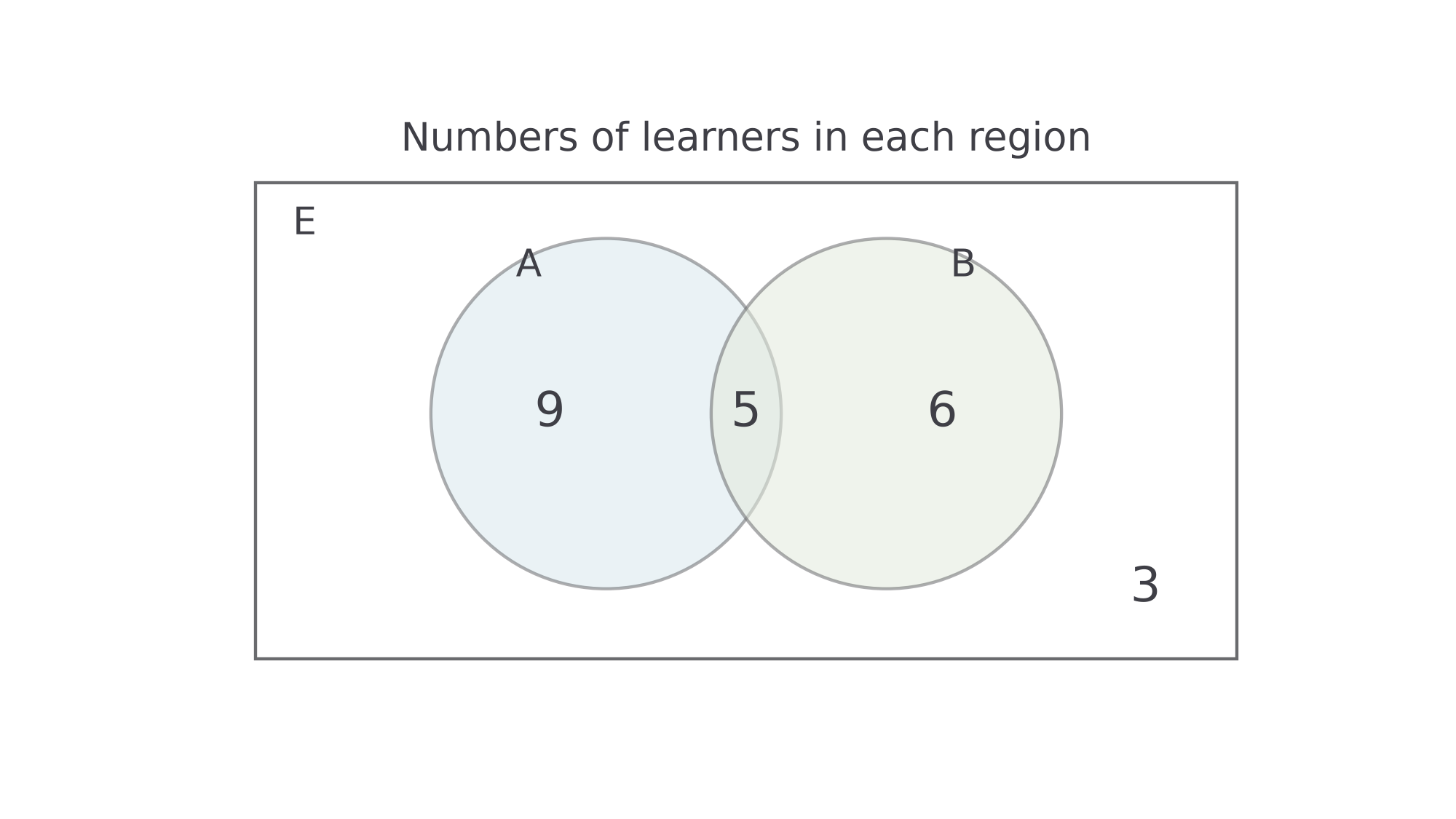
Read whole circles by including the overlap: here , , and . The region counts do not overlap, so you can add them directly.
Counting two overlapping sets
For finite sets, subtract the intersection once because it appears in both set totals. The number in neither is . Higher: not supplied. Not in the formulae sheet: learn it.
Start with the shared region, subtract it from each circle total, then use the universal total for the outside region. Each resulting count must be a nonnegative integer.
Worked example 3: find the four regions
Question. Of students, belong to , to , and to both. Find the numbers in only, only and neither.
Plan. Enter the overlap first, then subtract it from each set total and from the universal total as needed.
Why subtract from both totals? Each total already includes those shared students, who have their own region.
Answer. in only, in only, and in neither.
Check. , , and .
Change only the overlap from to . The circle totals stay fixed, so both “only” regions become smaller.
Worked example 4: a larger overlap
Question. Of students, belong to , to , and to both. Find the numbers in only, only and neither.
Plan. Use the new overlap in the same region method.
Why does the union shrink? With fixed set totals, more shared people means fewer distinct people overall.
Answer. in only, in only, and in neither.
Check. , agreeing with the sum of the internal regions.
Language tells you which regions to add. “Exactly one” excludes the overlap; “at least one” includes it.
Watch out
Writing double counts the shared students. For Worked example , the correct line is . A union cannot exceed its universe of .
Use fresh survey totals and find the union before the outside count.
Practical problems with overlapping groups (Higher)
With three sets, begin where all three overlap. A pairwise total such as normally includes the people in all three sets. Subtract the triple intersection to obtain “ and only”. Then work outwards to the single-set regions.
For the opening puzzle, let be three clubs. A person can contribute to two or three club totals, but still occupies one region of the diagram. “Memberships” and “people” are different totals.
Worked example 5: three clubs
Question. There are people. Club totals are , , . The pairwise totals are , , , each including the people in all three. Find the numbers in each region and in none.
Plan. Place the triple count, remove it from each pair total, then use the club totals for the single regions.
Why remove the triple count from each pair total? Those people already have a central region; they are not in a pair-only region as well.
Answer. The diagram below gives all eight region counts, including in none.
Check. The circles total , , and . All regions total .
Read the diagram as frequencies. The central contributes to every circle total, but to the universal total only once.
[DIAGRAM: asset_slug: sets_three_club_counts; caption: Forty people sorted into the eight regions of three clubs; description: Rectangle E contains three overlapping circles A, B and C. A only 8, B only 7, C only 5, AB only 6, AC only 5, BC only 4, all three 3, and none 2. Counts are frequencies and circle areas are not to scale.; file: sets_three_club_counts.png; recommended_method: matplotlib]
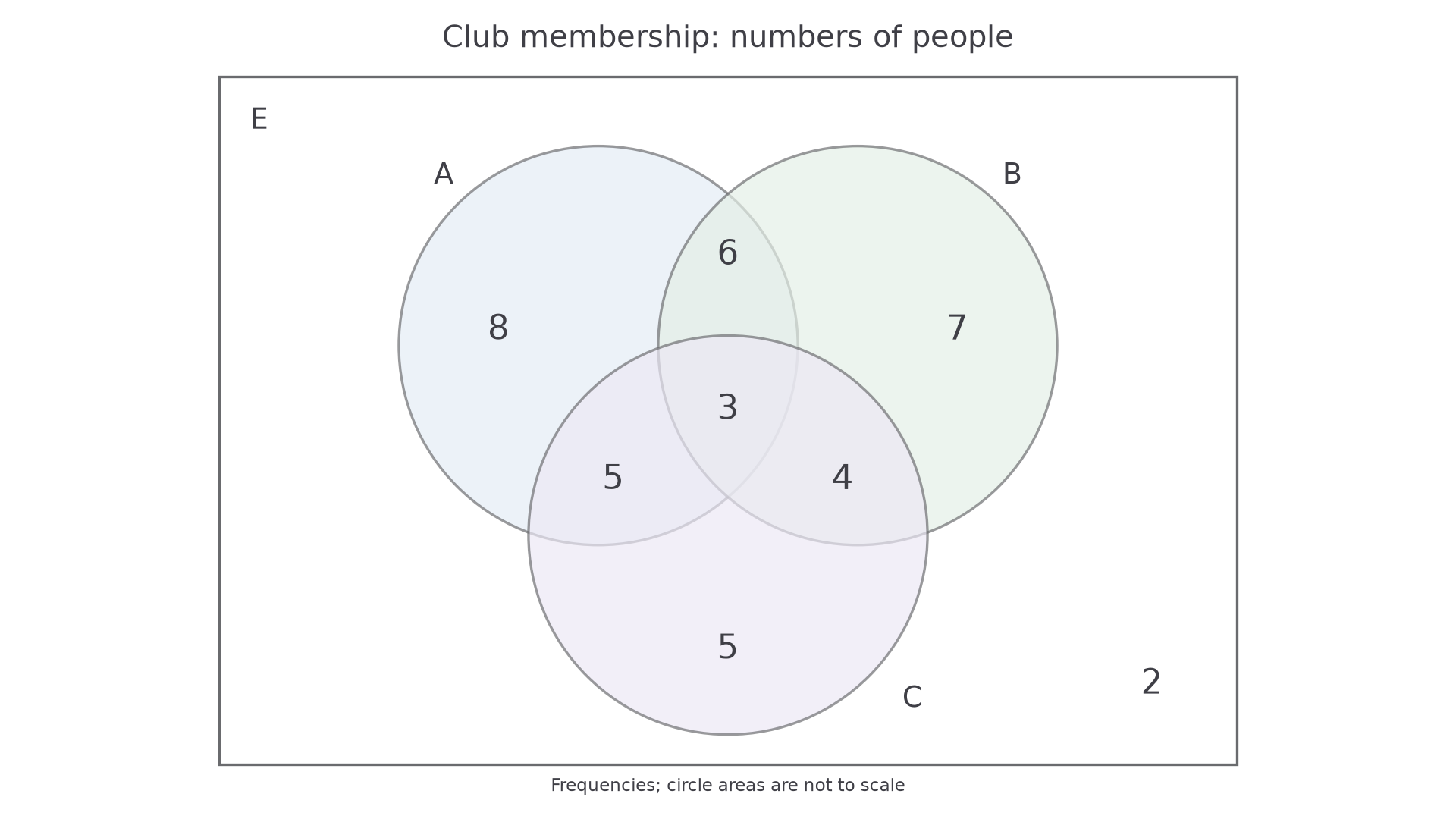
Now change only the triple count, from to . Keep the club totals and pairwise totals fixed. Recalculate every region affected by the change.
Worked example 6: change the central overlap
Question. For people, the club totals remain and the pairwise totals remain for . Now people belong to all three. Find the number in none.
Plan. Rebuild pair-only and single-only counts using the new central count, then total the union.
Why redo the outer regions? Fixed circle totals must still be recovered when the central count changes.
Answer. person belongs to none of the clubs.
Check. , , , and .
Here is a surprising consequence: with the same three club totals and pairwise totals, the number of distinct members rose from to . The larger triple overlap forced changes in the other six regions. You cannot reason about one region in isolation. This counting method is not supplied on the Higher formulae sheet.
Watch out
Putting in the -only region in Worked example is wrong: it includes the central again. Write there. Negative region counts or an overlap larger than a whole set signal inconsistent data or interpretation.
A useful final check is to reconstruct each original total. Checking only the grand total can miss a value placed in the wrong region.
Problem-solving
Translate “both”, “only”, “at least one” and “none” into regions before calculating. In three sets, start at the centre and work outwards.
The opening totals are possible: of the people can hold memberships between them, with people in no club. Apply the same reasoning to a new group.
Quick Recap
- Set-builder notation needs a domain and a rule; is a number, not a set.
- A subset requires every member to belong; one counterexample disproves the claim.
- Count disjoint regions once. Whole-set totals include their overlaps.
- For three sets, place the triple intersection first, then pair-only regions, then single-only regions and none.
Yes, the opening totals are possible for people: the first club diagram has people in at least one club and in none. Adding memberships counts some people more than once.