3.3 - Coordinates and midpoints
A coordinate pair turns a position into two numbers. You will plot and read points in all four quadrants, use geometric information to locate vertices and find midpoints or missing endpoints. These skills let you solve a map problem exactly, even when the picture is not drawn accurately.
Cartesian coordinates and quadrants
Two friends are at and on a map. Where is the point halfway along the straight path between them? We will find it without measuring the map. First, each pair must identify just one position.
You already know
Positive and negative numbers describe opposite directions from zero. A scale tells you the value of each interval; a square need not represent one unit.
Rectangular Cartesian coordinates use two perpendicular axes. The horizontal axis is the -axis and the vertical axis is the -axis. Their intersection is the origin, . Positive values go right or up; negative values go left or down.
Ordered pair
The coordinates give horizontal position first and vertical position second. For example, means three units left and two units up. It does not mean two units left and three units up.
To plot a point, read both scales, move horizontally to its -coordinate, then vertically to its -coordinate. Put a small cross or dot exactly at the intersection. To read a point, reverse that process. The point has position but no width.
[DIAGRAM: asset_slug: m047_cartesian_points; caption: Four labelled points on a Cartesian grid with one unit per square; description: A at minus 3 comma 2, B at 2 comma 3, C at minus 2 comma minus 3 and D at 4 comma minus 2 show all four quadrants; file: m047_cartesian_points.png; recommended_method: matplotlib]
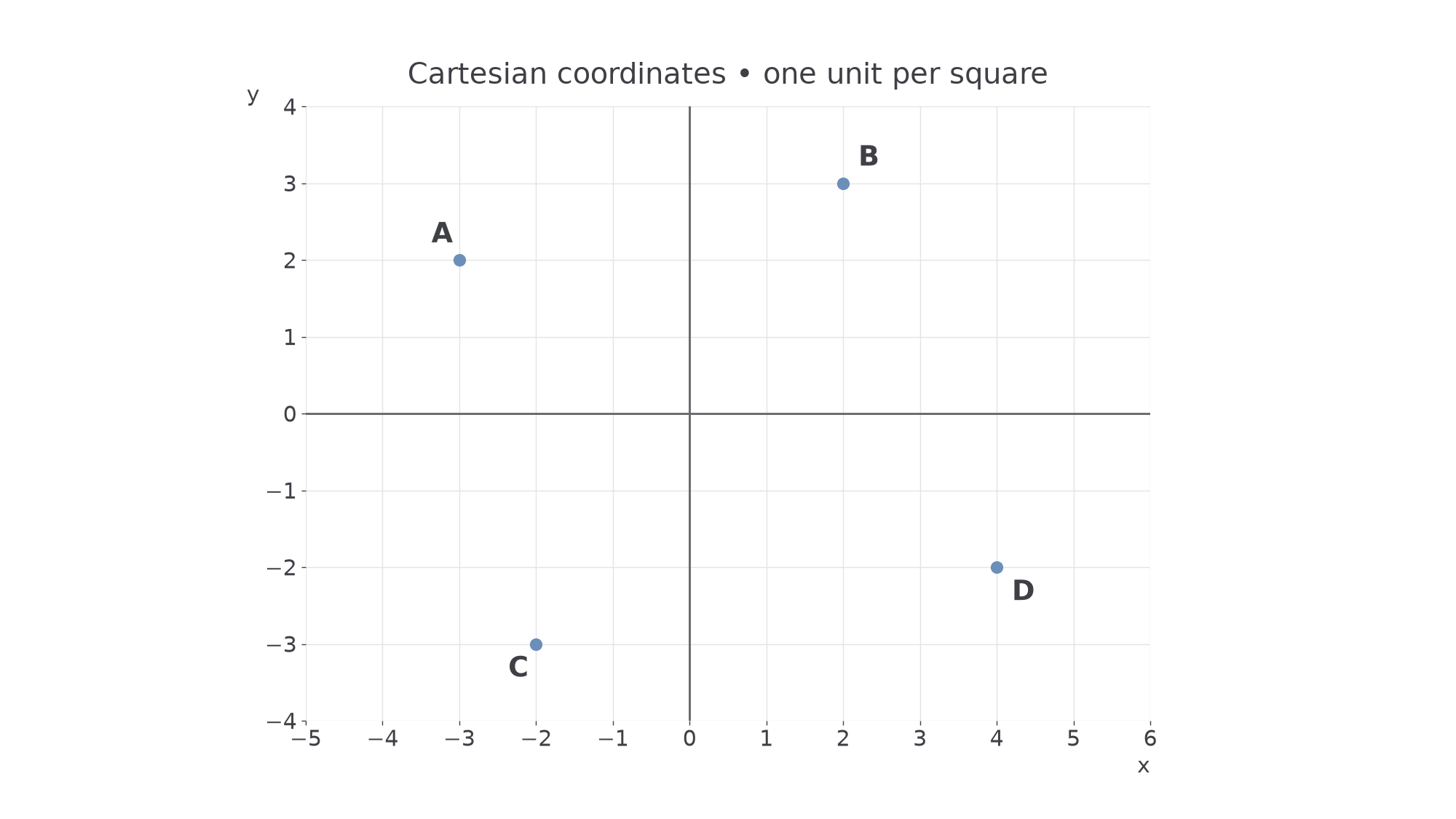
The axes split the plane into four quadrants, numbered anticlockwise from the top right. Their sign pairs are I: , II: , III: , IV: . A point on an axis is in no quadrant: on the -axis, ; on the -axis, . These conventions are not in either tier's formulae sheet: learn them.
Worked example 1: read a position
Question. Point is three units left of the origin and two units up. Write its coordinates and state its quadrant.
Plan. Give each direction its sign, then write horizontal position first.
Why? The order of the two numbers tells us which axis each number belongs to.
Answer. , in quadrant II.
Check. The point in the diagram is left of the vertical axis and above the horizontal axis.
Now change only the directions: the next point is right and down. The order of the coordinates stays the same even when their signs change.
Worked example 2: plot a position
Question. Locate , four units right of the origin and two units down. Write its coordinates and quadrant.
Plan. Use the signed horizontal and vertical movements to place the point.
Why? Moving down changes the sign of the second coordinate, not the order of the pair.
Answer. Mark , in quadrant IV, as shown in the diagram.
Check. The point is right of the origin and below the horizontal axis.
Coordinates make the position unambiguous. Swapping the numbers usually moves you to a different point, even if both points are in the same quadrant.
Watch out
The line is wrong for four right and two down: it swaps the axes. The correct pair is . Read across first, then up or down.
Try the same reading process with a point on the other side of the vertical axis.
Coordinates from geometric information
Geometry can give an exact coordinate even when a drawing is only a sketch. Points on a horizontal line share a -coordinate; points on a vertical line share an -coordinate. An axis-aligned rectangle therefore uses just two distinct values of each coordinate.
Read the order of the vertices. Consecutive vertices follow one another around the boundary, so identify two sides, not a side and a diagonal. The fourth corner must finish both the horizontal and vertical sides.
[DIAGRAM: asset_slug: m047_rectangle_midpoint; caption: Rectangle ABCD with the diagonal midpoint M marked on an exact coordinate grid; description: A minus 4 comma minus 1, B 2 comma minus 1, C 2 comma 3, D minus 4 comma 3, and midpoint M minus 1 comma 1 of diagonal AC; file: m047_rectangle_midpoint.png; recommended_method: matplotlib]
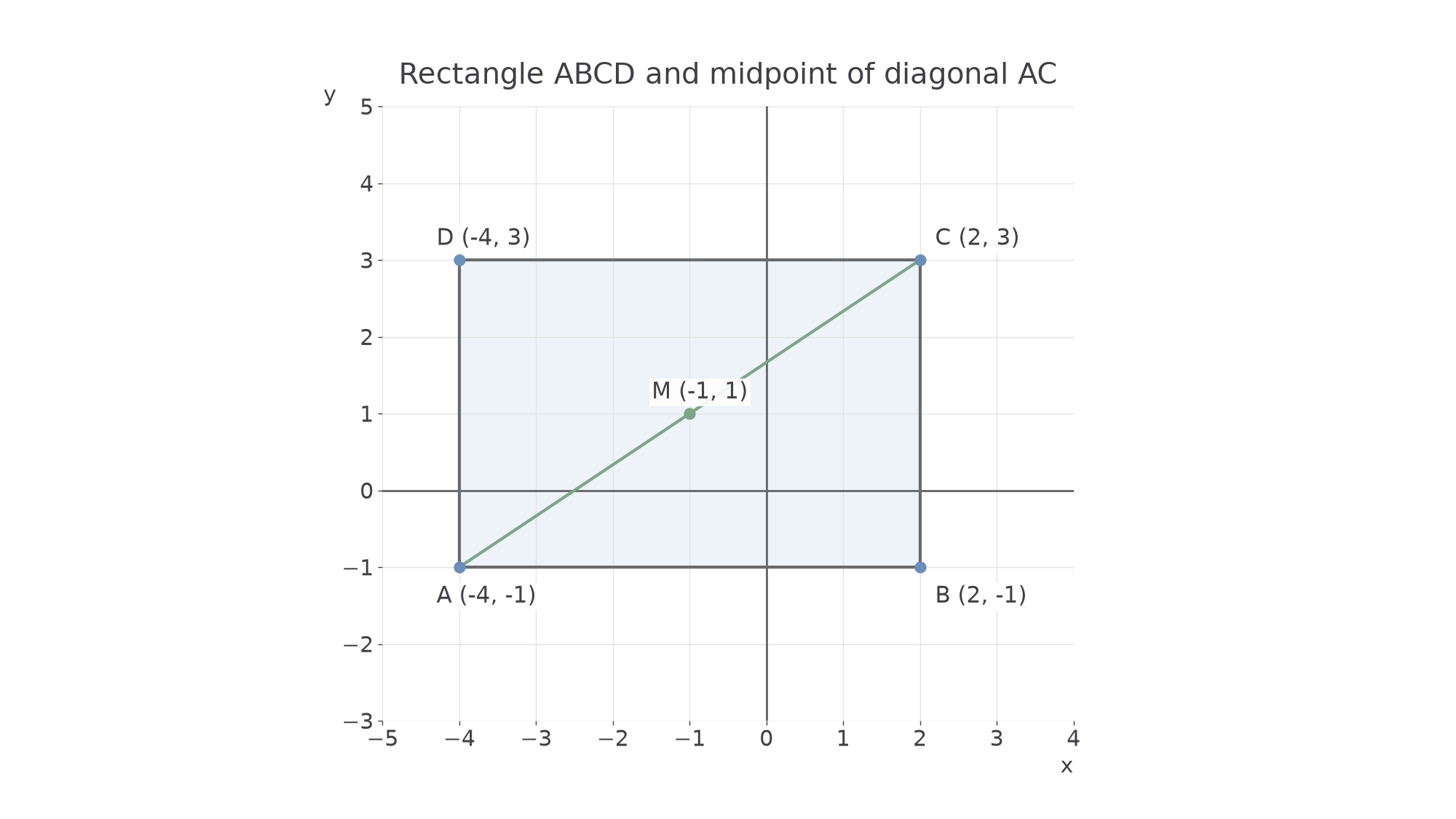
For this rectangle, the left corners have and the right corners have . The bottom corners have and the top corners have . You can combine these facts without estimating lengths from the picture.
Continue this lesson.
You’re previewing NovaLearn without an account. Create a free account to read the rest.
Create free account