3.1 - Sums of arithmetic series
Learn to add an arithmetic sequence efficiently and explain why its sum formula works. You will use totals to solve a saving-budget problem. This lesson is for Higher students.
Pairing the first and last terms (Higher)
You plan to save in week one, then more each week. How many complete weeks can you fund from ? The amount in one week and the total across several weeks are different questions.
You already know
An arithmetic sequence has first term , common difference and nth term . From the first to the nth term there are jumps.
Adding through looks like a hundred calculations, but a useful surprise makes it one multiplication: . Every opposite-end pair has the same total, so the whole sum is .
Arithmetic series
An arithmetic series adds consecutive terms of an arithmetic sequence. The symbol names one term; names the sum of the first terms.
Suppose the first term is and the last is . The second is , while the second-last is ; their sum is still . Write the series once forwards and once backwards. Every column then totals .
[DIAGRAM: asset_slug: m044_pairing_terms; caption: A forward and reversed arithmetic series make equal column sums; description: The two copies of 4 plus 7 plus 10 through 31 are aligned in opposite orders; each of ten columns totals 35, so two sums total 350; file: m044_pairing_terms.png; recommended_method: matplotlib]
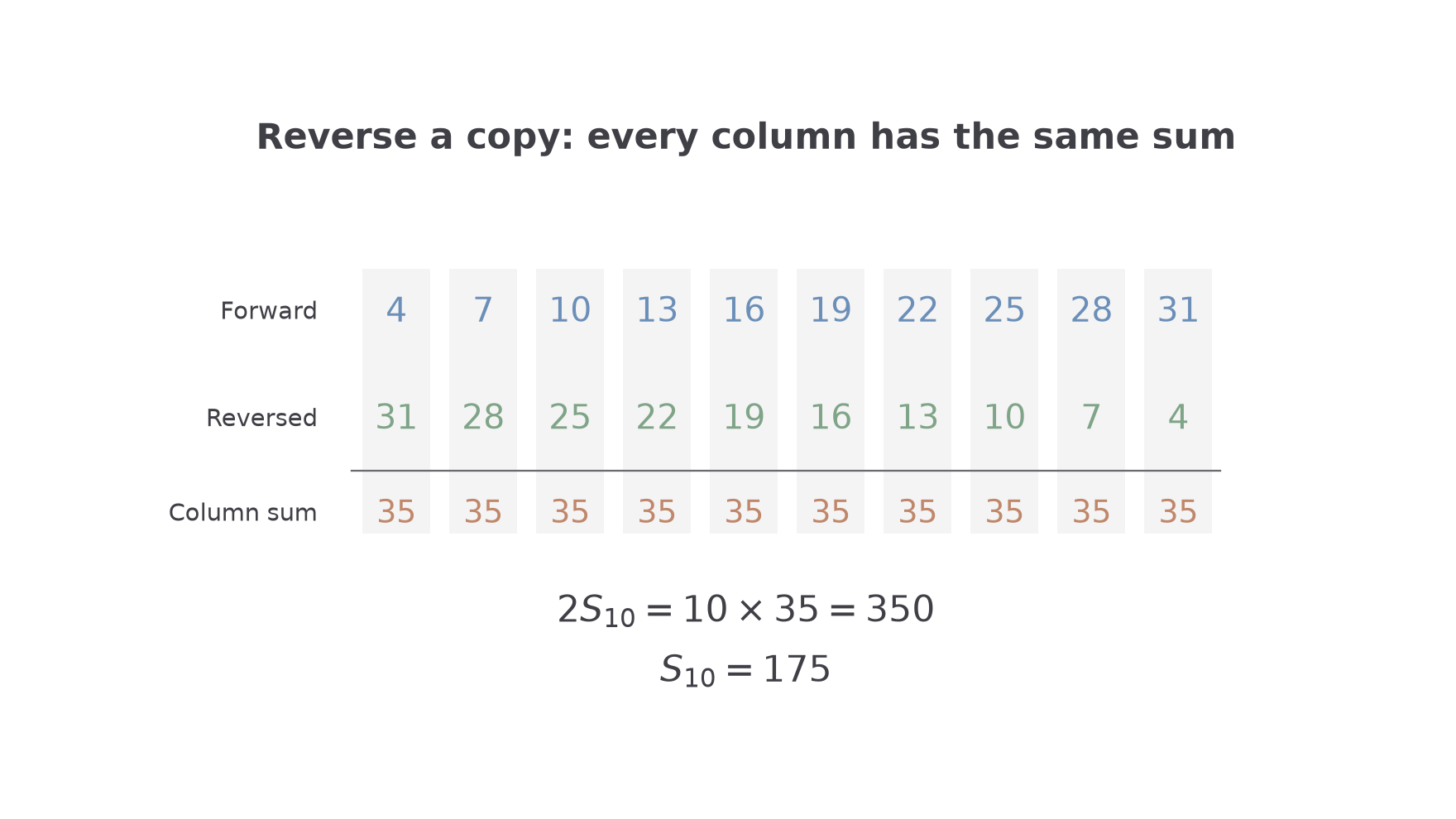
The picture gives . Divide by because you added two copies, not because the original series must have an even number of terms.
Arithmetic sum from endpoints
For an arithmetic series of terms, first term and last term ,
This endpoint form is not printed on the Higher formulae sheet; it follows from the supplied arithmetic-series formula. Not in the formulae sheet: learn it. Foundation does not require arithmetic-series sums and has neither form on its sheet.
Count terms carefully when only the endpoints and difference are given.
Worked example 1: count the terms before adding
Question. Work out .
Plan. Count the equal jumps, add one to count terms, then use the endpoints.
Why add to the jump count? Nine gaps join ten terms.
Answer. The sum is .
Check. Two reversed copies total ; half is .
Now change only the final term from to . There are nine terms, so the two-copy argument is especially helpful.
Worked example 2: an odd number of terms
Question. Work out .
Plan. Count the terms and use the same endpoint formula.
Why is allowed? It comes from halving nine pairs across two copies; it need not count whole pairs in one copy.
Answer. The sum is .
Check. Four outer pairs total ; the middle term is , giving .
Use the same count for everywhere in the calculation.
Watch out
The wrong line uses nine jumps as nine terms. There are ten terms, so the correct line is .
The next sum changes only the final term once more.
Using first term and common difference (Higher)
Usually a question gives the first term and common difference rather than the last term. Substitute into the endpoint formula:
Combining the two copies of produces the form printed on the sheet.
Arithmetic-series sum
For constant difference , first term , and positive integer number of terms ,
Higher: In the formulae sheet. The Foundation sheet does not supply this result, and arithmetic-series sums are Higher content.
Identify , and before substituting. Keep a negative difference in brackets so its sign survives the multiplication.
Worked example 3: substitute three quantities
Question. Find the sum of the first terms when and .
Plan. Substitute into the supplied sum formula, then simplify its bracket first.
Why use inside the bracket? The last term is eleven jumps beyond the first.
Answer. .
Check. The last term is , so .
Continue this lesson.
You’re previewing NovaLearn without an account. Create a free account to read the rest.
Create free account