2.7 - Linear and quadratic simultaneous equations
Find every pair of values that satisfies a line and a quadratic equation together. Learn how substitution finds exact intersections, why brackets matter when squaring, and how to recognise one solution or no real solutions.
Substitution and solution pairs (Higher)
Can a straight line meet the same parabola twice, once or not at all? Start with and . At , both give . At , both give . There are already two shared points to explain.
You already know
Substitution replaces a variable by an equal expression. To solve a factorised quadratic equal to zero, set each factor equal to zero. An ordered pair gives the two coordinates in that order.
A shared point must use the same values in both equations. This is stronger than finding one point on each graph separately.
Simultaneous solution
A pair of values satisfying both equations at the same time. For and , is a solution; is not, because it fails both equations.
When both equations are written as , equate their right-hand sides. This removes and leaves one quadratic to solve. Then each root needs its own matching -value. The substitution method is not in the Higher formulae sheet: learn it. The quadratic formula is in that sheet if factorisation is inconvenient.
Worked example 1: finding both shared points
Question. Solve and .
Plan. Equate the expressions for , factorise, then find the matching coordinate for each root.
Why equate the expressions? At a shared point, both expressions name the same height.
Answer. or .
Check. and , so each pair satisfies both originals.
The diagram turns the algebraic answers into intersections. A sketch shows the possibilities; algebra establishes exact coordinates.
[DIAGRAM: asset_slug: m038-intersections; caption: The parabola y equals x squared meets three different lines twice, once and not at all; description: Three exact coordinate panels show y equals x squared with y equals x plus 2 intersecting at minus 1 comma 1 and 2 comma 4, y equals 2x minus 1 touching at 1 comma 1, and y equals 2x minus 3 with no real intersection; file: m038-intersections.png; recommended_method: matplotlib]
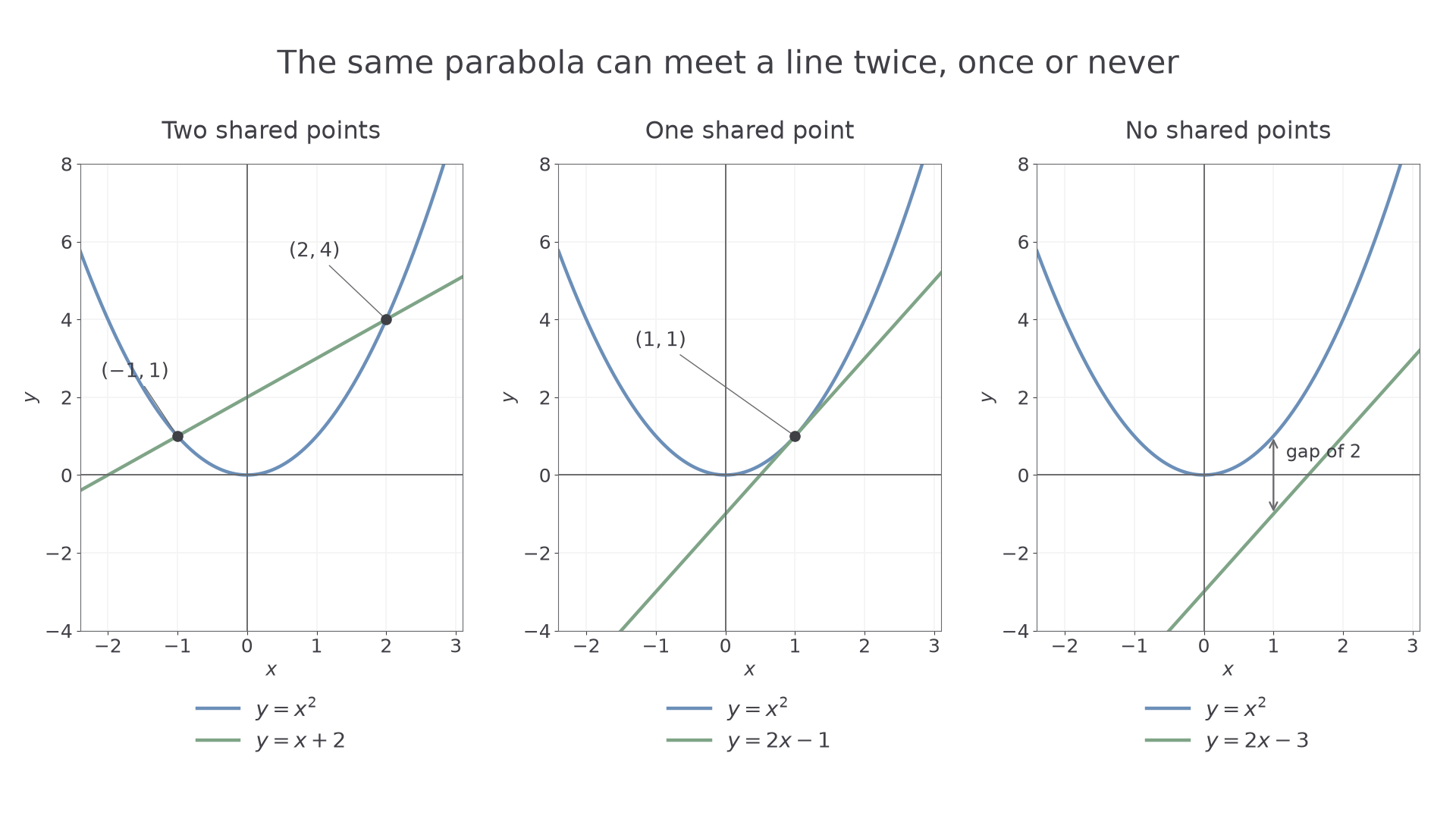
Now change only the line's constant term. The parabola and the substitution decision stay the same.
Worked example 2: changing the line's height
Question. Solve and .
Plan. Equate, factorise and pair each root with its line value.
Why calculate two heights separately? Each root identifies a different shared point.
Answer. and .
Check. and .
Keep the pairing visible even when you have found all four coordinate values.
Watch out
The line “, , so is a solution” mismatches the coordinates. . The correct pairing is and .
Try another change to the line's constant. Give complete ordered pairs.
Substituting into squared terms (Higher)
When a variable is squared, replace it by the whole linear expression inside brackets. For , the expression becomes . It does not become .
Square of a difference
The middle term comes from both cross-products in . Not in the Higher formulae sheet: learn it.
For example, . Preserve the original equations so that the final check can detect an expansion error.
Worked example 3: a squared coordinate
Question. Solve and .
Plan. Write , substitute into the square, then solve and pair the roots.
Why use brackets? The square applies to every term replacing .
Answer. From , the solutions are and .
Check. Both sums are ; both sums of squares are .
Continue this lesson.
You’re previewing NovaLearn without an account. Create a free account to read the rest.
Create free account