4.1 - Angles, parallel lines and triangles
You will identify angle types and find unknown angles in lines and triangles. You will learn which angles are equal, which add to a fixed total, and how to explain your choice. These ideas let you calculate angles even when a drawing cannot be measured accurately.
Angle types and notation
An isosceles roof has a top angle of . Can you find the outside angle at its base without climbing onto the roof? Keep that question in mind: first we need a language for turns.
You already know
You can add and subtract whole numbers. A quarter turn is , a half turn is , and a full turn is .
Opening a door makes a turn about its hinge. The length of the door does not change the angle: longer rays show the same turn.
Angle
An angle measures the turn between two rays meeting at a vertex. In , the middle letter names the vertex; the rays are and .
The marked arc tells you which turn to use. Two rays usually enclose both a smaller turn and a larger reflex turn.
| Type | Size | Example |
|---|---|---|
| Acute | ||
| Right | A quarter turn | |
| Obtuse | ||
| Straight | A half turn | |
| Reflex |
[DIAGRAM: asset_slug: angles_reference; caption: Marked acute, right, obtuse and reflex turns; description: Four separate ray pairs with marked turns 35, 90, 120 and 250 degrees. The reflex arc is the larger turn; file: angles_reference.png; recommended_method: matplotlib]
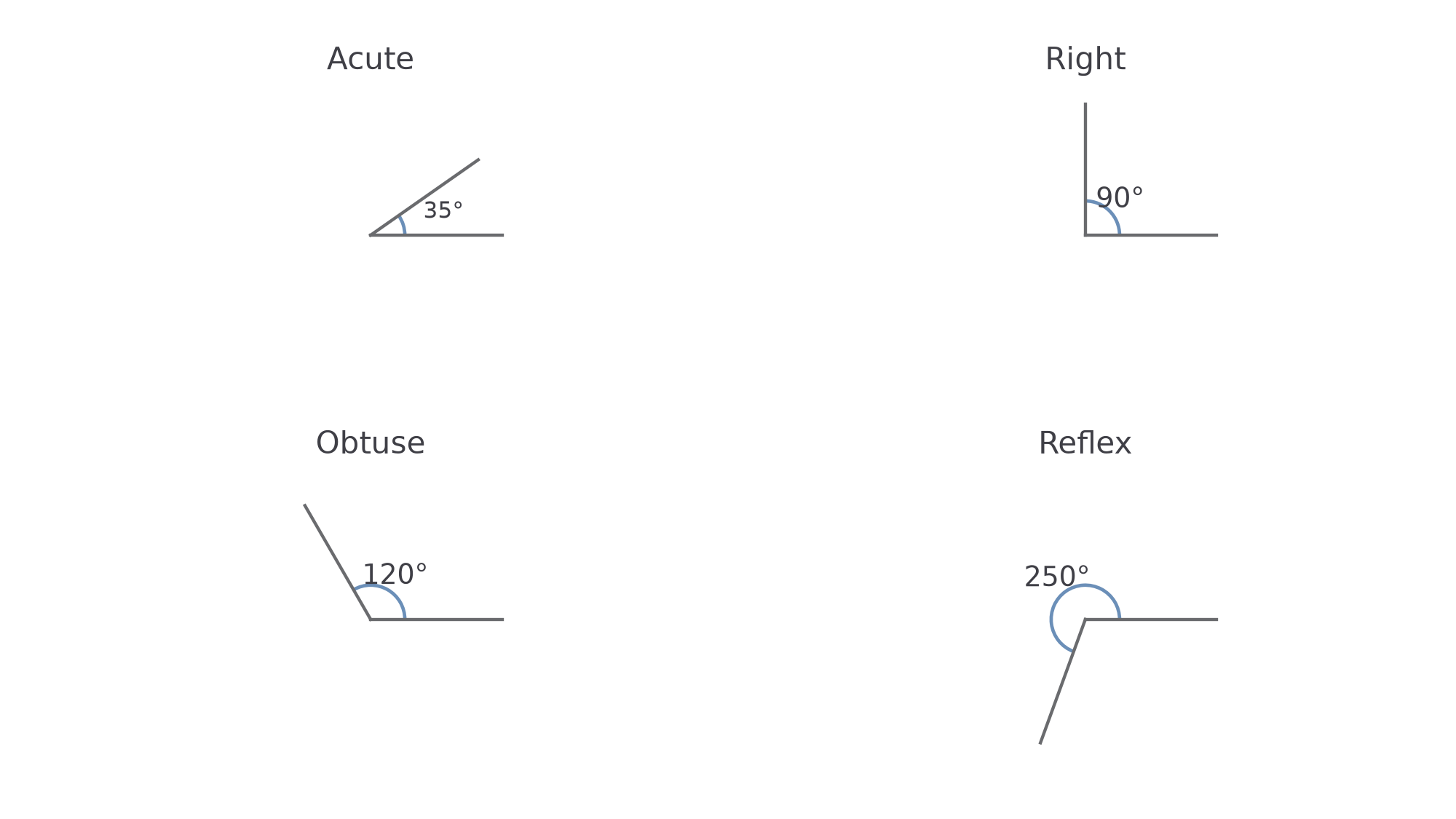
The reflex turn shown is ; the other turn is , which is obtuse. Notice the boundaries: is right, not acute or obtuse. These angle facts are absent from both the Foundation and Higher formulae sheets: learn them.
Key idea
Classify the marked turn, not the length or direction of its rays.
Use the strict boundaries in the table for this check.
Angles on and around straight lines
Straight lines give you a fixed total. Adjacent angles filling one side of a line have no gaps or overlaps, so they make a half turn. Angles filling a full turn around a point have total .
Line and point angle facts
The angles must fill the stated turn exactly. For Foundation and Higher: Not in the formulae sheet: learn it.
When two straight lines cross, vertically opposite angles face each other across the vertex. They are equal: each is minus the same neighbouring angle. Adjacent angles are beside each other, not vertically opposite.
[DIAGRAM: asset_slug: line_angles_examples; caption: Crossing lines and a divided straight angle; description: Left and centre panels have intersecting lines with given angles 63 and 73 degrees and unknown opposite and neighbouring angles. Right panel has adjacent angles 48, 79 and x degrees on a straight line; file: line_angles_examples.png; recommended_method: matplotlib]
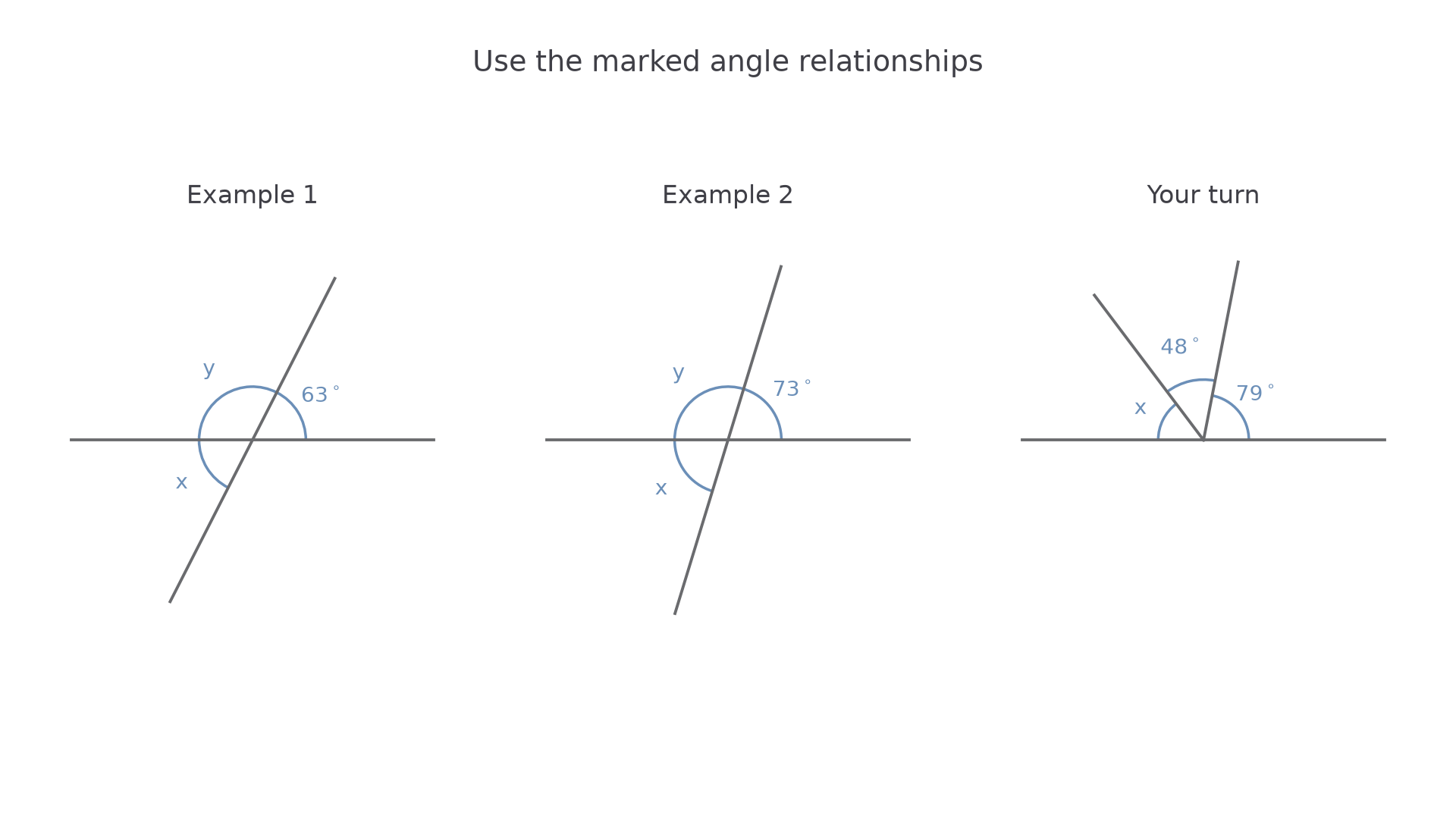
Use the left panel first. The two unknowns need different reasons.
Worked example 1: crossing lines
Question. Two straight lines intersect. One angle is . Find the vertically opposite angle and its neighbouring angle .
Plan. Use equality across the vertex, then a straight-line total.
Why these rules? faces the given angle; shares a side with it and completes a half turn.
Answer. , .
Check. All four angles total .
Change only the given angle to , as in the centre panel. The relationships stay the same.
Worked example 2: the same crossing, a new angle
Question. Two straight lines intersect. One angle is . Find its vertically opposite angle and neighbouring angle .
Plan. Copy the opposite angle and subtract from the half turn for the neighbour.
Why subtract? The two adjacent angles fill a straight angle; they are not equal partners.
Answer. , .
Check. .
The same subtraction works when more than two angles divide the half turn. For a full turn, start from instead; for example, three equal angles around a point are each .
Watch out
The line is wrong for a neighbour of the given angle. Neighbours here are supplementary: .
For a reason mark, write the full relationship, such as “angles on a straight line sum to ”. A letter pattern or “it looks equal” does not justify a result.
Angles between parallel lines
Parallel lines stay the same distance apart and never meet when extended. A transversal crosses them. A statement or matching arrows establish parallelism; their appearance alone does not.
Parallel-line angle pairs
Corresponding angles occupy the same position at the two crossings and are equal. Alternate interior angles lie between the lines, on opposite sides of the transversal, and are equal. Allied angles, also called co-interior angles, lie between the lines on the same side of the transversal and sum to .
The familiar F, Z and C patterns help you locate a pair. The reason you write is the angle relationship and the parallel lines. All three rules are absent from both the Foundation and Higher formulae sheets: learn them.
[DIAGRAM: asset_slug: parallel_angles; caption: Parallel lines crossed by a transversal, with angles in different positions; description: Lines l and m are parallel. Upper top-right angle is 72 degrees, upper bottom-right a, lower top-right b and lower top-left c. This is a schematic relationship diagram, not a measuring task; file: parallel_angles.png; recommended_method: matplotlib]
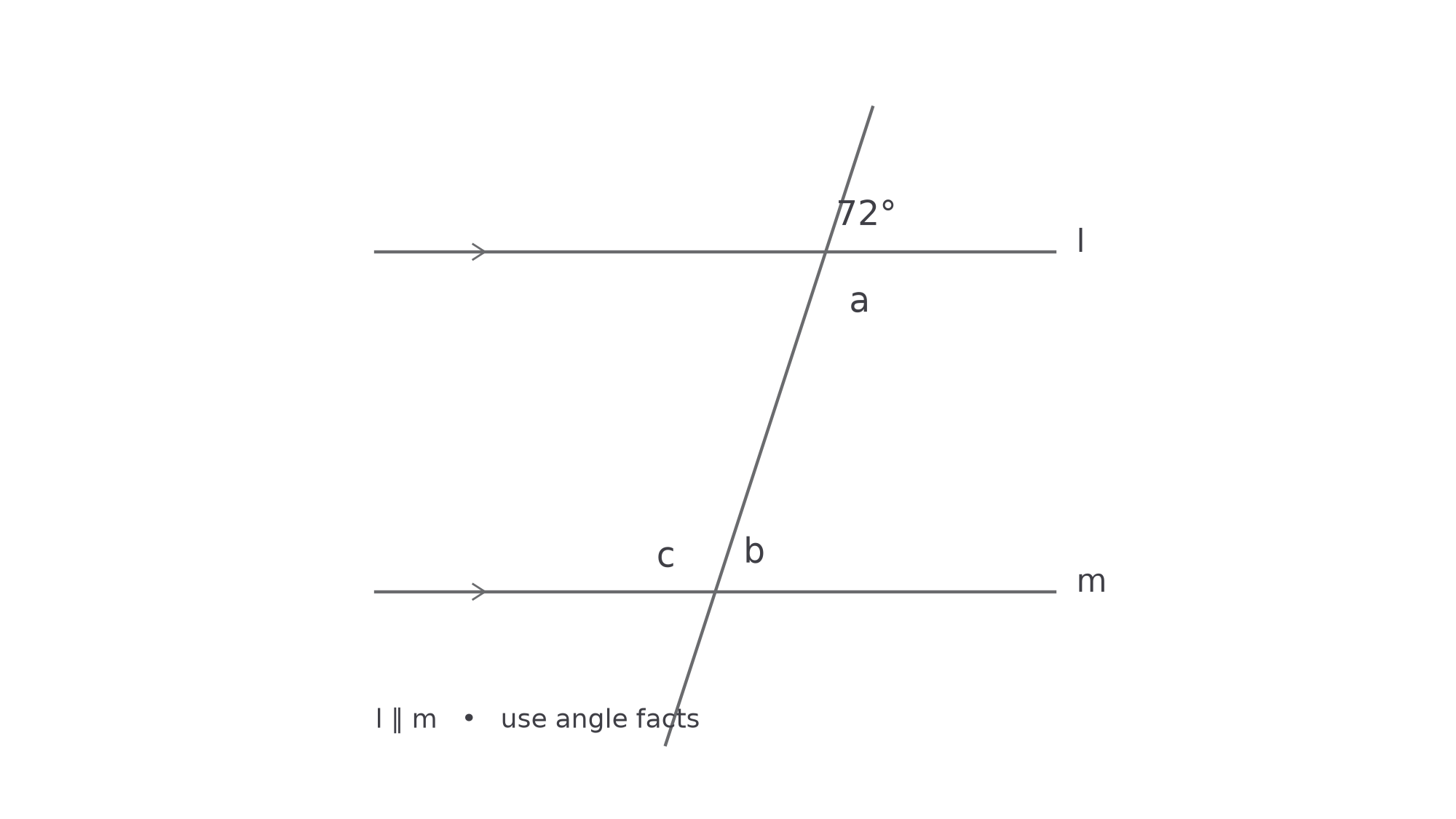
Start with the labelled positions in this figure rather than guessing a letter shape.
Continue this lesson.
You’re previewing NovaLearn without an account. Create a free account to read the rest.
Create free account