3.3 - Sine, cosine and tangent graphs
Sine, cosine and tangent keep working after an angle passes a full turn. You will draw their graphs in degrees, recognise their repeating patterns and find all the angles that give a chosen output. Keep your calculator in degree mode throughout.
The sine graph (Higher)
How can an angle of give the same sine as ? Imagine a point turning round a circle of radius . After one complete turn it is back in the same place, so another quarter turn reaches the same height as the first quarter turn.
You already know
In a right-angled triangle, sine is opposite divided by hypotenuse. Coordinates describe a point's horizontal and vertical position. A full turn is .
The circle picture extends the triangle ratio: sine is the vertical coordinate of the turning point. It can be negative below the horizontal axis. The output is a ratio, so it has no length unit.
Period
A graph's period is the smallest positive input change that repeats the whole graph. Sine has period . Its domain is all real degree angles and its range is .
Start a drawing with the values below. Label a regular degree scale, plot the points, then join them with a smooth wave. Use extra calculator values between them if you need help with the shape. Peaks and troughs are rounded, with horizontal tangents.
| in degrees | |||||
|---|---|---|---|---|---|
[DIAGRAM: asset_slug: m052_sine; caption: Sine repeats every 360 degrees, including negative and larger angles; description: Exact degree-mode y=sin x from negative 360 to 720 with outputs between negative 1 and 1 and key points every 90 degrees; file: m052_sine.png; recommended_method: matplotlib]
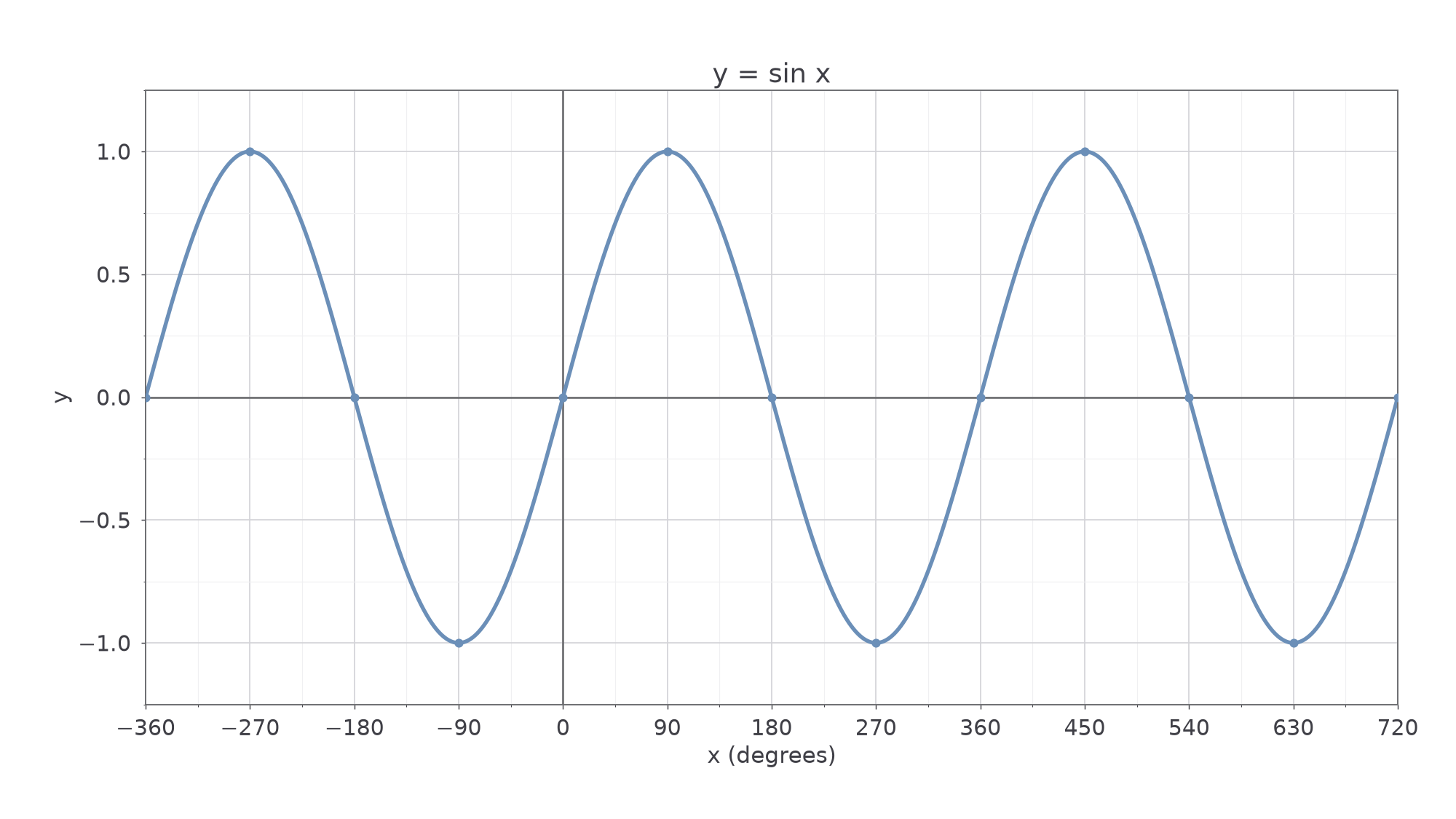
The picture repeats to the left as well as the right. Sine is positive in the upper half-turn and negative in the lower half-turn.
Sine cycles
These hold for every real degree angle. They are not in the Higher formulae sheet: learn them. This lesson is Higher only.
Use the cycle to turn a large angle into a familiar one.
Worked example 1: another full turn
Question. Find .
Plan. Remove one full turn, then use a key point.
Why this step? A full turn returns the circle point to the same height.
Answer. .
Check. The graph has a peak at , and sine cannot exceed .
Change only the direction of the angle next. Turning backwards reverses the vertical coordinate for sine.
Worked example 2: a negative input
Question. Find .
Plan. Use the sign relationship, then the same full-turn reduction.
Why this step? Sine measures height, which changes sign when the circle point is reflected below the horizontal axis.
Answer. .
Check. Adding gives , where the graph has value .
A useful surprising fact is that sine can distinguish opposite directions even when the angle sizes are equal: , but .
Watch out
The line is wrong: removing a zero is not removing a turn. Subtract , giving , not .
Try the same idea with a different negative input.
The cosine graph (Higher)
Cosine gives the horizontal coordinate on the same unit circle. At zero angle the point is at the rightmost edge, so cosine starts at , while sine starts at .
Cosine graph
The graph has domain all real degree angles, range and period . Its symmetry about the vertical axis means .
Plot these key points, join smoothly and repeat the cycle. The first minimum is at ; the first two zeros are at and .
| in degrees | |||||
|---|---|---|---|---|---|
[DIAGRAM: asset_slug: m052_cosine; caption: Cosine starts at a maximum and is symmetric about the vertical axis; description: Exact y=cos x in degrees from negative 360 to 720, period 360 and range negative 1 to 1; file: m052_cosine.png; recommended_method: matplotlib]
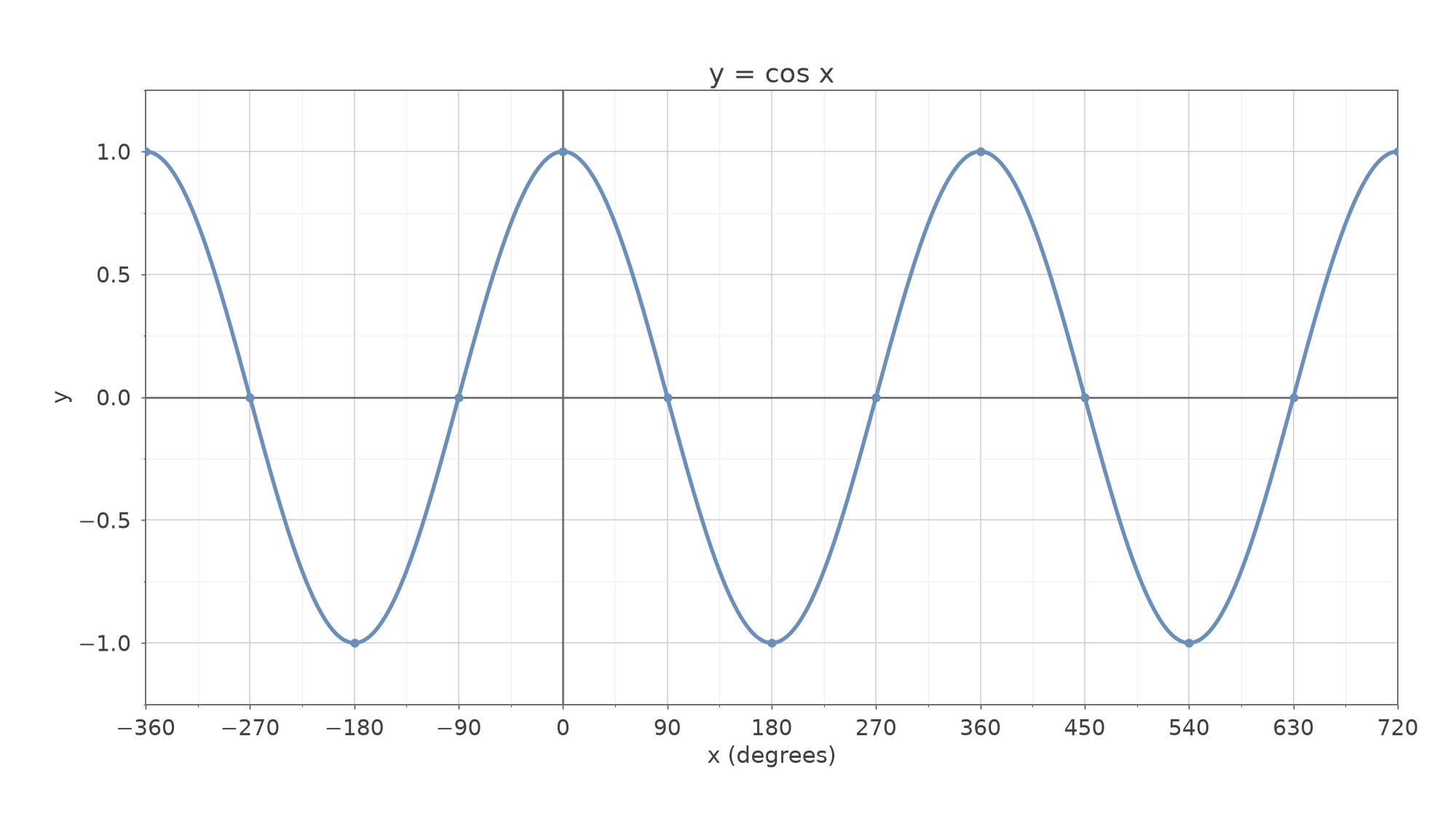
Cosine's cycle and symmetry facts are not in the Higher formulae sheet: learn them. Negative input does not automatically mean negative output.
Worked example 3: cosine at a negative angle
Question. Find .
Plan. Use cosine's symmetry, then a familiar circle position.
Why this step? Opposite rotations have the same horizontal coordinate.
Answer. .
Check. Degree-mode calculation gives , within the permitted range.
Keep the same angle size within a cycle, but add two full turns to the input.
Worked example 4: a negative angle beyond a cycle
Question. Find .
Plan. Add complete turns until the input becomes familiar.
Why this step? Periodicity changes the input while leaving the output unchanged.
Answer. .
Check. Adding a further gives , another point with cosine .
Both examples have negative outputs because their circle points are on the left, not because their inputs are negative.
Watch out
incorrectly uses sine's sign rule. Cosine is symmetric: .
Check a new cycle position and its zeros.
Continue this lesson.
You’re previewing NovaLearn without an account. Create a free account to read the rest.
Create free account