4.7 - Chains of geometrical reasoning
An angle answer becomes convincing when each step has a reason. You will connect facts about lines, triangles and polygons to find missing values. You will also use chord and tangent facts, with circle-angle reasons in the Higher section.
Link a value to its reason
An isosceles triangle has a base angle of . Can you find its exterior angle without measuring the drawing, and convince someone your answer must be right? First, practise attaching a reason to a value.
You already know
Angles on a straight line total , and angles around a point total . Triangle angles total . In , the middle letter names the vertex.
“I subtracted” describes arithmetic. “Angles around a point total ” explains why the subtraction works. Appearance alone does not establish equal lengths, parallel lines or right angles.
Geometrical reason
A geometrical reason is a property that justifies a deduction. For example, vertically opposite angles are equal when two straight lines intersect. “They look equal” is not a geometrical reason.
Choose a property whose conditions are given or already deduced. These properties are absent from both the Foundation and Higher formulae sheets: learn them.
| Established situation | Useful reason |
|---|---|
| A straight line or full turn | Angles total or , respectively. |
| Two intersecting straight lines | Vertically opposite angles are equal. |
| A transversal crosses parallel lines | Alternate or corresponding angles are equal; co-interior angles total . |
| An isosceles triangle | Angles opposite the equal sides are equal. |
| An -sided polygon | Interior angles total . |
| Radius and tangent at the contact point | They meet at . |
| Perpendicular from centre to chord | It bisects the chord. Conversely, the perpendicular bisector of a chord passes through the centre. |
| Two tangents from one external point | Their lengths are equal. |
Worked example 1: a full turn
Question. Two angles that complete one turn are and . Find , giving a reason.
Plan. Subtract the known angle from the full-turn total.
Why this total? The angles complete a full turn rather than a straight line.
Answer. , because angles around a point total .
Check. .
Change only the known angle to . The reason stays the same; the remaining angle gets smaller.
Worked example 2: a changed angle
Question. Two angles that complete one turn are and . Find , giving a reason.
Plan. Use the full-turn total again.
Why keep the reason? The size changed, but the arrangement still completes a full turn.
Answer. , using angles around a point.
Check. .
A correct number with an unrelated reason does not justify a result.
Watch out
The line is wrong here: these angles complete a turn, not a straight line. Use .
Change only the supplied angle again.
Build and check a linked chain
A chain uses one justified result as the starting point for the next. Name each intermediate angle so your reader knows where each number belongs.
[DIAGRAM: asset_slug: m068_foundation_chain; caption: Isosceles triangle ABC, straight extension B–C–D and parallel line E–A–F; description: AB equals AC. B, C and D are collinear, and EF through A is parallel to BC. The figure is schematic; file: foundation_chain.png; recommended_method: matplotlib]
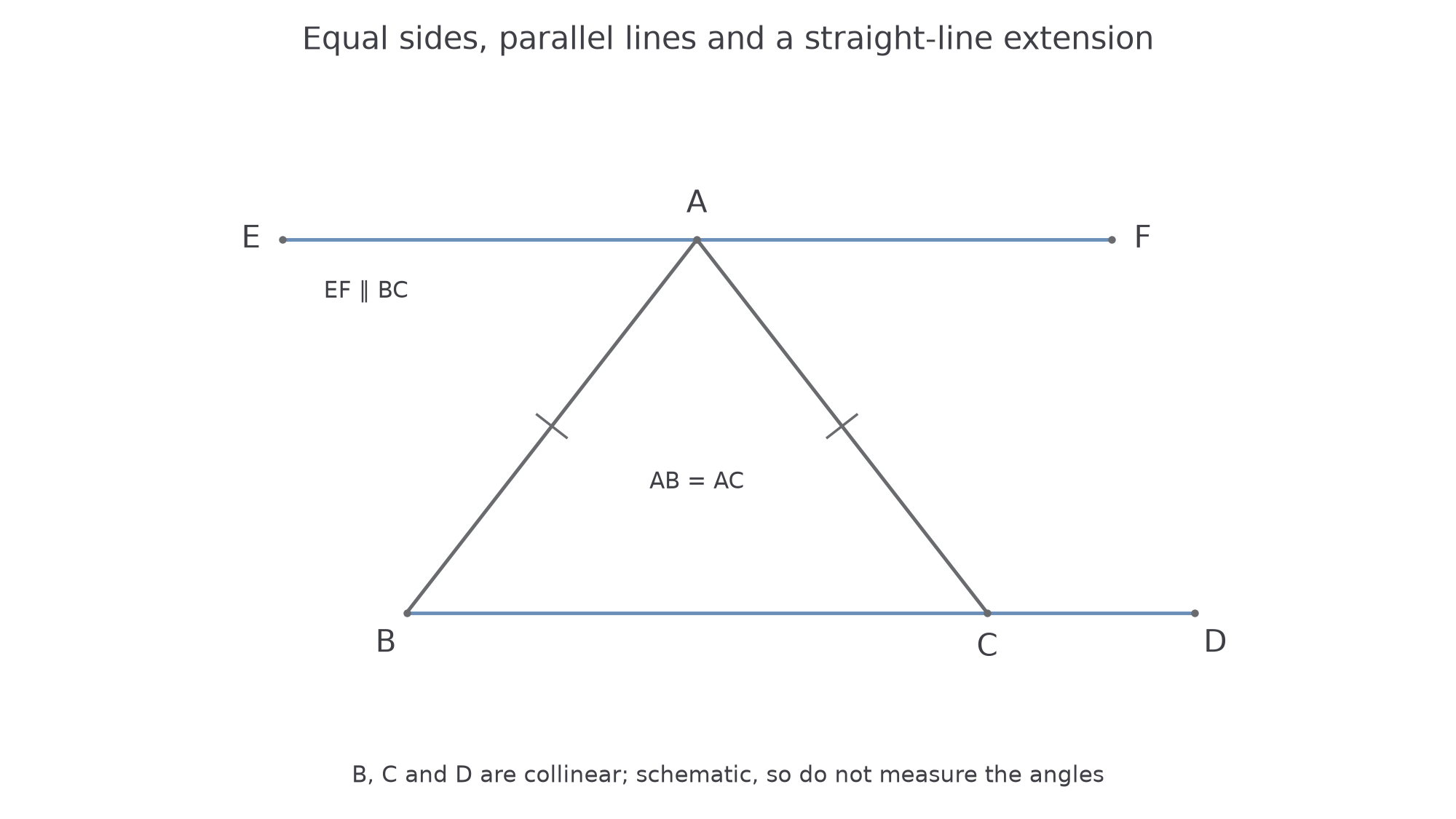
The equal sides and face the angles at and . The line also crosses the parallel lines and . This transversal lets you carry the angle at up to .
Worked example 3: equal sides, then angle totals
Question. In the figure, , are collinear, and . Given , find , and , giving reasons.
Plan. Find the other base angle, then use the triangle, straight line and parallel lines.
Why start with ? Equal sides give it immediately; that value unlocks the later steps.
Answer. The requested angles are , and , respectively.
Check. , and the exterior angle is .
There is a useful surprise in that check: a triangle's exterior angle equals the sum of its two remote interior angles. If those are and , the third is . Its exterior angle is . This follows from angle totals, rather than measuring a picture.
Change only the given base angle to . Keep the same diagram conditions.
Worked example 4: carry a changed base angle through
Question. Under the same figure conditions, . Find , and , giving reasons.
Plan. Repeat the equal-angle deduction before using the angle totals.
Why not use at ? The interior and exterior angles together make a straight angle.
Answer. The angles are , and .
Check. The remote angles give .
Continue this lesson.
You’re previewing NovaLearn without an account. Create a free account to read the rest.
Create free account