1.5 - Sets and Venn diagrams
Sets give you a precise way to sort objects into groups. You will describe membership, select unions, intersections and complements, and place elements in Venn diagrams. The same language works for numbers, letters and people.
Sets and membership
Where should go if one circle means “even numbers” and another means “prime numbers”? And where should go? You will build a diagram that gives both numbers exactly one home.
You already know
An even integer is divisible by . A prime number has exactly two positive factors, and itself, so is not prime.
Start with the primes below : . Everyone using this rule obtains the same collection. “Nice numbers” is different: without a rule for “nice”, you cannot decide which numbers belong.
Set and element
A set is a well-defined collection of distinct objects. Each object in it is an element. Write the elements in braces, for example . Then means “ belongs to ”, and means “ does not belong to ”.
Order does not matter: and are the same set. Repeating an entry changes nothing either: . A set records whether an object belongs, not how often it was written.
There is a neat reason why the opening number is special: it is the only even prime. Any even integer larger than has as a factor in addition to and itself, so it is not prime. Set notation is not supplied on either the Foundation or Higher formulae sheet.
Key idea
Membership is a yes-or-no decision about one object and one set. Braces describe the collection; and describe whether an object belongs.
Check the actual entries before choosing a symbol. A number's size does not decide whether it belongs.
The universe and complements
“Not in my group” needs a boundary. If your problem considers only the integers from to , an answer cannot suddenly include .
Universal set and empty set
The universal set, , contains every object being considered. The empty set, , contains no elements. For example, there are no multiples of in . The set is not empty: it contains the element .
Once you know the boundary, you can say exactly what lies outside a particular set.
Complement
The complement contains the elements of that are not in . For example, if and , then .
To find a complement, work through the universal set and remove every member of the named set. The rule for complements is not supplied on either tier's formulae sheet.
Worked example 1: stay inside the universe
Question. Find for and .
Plan. Start with the universe and keep only the entries not in .
Why start with ? The complement is the rest of this universe, not every other number that exists.
Answer. .
Check. The two lists have no shared entry, and together they contain every entry of .
Change only the universe by adding . The set stays the same, but its complement changes.
Worked example 2: change the boundary
Question. Find for and .
Plan. Remove the same entries from the enlarged universe.
Why include now? It is in the new universe and is not in .
Answer. .
Check. Every integer from to appears in exactly one of and .
An empty result and a result containing zero have different meanings.
Watch out
The line is wrong. The left side has no element; the right side contains . If nothing remains after removing a set from the universe, write .
For your turn, change the universe once more and keep the same set to remove.
Union and intersection
Two sets can share members. You need different instructions for selecting their shared members and for collecting everything in either set.
Intersection and union
The intersection contains elements in both sets. The union contains elements in at least one set, including those in both. For and , the shared entries are and .
Think “both” for an intersection and “either or both” for a union. Write every selected element once. These operations are not supplied on either tier's formulae sheet.
Worked example 3: select both or either
Question. For and , find and .
Plan. First find entries common to the lists; then combine the lists without repeats.
Why keep and in the union? Belonging to both still satisfies “at least one”.
Answer. , .
Check. Every intersection entry lies in both original sets; every union entry appears in an original list.
Change only the final entry of , from to . One shared member disappears, while a new union member appears.
Worked example 4: one entry changes
Question. For and , find and .
Plan. Test common membership, then collect all distinct entries.
Why is still in the union? It belongs to ; union membership does not require both sets.
Answer. , .
Check. Only is repeated across the two original lists, and it is written just once in each answer.
If no elements are shared, the sets are disjoint and their intersection is . With complements, means “in , but not in ”, while means “in neither”. Brackets show what the complement applies to.
Watch out
Writing for the sets in Worked example wrongly removes the shared entries. A union includes the overlap. The correct union is .
This time change one entry of . Use the same two selection rules.
Representing sets in Venn diagrams
A Venn diagram turns membership rules into positions. Draw a rectangle for and labelled closed curves for the sets. Inside a circle means “belongs”; outside it means “does not belong”. The overlapping region belongs to both sets.
Draw enough space for every region, then put shared elements in the overlap first. Next fill each “only” region. Finally put elements in neither set inside the rectangle but outside both circles. Circle areas do not measure the size of the sets.
Worked example 5: give every element one home
Question. Represent , and in a Venn diagram.
Plan. Draw and label the rectangle and two overlapping circles, then fill the shared, only and neither regions.
Why place only once? A point in the overlap is already inside both circles.
Answer. The labelled diagram below represents the three given sets.
Check. Read the whole of each circle, including its overlap: you recover and . All eight universe elements appear once.
Here is the completed construction. It answers the opening puzzle: is even and prime, while is neither.
[DIAGRAM: asset_slug: sets_venn_elements; caption: Each of the eight elements occupies exactly one region; description: Rectangle E contains overlapping circles A and B. A only contains 4,6,8, overlap contains 2, B only contains 3,5,7 and outside both contains 1. Positions are set membership, not numerical scale.; file: sets_venn_elements.png; recommended_method: matplotlib]
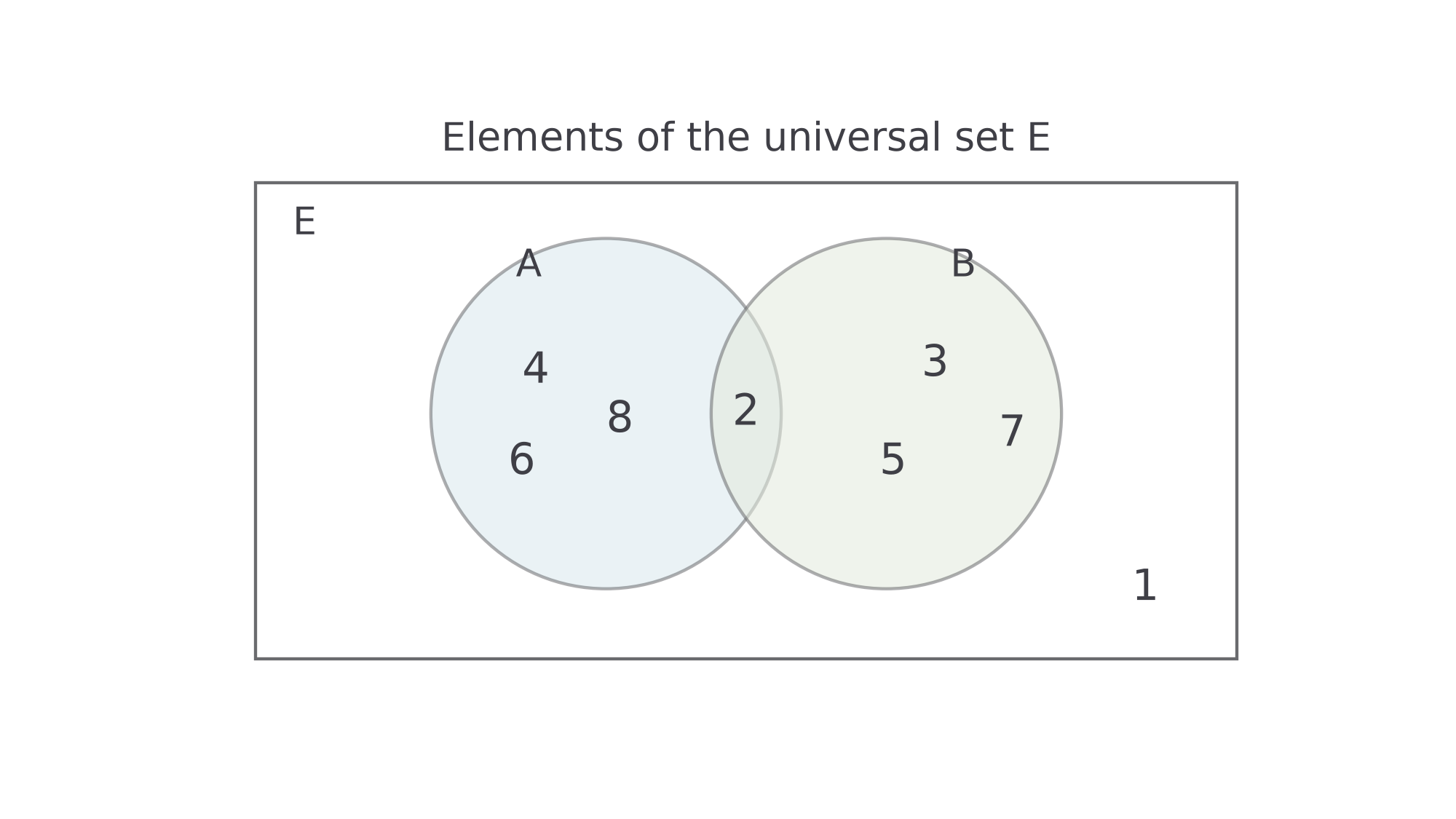
Now change only one entry of , replacing with . The sets become disjoint, so draw separate circles rather than an overlap containing a member.
Worked example 6: represent disjoint sets
Question. Represent , and in a Venn diagram.
Plan. Draw two separate labelled circles in the universal rectangle, then place the members of each set.
Why separate the circles? It makes the absence of shared members clear. Overlapping circles with an empty intersection would also represent these sets correctly.
Answer. Put inside , inside , and nothing outside the circles.
Check. The two lists together account for all eight elements, with no repeat.
If a whole set belongs inside another, draw its curve wholly inside the other's curve. In every case, it is membership, rather than the shape or size of a circle, that decides placement.
Watch out
Putting in the -only region and another in the -only region misrepresents Worked example . Both positions claim “not in the other set”. Put one in the overlap instead.
Use the same region method with the universe enlarged by one element. A short list for each region lets you check a diagram you draw on paper.
Quick Recap
- A set has distinct elements; and describe membership.
- The universal set sets the boundary; selects its members outside .
- An intersection means both; a union means either or both.
- In a Venn diagram, place every element once and include the overlap when reading either circle.
In the opening puzzle, belongs in the overlap of the even and prime sets. The number goes outside both circles, but inside the universal rectangle.