4.4 - Speed, density and pressure
You will calculate average speed, density and pressure using quantities with matching units. You will also rearrange the relationships and explain what happens when one quantity changes. These compound measures describe an amount per unit of something else; the pressure formula is supplied in questions when needed.
Average speed, distance and time
You drive at , then another at . Is the whole-journey average , halfway between the two speeds? We will find out by keeping track of time.
You already know
You can divide to find an amount per unit and rearrange a simple formula. and .
If you cover in one hour, you average . “Per hour” gives a unit rate: the journey need not last exactly one hour or keep the same speed throughout.
Average speed
Average speed is total distance divided by the elapsed time for the stated journey. Use a positive elapsed time and compatible distance and time units.
Multiplying the rate by time gives distance. Rearranging the same relationship gives the time needed at a known average speed.
Speed, distance and time
Here is average speed, is distance and is time; use when dividing by it. For Foundation and Higher: Not in the formulae sheet: learn it.
Kilometres divided by hours gives ; metres divided by seconds gives . Convert a mixed time to a single unit before dividing.
Worked example 1: convert the time before dividing
Question. A bus travels in hour minutes. Find its average speed in .
Plan. Express the time in hours, then divide distance by time.
Why divide by ? The speed is requested per hour, so the denominator must be hours.
Answer. .
Check. , the given distance.
Change only the distance from to . The time stays the same, so the speed should increase.
Worked example 2: more distance in the same time
Question. A bus travels in hour minutes. Find its average speed in .
Plan. Keep the time conversion and use the new distance.
Why does speed increase? More distance in the same number of hours means more kilometres per hour.
Answer. .
Check. .
To find time instead, divide distance by speed: hour minutes. As another unit-rate example, a cyclist covering in minutes averages .
Watch out
The line treats minutes as hundredths. Correct it to before dividing.
Keep the same time and change only the distance again.
Speed units and whole journeys
A speed has two units. To convert it, change both the distance unit and the time unit. One hour contains seconds, so a distance travelled in an hour must be divided by to get the distance per second.
Converting speed units
For Foundation and Higher: Not in the formulae sheet: learn it.
For example, . Reversing gives . Similarly, . If the speed is , the same reasoning gives ; using a letter does not change the conversion.
For a journey with several legs, add all distances and all times in the stated journey. If a leg's time is unknown, calculate it using distance divided by speed first. A stop adds elapsed time but no distance. Whole-journey average speed is total distance divided by total elapsed time.
[DIAGRAM: asset_slug: journey_timeline; caption: The same two travel legs with different stop durations; description: Three timelines show 36 km in 45 minutes, a stop of 15, 45 or 30 minutes, then 24 km in 30 minutes. Horizontal segment widths are proportional to elapsed minutes; file: journey_timeline.png; recommended_method: matplotlib]
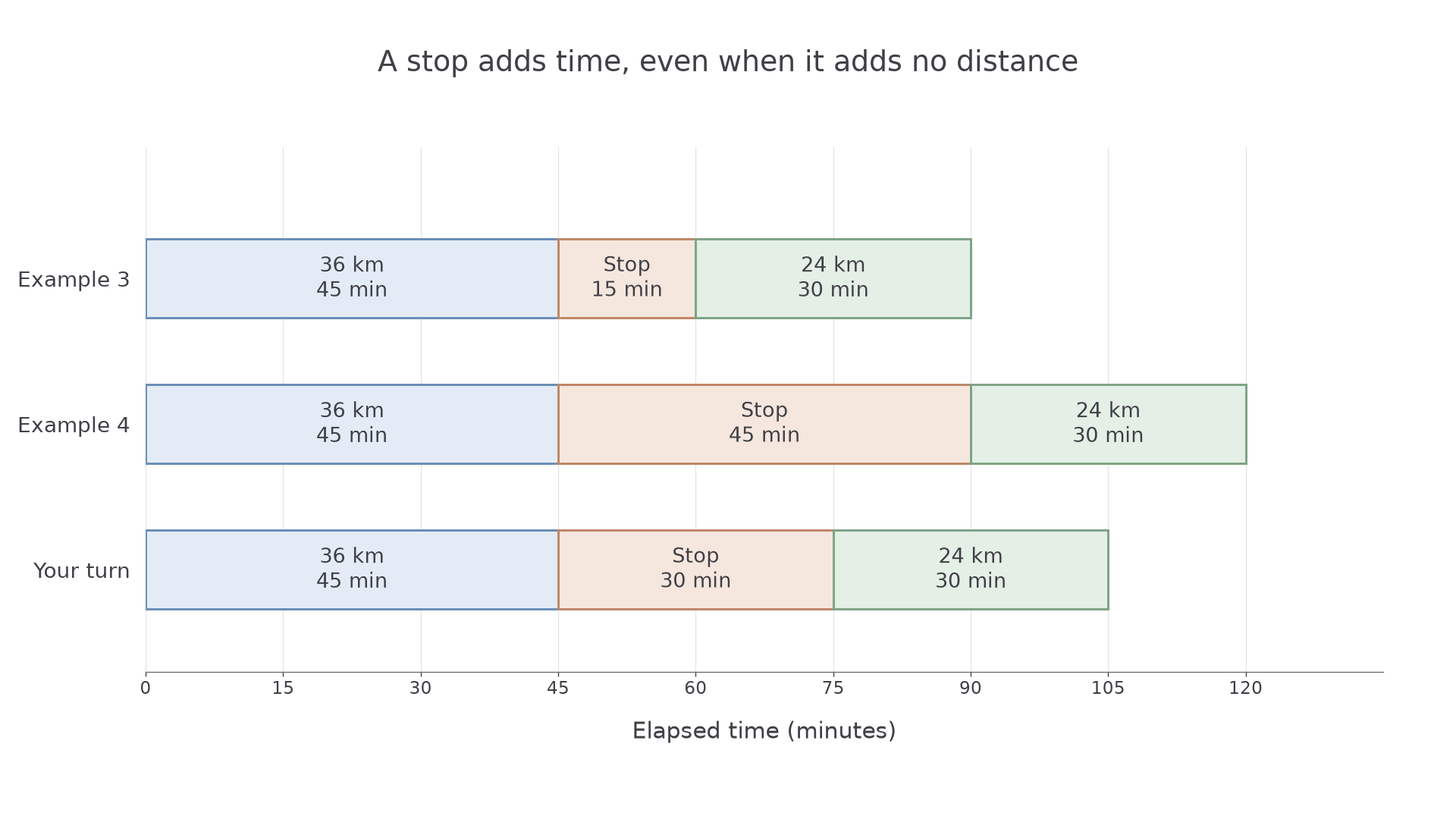
The first row includes the stop, so it belongs in the denominator.
Worked example 3: include the stop
Question. A journey covers in minutes, stops for minutes, then covers in minutes. Find the average speed for the whole journey.
Plan. Add the distances and elapsed times, including the stop, then divide.
Why include the stop? “Whole journey” measures the time from departure to final arrival, including that interval.
Answer. .
Check. . Excluding the stop would give , a different average for moving time only.
Change only the stop duration, from minutes to minutes. The travel legs stay the same.
Worked example 4: a longer stop
Question. A journey covers in minutes, stops for minutes, then covers in minutes. Find its whole-journey average speed.
Plan. Keep the total distance and increase the elapsed time for the longer stop.
Why is the average lower? The same distance now uses more elapsed time.
Answer. .
Check. , and , consistent with the longer stop.
The opening journey reveals a useful surprise: even equal distances do not justify averaging the two speeds. The first takes hour; the second takes hours. Therefore the average is , not . You spend twice as long at the slower speed. The arithmetic mean of speeds works for equal time intervals, because each speed then contributes distance for the same length of time.
Watch out
The line is wrong for the equal-distance opening journey. Use .
In the last timeline, change only the stop to minutes. Keep full calculator precision until the final rounding.
Continue this lesson.
You’re previewing NovaLearn without an account. Create a free account to read the rest.
Create free account