4.9 - Perimeter and area of polygons
Measure the boundary and the region inside a shape, then use the right units for each. You will convert measurements, choose areas for triangles and quadrilaterals, and work out how much material a compound shape needs.
Metric length and area
Can cutting a corner off a rectangular card reduce its area while leaving its perimeter unchanged? We will test this with a by card and a by corner cut. First, separate the two things we are measuring.
Perimeter and area
Perimeter is the total length around a shape's boundary. Area measures the region it covers, in square units. A square centimetre is the area of a square with side ; it is not a length of .
You might buy ribbon by length to go around a card, but paint by area to cover it. The unit tells you which kind of measurement you need.
You already know
, and . Smaller units fit more times into the same measurement.
Area conversions use the length factor twice. A square of side has rows of square centimetres. Thus . Similarly, , , and . Metric conversion factors are absent from both tier formula sheets; learn the length relationships and square their factors for area.
Worked example 1: from metres to centimetres
Question. Convert to centimetres and to square centimetres.
Plan. Multiply the length by , and the area by .
Why use different factors? Area contains two length directions; each changes by .
Answer. and .
Check. Dividing by and , respectively, returns in the starting units.
Change only the starting unit from metres to centimetres. We now convert towards larger units, so the operations reverse.
Worked example 2: from centimetres to metres
Question. Convert to metres and to square metres.
Plan. Divide by the matching length and area factors.
Why divide? A larger unit covers more, so fewer of those units are needed.
Answer. and .
Check. Multiplying the answers by the respective factors returns .
Make all lengths use one unit before multiplying them in an area formula.
Watch out
is wrong: only one direction has been converted. The correct factor is , so .
Try one length and one area conversion, keeping their factors separate.
Tracing the perimeter
Imagine walking once around the edge of the card. Your route includes every exposed side, including the sides of the cut-out corner.
For a rectangle, the two pairs of equal sides give . For a triangle, add its three sides. For example, sides give perimeter . These relationships are absent from both tier formula sheets; learn them. A triangle's internal perpendicular height is not another boundary side.
A compound shape joins simpler shapes. A shared edge inside the joined region is not part of the outside perimeter. If you add the separate perimeters, subtract the shared length twice, because it was counted in each shape.
[DIAGRAM: asset_slug: m074_compound_boundary; caption: Six boundary segments of an L-shaped card; description: A 12 by 8 rectangle loses its top-right 5 by 3 corner. Remaining right vertical is 5 and top horizontal is 7. Dashed lines belong to the removed corner, not the boundary; file: m074_compound_boundary.png; recommended_method: matplotlib]
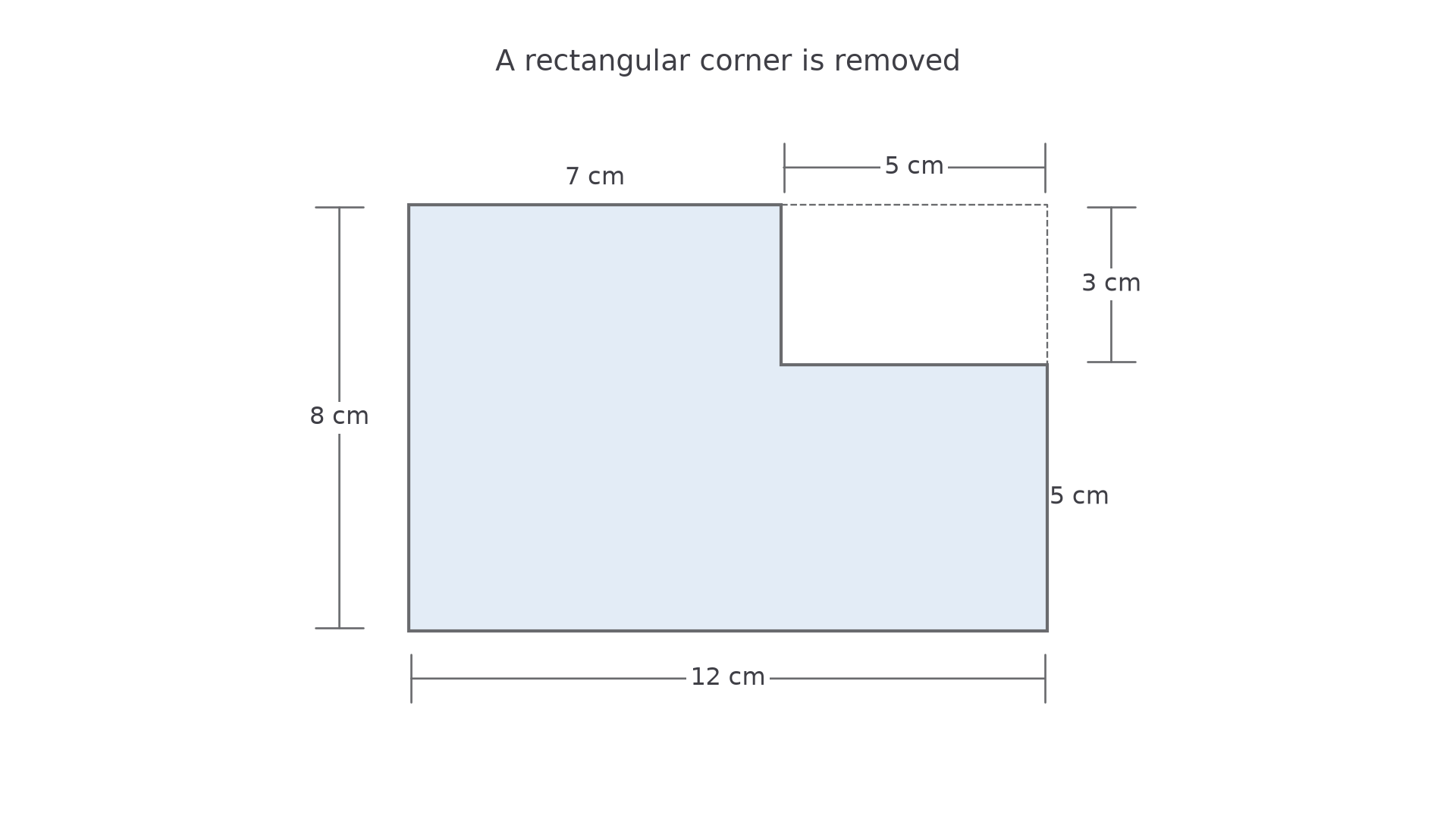
Use subtraction to find missing horizontal or vertical lengths. Do not measure a drawing when dimensions are given.
Worked example 3: the card's new boundary
Question. A by rectangle loses a by rectangle from its top-right corner. Find the remaining perimeter.
Plan. Find the two remaining outside lengths, then trace all six boundary segments.
Why include the cut edges? They now separate the card from the empty region, so they are exposed boundary.
Answer. The perimeter is .
Check. The original rectangle had perimeter . The cut replaces lengths by new edges totalling .
Change only the cut's height from to . Two boundary lengths change in opposite directions.
Worked example 4: a deeper corner cut
Question. The same by card instead loses a by top-right corner. Find its perimeter.
Plan. Keep the outside dimensions and update the cut's vertical lengths.
Why is the perimeter unchanged again? The lost outside horizontal and vertical lengths are replaced by equal total lengths inside the corner.
Answer. .
Check. This still equals . The argument depends on a rectangular corner cut; a notch in the middle of a side adds extra boundary.
The same tracing habit works when you join a triangle to a rectangle: omit their shared side and include the exposed sloping sides.
Watch out
For a by rectangle joined along a side to a triangle with other sides , double-counts the join. Correct it to .
Try a new card size. Find any missing boundary lengths before adding.
Rectangles and triangles
Area counts the region inside the boundary. A rectangle can be filled with rows of unit squares. A triangle with the same base and perpendicular height covers half the corresponding parallelogram.
Rectangle and triangle areas
For a triangle, meets the base or its extension at . For a square, . These results are absent from both tier sheets. Not in the formulae sheet: learn it.
Two congruent triangles can form a parallelogram, explaining the half factor. The height may lie outside an obtuse triangle. Any side may be the base, provided you use its matching perpendicular height. A sloping side is not automatically that height.
Worked example 5: rectangle and triangle areas
Question. Find the areas of (a) a by rectangle and (b) a triangle with base and perpendicular height .
Plan. Multiply the rectangle dimensions; halve base times height for the triangle.
Why halve only the second product? Only the second region is triangular.
Answer. (a) ; (b) .
Check. Two such triangles have area .
Change only the triangle's height from to . The rectangle is unchanged.
Worked example 6: doubling the triangle's height
Question. Find the areas of (a) the same by rectangle and (b) a triangle with base and perpendicular height .
Plan. Keep the rectangle calculation and update the triangle's height.
Why does the triangle's area double? Its base and half factor stay fixed while its perpendicular height doubles.
Answer. (a) ; (b) .
Check. , matching the height change.
A distracting sloping side should not change your base-height choice.
Continue this lesson.
You’re previewing NovaLearn without an account. Create a free account to read the rest.
Create free account