4.10 - Prisms, cylinders and volume units
Find the space inside prisms and cylinders, choose which cylinder surfaces to count, and convert volumes into capacities. These methods help you decide how much a container holds and how much material covers it.
Volume of a prism
Can a tank with internal dimensions , and hold litres? First we need a way to measure the space inside it.
You already know
A rectangle has area ; a triangle has area , using perpendicular height. Multiplying three lengths gives cubic units.
Start with a cuboid measuring by by . Each -thick layer contains unit cubes. Eight layers contain unit cubes, so the volume is .
Prism and cross-section
A prism has two congruent, parallel polygonal ends and an unchanged cross-section along its length. A cross-section is the shape of a cut perpendicular to that length. A triangular prism is an example; a cone tapers, so it is not a prism.
The stacking argument works for any cross-section with a known area. Use the distance between the identical ends, rather than a sloping edge of an end face.
Volume of a prism
Here is the cross-sectional area and is the length between the ends. On both Foundation and Higher sheets: volume equals area of cross-section times length. In the formulae sheet.
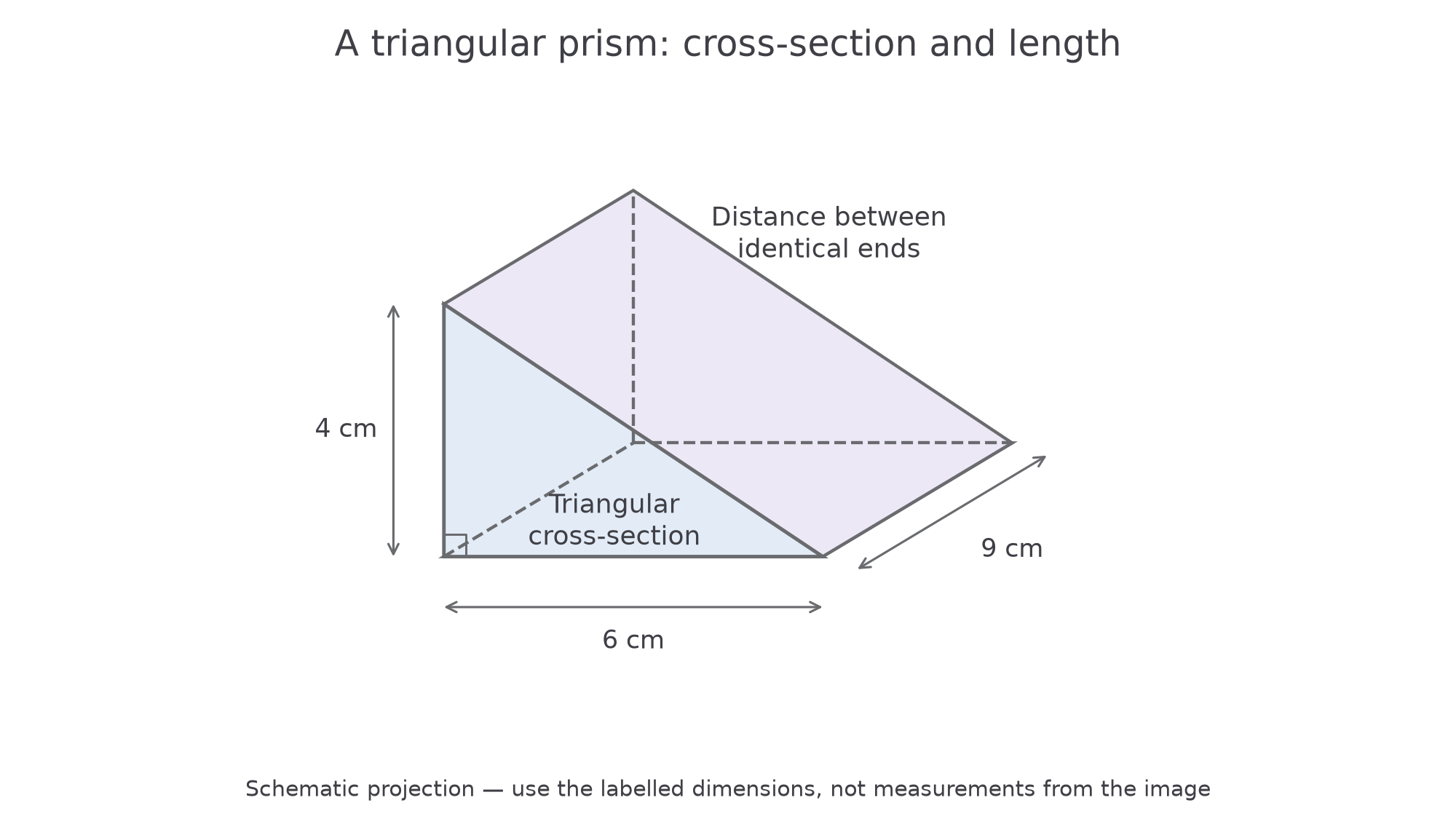
The shaded triangle below is one whole end. Its two perpendicular dimensions find the area; the separate dimension supplies the prism length.
[DIAGRAM: asset_slug: m078_prism; caption: A triangular cross-section and the separate prism length; description: Schematic triangular prism with right-triangular cross-section base 6 cm and perpendicular height 4 cm. Extrusion between triangular ends is 9 cm. The three labels describe distinct dimensions.; file: m078_prism.png; recommended_method: matplotlib]
Worked example 1: a triangular prism
Question. A triangular prism has end-face base , perpendicular height , and prism length . Find its volume.
Plan. Find one triangular end's area, then multiply by the prism length.
Why this step? Every slice has the same triangular area, so the full length multiplies that area.
Answer. .
Check. The triangle is half a by rectangle, so the volume is half , as required.
Now change only the end-face shape: a trapezium replaces the triangle inside the same base, height and prism length. The area calculation changes; the final multiplication does not.
Worked example 2: a trapezium end
Question. A prism has a trapezium end with parallel sides and , perpendicular separation , and prism length . Find its volume.
Plan. Use the trapezium-area formula, then multiply by .
Why this step? The parallel sides describe the end face, so neither is the prism length.
Answer. .
Check. Its area lies between the enclosing rectangle's and the triangle's ; its volume lies between and .
A formula can be supplied and still need careful interpretation. Identify the cross-section before choosing its dimensions.
Watch out
The line is wrong for the triangular prism: it uses a rectangular end. Correct it to .
Try changing just the shorter parallel side in the trapezium example.
Volume of a cylinder
A cylinder has the same circular cross-section all the way along its perpendicular height. It has curved sides, so we do not call it a polygonal prism, but the same stacking argument gives its volume.
A circle of radius has area . Extending it through gives . Radius means centre to rim; diameter means the full distance across the circle through its centre.
Volume of a cylinder
Use radius and perpendicular height in the same length unit. This result is supplied on both Foundation and Higher sheets. In the formulae sheet.
Circle area and the relationship are not printed on either tier sheet: learn them. For capacity, use internal dimensions; the outside includes the container's walls.
Worked example 3: radius given
Question. A cylinder has radius and height . Find its volume to three significant figures.
Plan. Substitute the radius and height; keep until rounding.
Why this step? The squared quantity is the radius because is the circular area.
Answer. .
Check. It fits inside a by by cuboid, whose volume is , so the answer is sensibly smaller.
Change only how the circle's size is supplied: give the diameter of the same cylinder. The geometry and volume stay unchanged.
Worked example 4: diameter given
Question. A cylinder has diameter and height . Find its volume to three significant figures.
Plan. Halve the diameter before using the volume formula.
Why this step? A diameter is twice the radius; entering it as would square an extra factor of .
Answer. .
Check. This is the same physical cylinder as in Worked example 3, so its volume must agree.
You can also work backwards: if volume and radius are known, divide by the circular area to find . The supplied formula is useful only when each symbol has been matched to the right measurement.
Watch out
is wrong when is the diameter. Use ; the wrong line gives four times the correct volume.
For the next cylinder, change only the diameter; the height stays the same.
Continue this lesson.
You’re previewing NovaLearn without an account. Create a free account to read the rest.
Create free account