2.3 - Forming expressions and formulae
Turn verbal rules, labelled dimensions and practical situations into algebra. You will define variables, choose operations and derive expressions and formulae. The same rule can then answer many questions, from a rectangle's area to which printing service costs less.
Translating words into symbols
A printing service charges £3 plus £2 per poster. Another charges £7 plus £1.50 per poster. Which is cheaper for ten posters? The lower fixed fee alone does not settle it. We will turn each price rule into a formula and answer this by the end.
You already know
Substitution replaces a letter by its value. Brackets preserve order: “add , then double” gives ; “double, then add ” gives .
First say what each letter measures, including its unit. “Per kilometre” means multiply the rate by distance measured in kilometres. “Plus a fixed charge” means add that amount once.
Expression and formula
An expression, such as , represents a quantity. An equation states that two expressions are equal. A formula is an equation expressing a rule between named quantities, such as . An expression alone has no equality.
A formula lets the input vary. A numerical equation such as instead asks which distance gives a specified cost. There is no general words-to-symbols formula on either the Foundation or Higher formulae sheet: learn to translate the meaning.
Worked example 1: a fixed charge and a rate
Question. A taxi charges £4 plus £1.50 per kilometre. Write a formula for cost pounds for distance kilometres. Find the cost when .
Plan. Add the fixed charge to the rate multiplied by distance, then substitute.
Why multiply only the rate by ? The fixed charge is paid once, regardless of distance.
Answer. ; the journey costs £13.00.
Check. At , the formula gives the fixed £4. Each extra kilometre adds £1.50.
Change only the fixed charge from £4 to £6. The distance term stays unchanged.
Worked example 2: change the fixed contribution
Question. A taxi charges £6 plus £1.50 per kilometre. Write a formula for pounds for kilometres, and find when .
Plan. Replace the fixed term while keeping the rate term.
Why has the cost risen by exactly £2? Only the fixed charge changed, by £2.
Answer. ; the cost is £15.00.
Check. The distance charge remains £9, and £9 plus the £6 fee is £15.
These models use . Fractional distances are allowed; the domain follows the meaning of distance.
Watch out
Wrong: . It multiplies the fixed fee by every kilometre. Correct: . At , the wrong formula gives zero instead of the fixed fee.
Now change only the rate, and keep the fixed charge separate.
Deriving expressions from dimensions
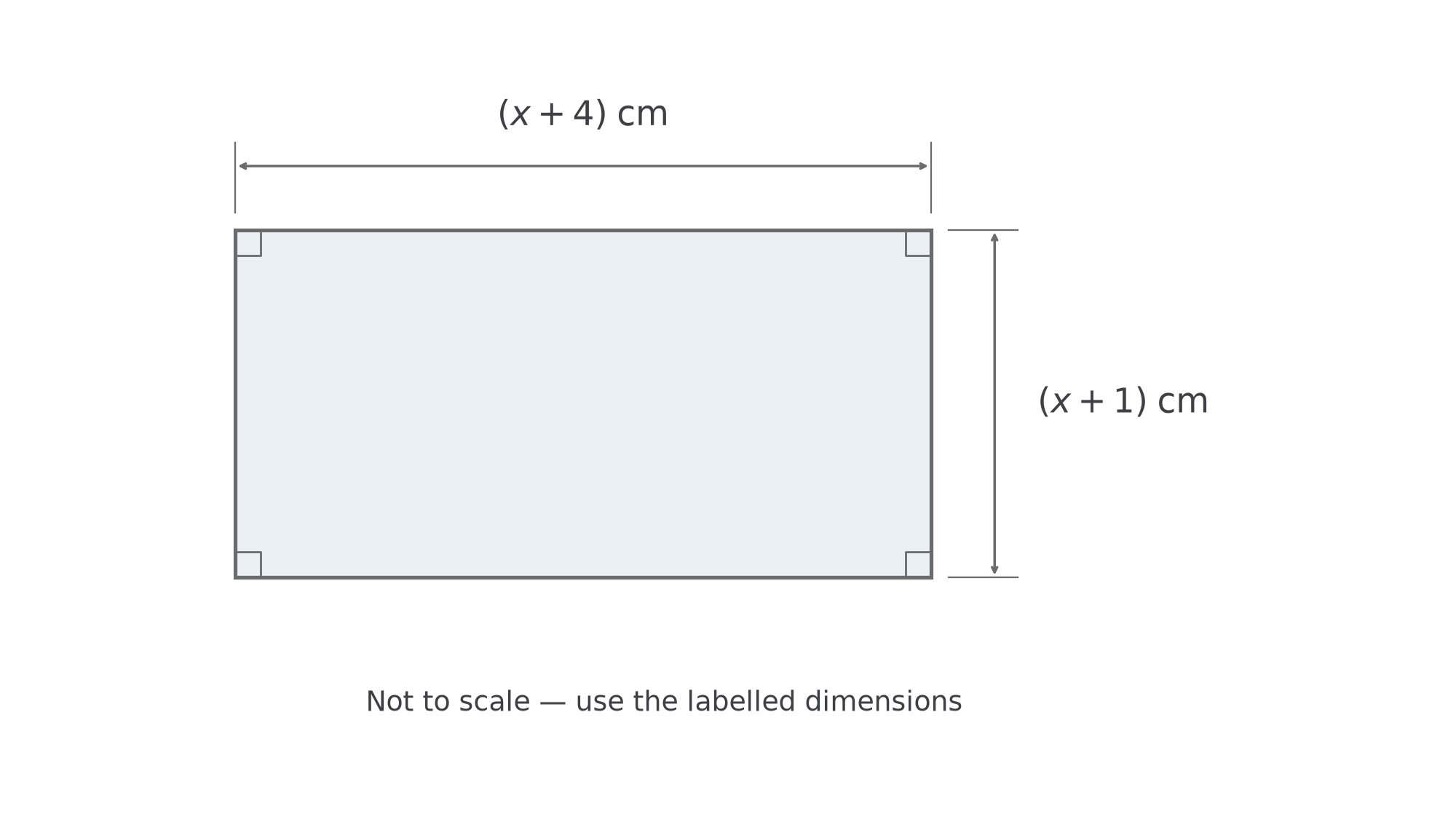
A labelled diagram supplies relationships as well as numbers. Perimeter adds boundary lengths; area measures the space inside. Identify the required quantity before choosing an operation, and use the labels rather than measuring a picture.
[DIAGRAM: asset_slug: m030_formula_rectangle; caption: A rectangle with length x plus 4 centimetres and width x plus 1 centimetres. The diagram is not to scale; description: A rectangle has horizontal side labelled (x+4) cm and vertical side labelled (x+1) cm. Opposite sides are equal and each angle is a right angle. Use the labels, not measured pixel lengths; file: m030_formula_rectangle.png; recommended_method: matplotlib]
Rectangle perimeter and area
For positive length and width , perimeter uses length units and area uses squared units. Foundation and Higher: Not in the formulae sheet: learn it.
Keep each multi-term dimension in brackets until you have multiplied it correctly.
Worked example 3: formulae from the rectangle
Question. A rectangle has length and width , where . Derive simplified formulae for perimeter in centimetres and area in square centimetres. Check at .
Plan. Add two of each side for perimeter and multiply the dimensions for area.
Why are the units different? Perimeter adds lengths; area multiplies two lengths.
Answer. and , in the stated units.
Check. At , the sides are and . Both formulae give the expected values: , . Equal numerical values do not make these the same quantity.
Continue this lesson.
You’re previewing NovaLearn without an account. Create a free account to read the rest.
Create free account