2.7 - Forming quadratic equations from contexts
Turn a situation into a quadratic equation, solve it and decide which roots fit the original conditions. You will use areas, number relationships, squared lengths and journey times, then check each answer in the situation that produced it.
Turning a context into an equation (Higher)
A rectangle has area , and its length is more than its width. Can those facts determine both sides? Define one unknown and the second side will follow from it.
You already know
Expand brackets carefully and rearrange a quadratic to zero. Factorisation, completing the square and the quadratic formula can then find its roots. Keep both roots until the context has been checked.
Let be the width in centimetres. Then the length is , not a second unrelated unknown. Multiplying those sides gives the area.
Rectangle area model
Use consistent units before forming the equation. Both physical side lengths must be positive.
Not in the Higher formulae sheet: learn it.
This picture ties each expression to its side. The two lengths multiply; a perimeter would use a sum instead.
[DIAGRAM: asset_slug: m037_rectangle_model; caption: A rectangle turns a length relationship into an area equation; description: A rectangle has width x centimetres, length x plus 3 centimetres and area 40 square centimetres. Side arrows identify the two dimensions and the model x times x plus 3 equals 40 is shown underneath.; file: m037_rectangle_model.png; recommended_method: matplotlib]
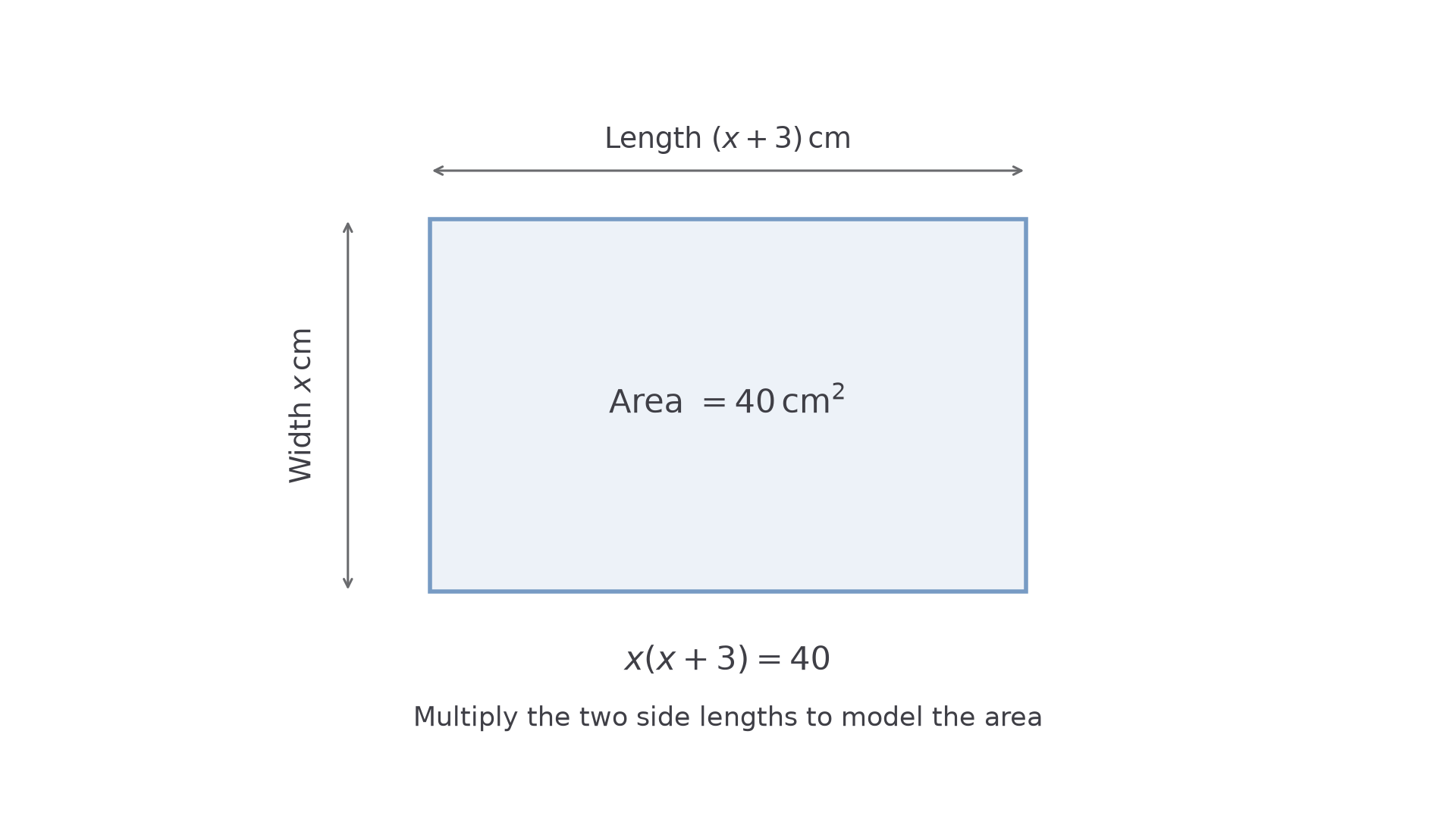
A quadratic model arises when the unknown is multiplied by another expression containing that unknown. Define the variable and its units first, express related quantities consistently, then use the relationship in the question.
Worked example 1: modelling the rectangle
Question. A rectangle's width is , its length is , and its area is . Find its dimensions.
Plan. Form the area equation, solve it and reject a negative physical width.
Why use ? “Three more than the width” adds to the same width, so only one unknown is needed.
Answer. Width , length .
Check. and . Both original facts hold, answering the opening question.
Now change only the length coefficient: the area stays , but the length becomes twice the width plus . The coefficient multiplies the width, not the whole sum.
Worked example 2: twice the width plus a constant
Question. A rectangle has width , length , and area . Find its exact dimensions.
Plan. Model its area with , use the quadratic formula, then interpret the roots.
Why , rather than ? The words double the width first, then add ; the latter expression would add .
Answer. Width , length .
Check. Their product is , and the length is twice the width plus . Both sides are positive; the other root is negative.
A negative root solves the algebraic equation but cannot be a physical width. Explain that restriction rather than adopting an “always choose positive” rule.
Watch out
For width and length , writing models a sum, not an area. The correct equation is .
The next question asks only for the model, so stop when it is formed.
Solving and interpreting the roots (Higher)
Solve the algebra completely before applying the original restrictions. A root may be mathematically correct yet fail a condition such as positive, integer, within a time interval or long enough for every side.
For consecutive integers, define the smaller as , so the next is . A count must remain an integer: rounding a noninteger root does not make it a valid count. For signed numbers or coordinates, however, a negative root can be valid.
Worked example 3: positive consecutive integers
Question. Two consecutive positive integers have product . Find them.
Plan. Form an equation for the smaller integer, solve it and apply positivity.
Why reject ? It would give , which are consecutive integers but are not positive.
Answer. and .
Check. They differ by , and .
Change only one word in the conditions: remove “positive”. The equation is unchanged, but the complete contextual answer changes.
Worked example 4: allowing signed integers
Question. Two consecutive integers have product . Find all possible pairs.
Plan. Use the same roots, then check which now satisfy the wider conditions.
Why keep the negative root now? The problem asks for integers, and negative integers are permitted.
Answer. The possible pairs are and .
Check. Both differences are , and .
That is a useful surprise: the same positive product can come from two negative consecutive integers. The conditions, rather than a root's sign alone, decide whether it stays.
Squared-length relationships give another common model. For a right triangle, put the two perpendicular sides on the left of Pythagoras' equation and the hypotenuse on the right.
Pythagoras' theorem for a model
where are the perpendicular sides and is the hypotenuse of a right triangle.
Not in the Higher formulae sheet: learn it.
Keep brackets around a whole side expression before squaring it. The following pair varies the numerical side data while keeping that same model structure.
Continue this lesson.
You’re previewing NovaLearn without an account. Create a free account to read the rest.
Create free account