4.8 - Obtuse angles, elevation and depression
You will extend trigonometry to obtuse angles and use angles of elevation and depression to calculate heights and distances. Clear angle geometry matters as much as calculator work. Use degree mode and keep full calculator precision until the final answer.
Trigonometry of obtuse angles (Higher)
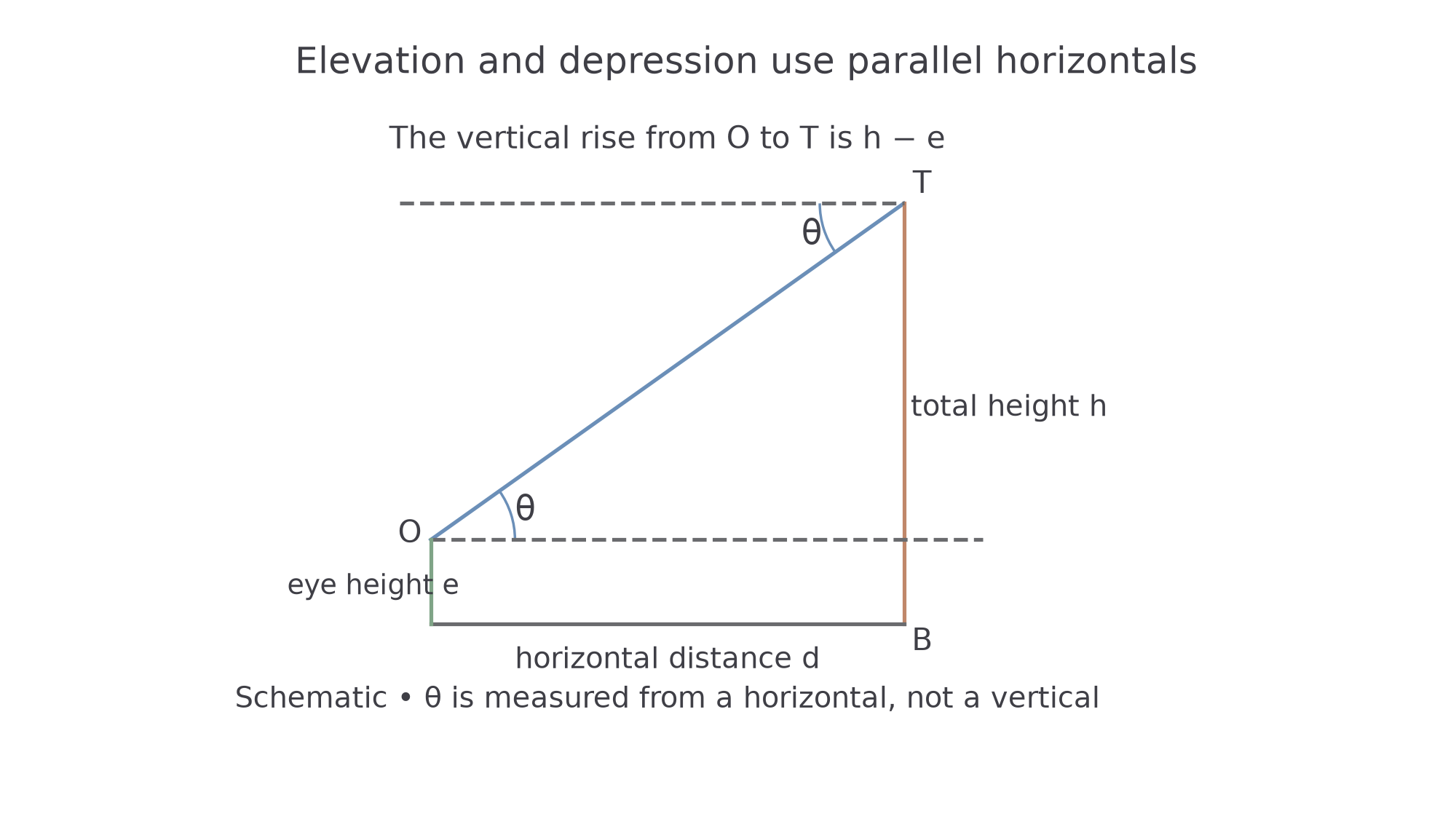
An observer's eye is above level ground, from a tower. The top is seen at above the horizontal. Is the tower's whole height? We will settle this after extending our angle toolkit.
You already know
For an acute angle in a right triangle, sine is opposite over hypotenuse, cosine is adjacent over hypotenuse, and tangent is opposite over adjacent. Inverse functions recover angles from ratios.
An obtuse angle lies between and . It cannot be a non-right angle inside a right triangle. Instead, extend sine and cosine using a point on a circle of radius : a ray turned anticlockwise through from the positive horizontal direction meets the circle at .
[DIAGRAM: asset_slug: m071_obtuse_reflection; caption: Acute and obtuse angles reflected in the vertical axis; description: On a unit circle the points at 60 and 120 degrees have equal positive heights and opposite horizontal coordinates. The point at 120 degrees has negative cosine and positive sine.; file: m071_obtuse_reflection.png; recommended_method: matplotlib]
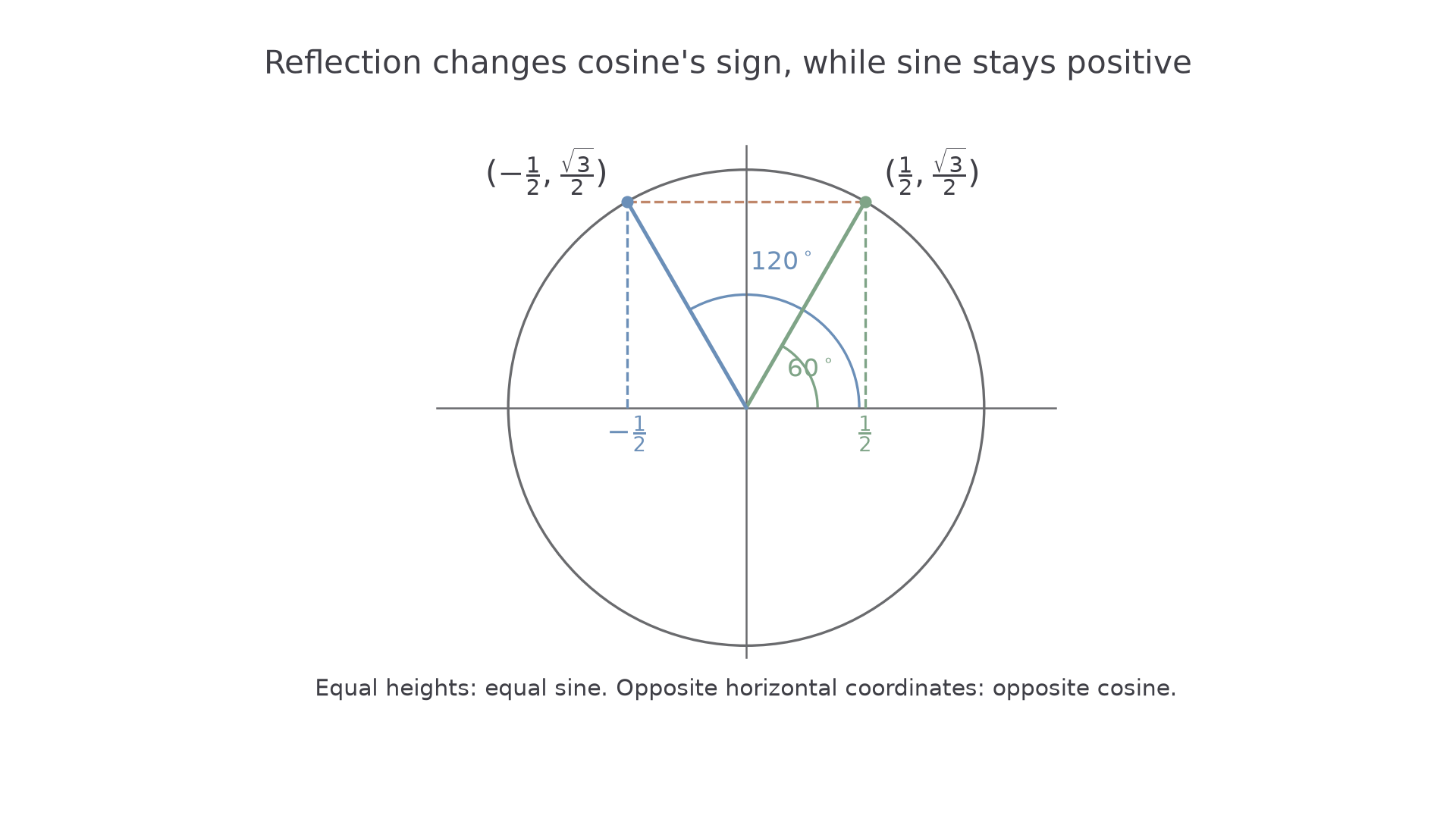
For an obtuse angle, the horizontal coordinate is negative and the vertical coordinate positive. Reflection keeps the height but reverses the horizontal direction. A useful surprise follows: two different angles can have the same sine, such as .
Obtuse-angle relations
For obtuse , let its acute reference angle be . Then
Tangent is sine divided by cosine. These relations are absent from the Higher sheet. Not in the formulae sheet: learn it.
Sine is positive for obtuse angles, while cosine and tangent are negative. At , cosine is zero and tangent is undefined; itself is not obtuse.
Worked example 1: exact obtuse values
Question. Find exact values of , and .
Plan. Use the acute reference angle and the signs in the obtuse quadrant.
Why does sine keep its sign? Both circle points lie above the horizontal axis.
Answer. , and , respectively.
Check. Dividing by gives , as required.
Change only the input angle from to . The sign pattern stays unchanged.
Worked example 2: another obtuse angle
Question. Find exact values of , and .
Plan. Use the new acute reference angle, keeping the obtuse signs.
Why is the reference angle ? It completes a straight angle with , rather than a right angle.
Answer. , and , respectively.
Check. .
For an input strictly between and , inverse sine gives an acute principal angle. An input of gives . If the question asks for an obtuse angle, take the acute angle's supplement. Inverse cosine gives an obtuse angle for an input strictly between and ; an input of gives . Inverse tangent of a negative input gives a negative principal angle, so add for the obtuse solution.
Worked example 3: select the obtuse sine solution
Question. Find the obtuse angle with , to decimal place.
Plan. Find the acute inverse-sine value, then take its supplement.
Why subtract from ? Acute and obtuse supplementary angles have equal sine.
Answer. .
Check. The answer is obtuse, and the sine of the unrounded angle is .
Change only the given sine value to . Keep the requirement that the angle is obtuse.
Worked example 4: a changed sine value
Question. Find obtuse with , to decimal place.
Plan. Take the supplement of the principal inverse-sine angle.
Why does the obtuse angle decrease? Its acute supplement increases while their total stays .
Answer. .
Check. The unrounded angle has sine and lies between and .
For the other inverse functions, the same sign picture controls the answer. For example, is already obtuse. If , the obtuse value is , or to decimal place. Its tangent is negative, as the picture predicts.
Watch out
The line ignores the word “obtuse”. The inverse gives the reference angle; use for the requested angle.
Check both the sign and the stated angle range, rather than accepting the first display value.
Angles of elevation and height (Higher)
An angle of elevation is measured upwards from the observer's horizontal to the line of sight. It is not measured from a vertical wall. On level ground, a vertical object gives a right triangle, but its vertical side is the rise above the observer's eye.
[DIAGRAM: asset_slug: m071_elevation_depression; caption: Elevation and depression angles from parallel horizontals with eye height e and total height h; description: The line OT joins eye O to tower top T. Elevation at O equals depression at T because the horizontals are parallel. Tower height h includes eye height e while the vertical rise in the sight triangle is h minus e. Diagram is schematic.; file: m071_elevation_depression.png; recommended_method: matplotlib]
Continue this lesson.
You’re previewing NovaLearn without an account. Create a free account to read the rest.
Create free account