4.11 - Area and volume scales of similar figures
Use length scales to compare areas and volumes of similar figures. Learn why the powers differ, work backwards from an area or volume ratio, and find unknown volumes from their difference.
Squaring the length factor (Higher)
Two containers have similar internal shapes. Their heights are and . Does the taller one hold just times as much? The answer depends on how many dimensions a measure uses.
You already know
Similar figures have one common multiplier for corresponding lengths. Area uses two length dimensions, while volume uses three. Keep the direction of a ratio consistent.
Start with a rectangle by , of area . Multiply both lengths by : it becomes by , of area . The area factor is , because the length multiplier appears twice.
Area scale factor
For similar figures, length ratio gives area ratio . This also applies to corresponding surface areas of similar solids. The result is absent from both Foundation and Higher sheets; it is Higher content. Not in the formulae sheet: learn it.
For a rectangle, . A triangle's base and perpendicular height also both scale, so the factor stays unchanged while its area gains . The same square rule applies to all similar plane figures. Compare matching types of area: one corresponding face with the other, or total surface area with total surface area.
Worked example 1: area of a similar triangle
Question. A triangle has base and perpendicular height . All lengths are enlarged by factor . Find the enlarged triangle's area.
Plan. Find the original area, then multiply by the square of the length factor.
Why this step? Both the base and the height are multiplied by .
Answer. .
Check. New base , new height ; .
Change only the length factor from to . The original triangle and the requested area stay the same.
Worked example 2: doubling every length
Question. A triangle has base and perpendicular height . All lengths are enlarged by factor . Find the enlarged triangle's area.
Plan. Multiply its original area by .
Why this step? Doubling both dimensions makes four copies of the original area fit the enlarged shape.
Answer. .
Check. using the new base and height.
The word “similar” is essential. Doubling only a rectangle's width doubles its area, but changes its proportions, so the square-factor rule would not apply to that change.
Watch out
is wrong for Worked example 1: it scales only one length dimension. Correct it to .
Change only the length factor again for your turn.
Cubing the length factor (Higher)
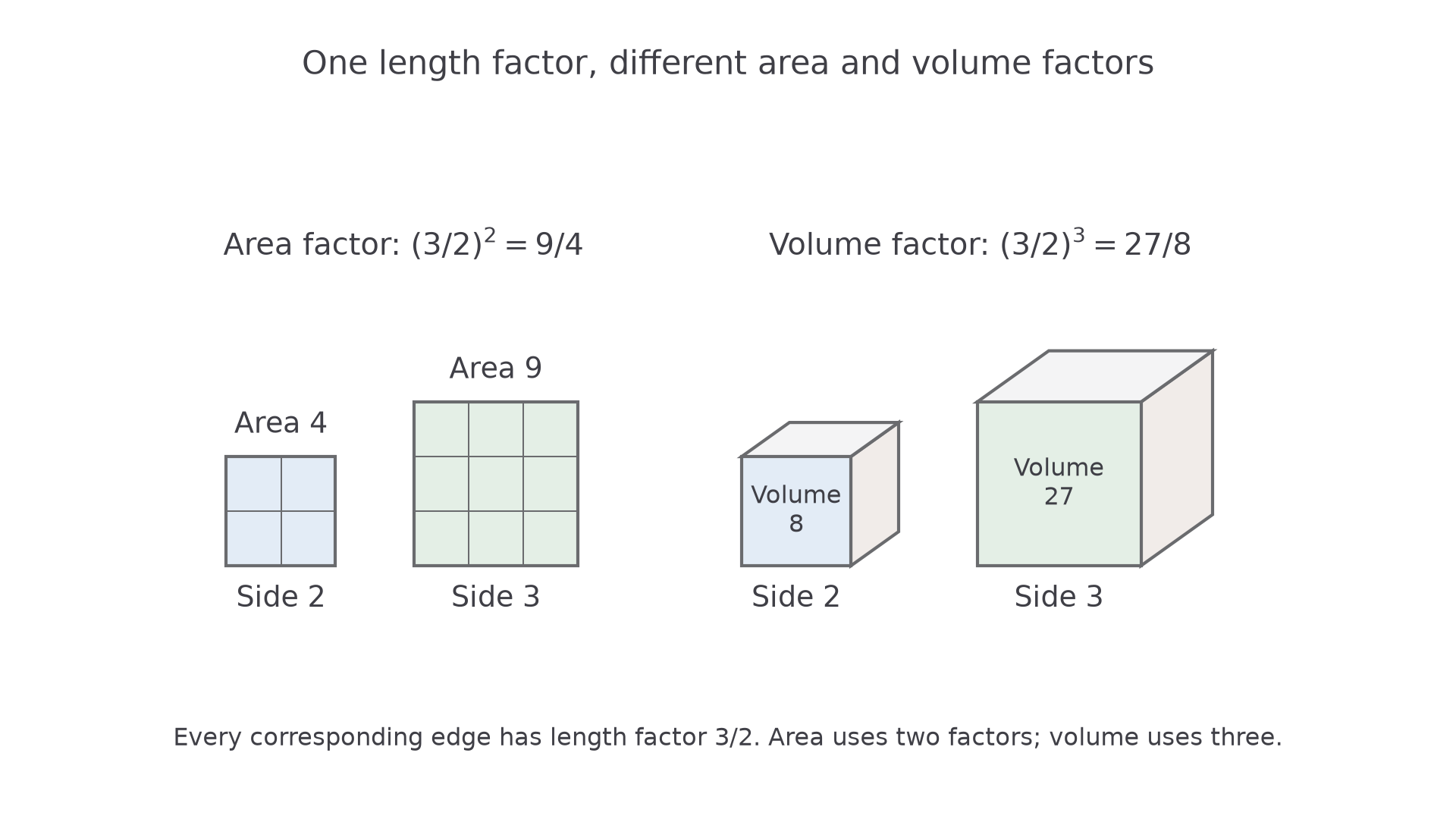
A similar solid changes in three length dimensions. Each contributes a factor of , so volume gains .
For a cuboid, this is . The rule also applies to similar cylinders, cones, spheres and irregular solids. The particular volume formula does not change the number of length dimensions.
[DIAGRAM: asset_slug: m081_scale_dimensions; caption: Length factor 3 over 2 produces area factor 9 over 4 and volume factor 27 over 8; description: Unit-gridded squares of sides 2 and 3 show areas 4 and 9. Schematic cubes of sides 2 and 3 show volumes 8 and 27. All corresponding dimensions, including depth, scale by 3 over 2.; file: m081_scale_dimensions.png; recommended_method: matplotlib]
Volume scale factor
For similar solids, length ratio gives volume ratio . This rule is absent from both Foundation and Higher sheets; it is Higher content. Not in the formulae sheet: learn it.
The opening containers have length factor . Their capacity factor is therefore . That is the surprise: a container only taller can hold more than three times as much, because it is also wider and deeper. Uniform similarity of the internal shapes is needed for a capacity comparison.
Worked example 3: smaller to larger volume
Question. Similar solids have corresponding lengths in ratio , smaller to larger. The smaller volume is . Find the larger volume.
Plan. Cube the smaller-to-larger length factor, then multiply the smaller volume.
Why this step? Volume scales in three dimensions, so the factor is , not or .
Answer. .
Check. , the cube of .
Change only the direction of the unknown. The length ratio and physical solids stay the same; now the larger volume is known.
Worked example 4: larger to smaller volume
Question. Similar solids have corresponding lengths in ratio , smaller to larger. The larger volume is . Find the smaller volume.
Plan. Cube the reverse length factor , then multiply the larger volume.
Why this step? A reduction needs a factor below ; cubing it preserves that direction.
Answer. .
Check. , so the reverse route recovers the given volume.
If only a prism's length doubles while its cross-section stays fixed, its volume merely doubles; the solids are generally not similar. Doubling every length instead multiplies volume by and corresponding surface area by .
Watch out
uses the area factor. For volume correct it to .
Keep the reverse direction and change only the known larger volume.
Recovering a length scale (Higher)
An area ratio already contains a square; a volume ratio already contains a cube. Undo that power before finding a length.
Continue this lesson.
You’re previewing NovaLearn without an account. Create a free account to read the rest.
Create free account