3.4 - Calculus in motion and practical models
A changing position gives a velocity, and a changing velocity gives an acceleration. You will use differentiation for motion along a straight line, track distance after reversals and find rates or greatest values in simple practical models. Every model has its own units and valid interval.
Velocity and acceleration from displacement (Higher)
Can a moving object have zero acceleration? A model can answer precisely: its velocity might be changing at zero rate while the object is still travelling. Keep position, velocity and acceleration separate.
You already know
A derivative gives rate of change. Differentiate an integer-power expression term by term, then substitute a requested input. Negative graph gradient means decreasing output.
Displacement is signed position relative to a fixed origin and chosen positive direction. Positive velocity means increasing displacement; negative velocity means motion the other way. Speed is the magnitude , so it is never negative.
Velocity and acceleration
For displacement in metres and time in seconds, velocity has units and acceleration . These relationships and differentiation rules are not in the Higher formulae sheet: learn them. This lesson is Higher only.
Differentiate displacement once for velocity, then differentiate velocity for acceleration. “Linear kinematics” means motion along a line; the displacement formula can still contain powers of time.
Worked example 1: moving with zero acceleration
Question. A particle has displacement metres for seconds. Find its position, velocity, speed and acceleration at .
Plan. Differentiate twice in stages, then evaluate the appropriate expression for each quantity.
Why this step? Each expression describes a different quantity; zero acceleration does not set the velocity to zero.
Answer. Position , velocity , speed , acceleration .
Check. The object is on the positive side of the origin but moving in the negative direction, which is physically consistent.
Change only the requested time. The object can now be instantaneously at rest even though its acceleration is nonzero.
Worked example 2: rest with nonzero acceleration
Question. For the same displacement model, find position, velocity, speed and acceleration at .
Plan. Use the same expressions, evaluated at the new time.
Why this step? Rest means zero velocity, while acceleration measures how velocity is changing through that instant.
Answer. Position ; velocity and speed ; acceleration .
Check. Both times lie within the permitted interval. A turn in the position graph can have zero velocity but nonzero acceleration.
Acceleration's sign alone does not tell you whether speed increases. When velocity and acceleration have the same sign, speed increases locally; when they have opposite signs, speed decreases locally. At zero velocity, inspect the motion on either side instead.
Watch out
“, therefore the particle is at rest” is wrong. Calculate velocity: , so it is moving. Rest requires .
Use another time in the same valid interval.
Rest, direction changes and distance (Higher)
A stop may reverse the motion, so subtracting the first position from the last can hide part of the journey. Find rest times from , then check the sign of velocity before and after each permitted time.
A change from positive to negative velocity reverses motion from increasing to decreasing displacement. A change from negative to positive reverses the other way. Zero velocity alone is not enough: for example, expand , then differentiate to get . This is zero at but positive on both sides, so there is no reversal.
Distance and displacement change
Displacement change is final position minus initial position. Distance travelled adds all lengths of the journey regardless of direction. Split at each reversal and add the absolute position changes. These relationships are not in the Higher formulae sheet: learn them.
For example, moving from position to , then to metres gives distance , but displacement change . Evaluate positions using the original displacement expression.
[DIAGRAM: asset_slug: m057_motion_distance; caption: Two direction reversals produce 12 metres of travel but only 4 metres of displacement change; description: Exact displacement-time graph s=t cubed minus 6t squared plus 9t for times 0 to 4 seconds, with rest at (1,4) and (3,0), alongside track arrows from 0 to 4, back to 0, then to 4 metres; file: m057_motion_distance.png; recommended_method: matplotlib]
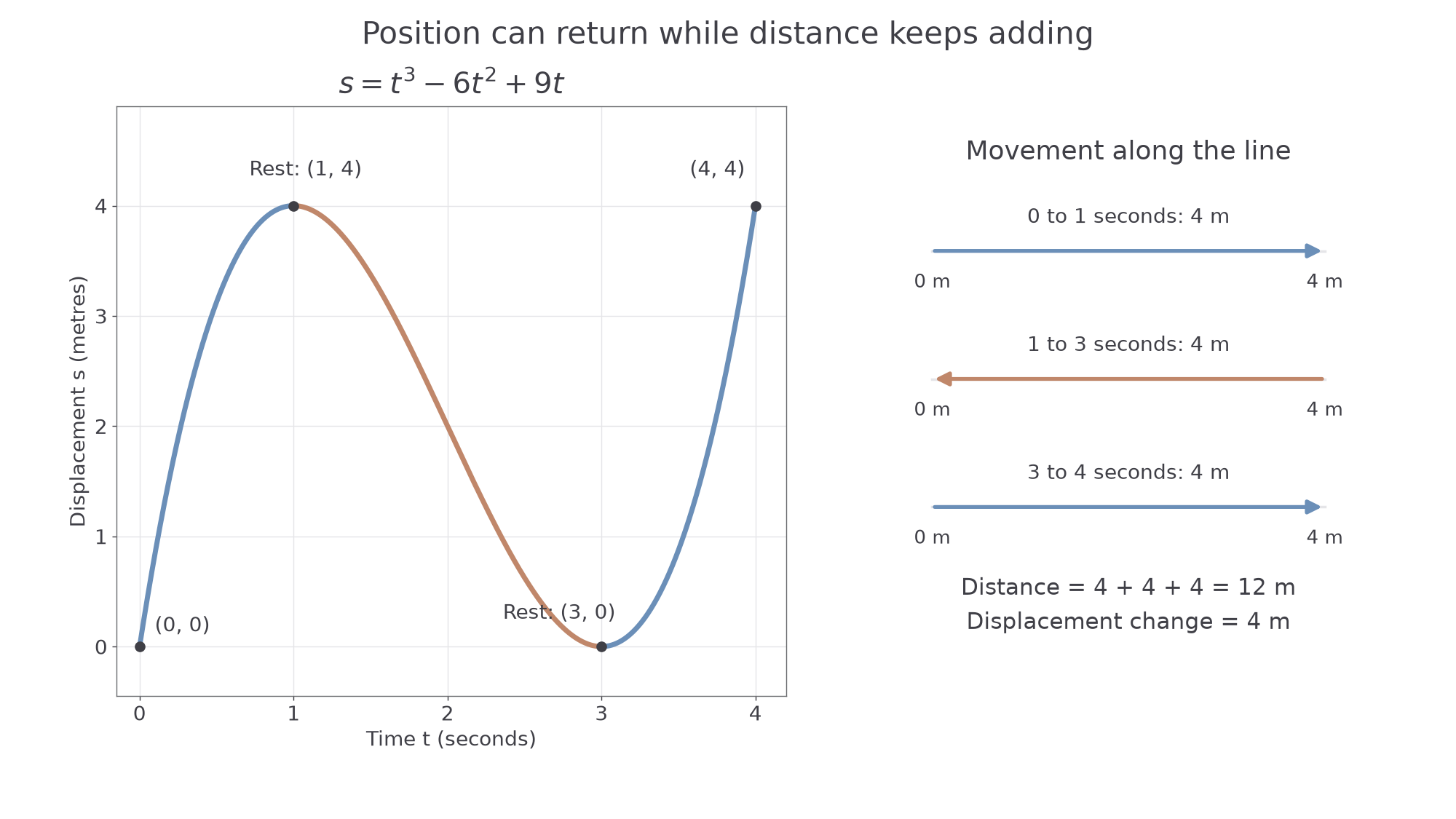
The falling middle section means travel back towards the origin; the final rise adds distance again.
Worked example 3: distance after two reversals
Question. For metres, seconds, find the rest times and total distance travelled.
Plan. Solve , check direction changes and add lengths between the start, reversals and end.
Why this step? Velocity is positive before , negative between and , then positive after , so both rest times reverse the motion.
Answer. Rest at and ; distance .
Check. The displacement change is . The larger distance includes the return journey, as the diagram shows.
Continue this lesson.
You’re previewing NovaLearn without an account. Create a free account to read the rest.
Create free account