4.8 - Three-dimensional Pythagoras and trigonometry
Find lengths and angles inside solids by bringing the right triangle into view. You will use a perpendicular projection to find a line's angle with a plane, then choose between different triangles in a pyramid.
Right triangles and space diagonals (Higher)
Can a straight rod of length fit exactly between opposite corners inside a box measuring by by ? No single face is long enough to show the whole rod. We need a triangle inside the box.
You already know
In a right-angled triangle, , where is the hypotenuse. You can use sine, cosine and tangent once you have identified the opposite, adjacent and hypotenuse sides.
A cuboid has three mutually perpendicular edge directions. Its perspective drawing can make a right angle look slanted. Trust the stated geometry rather than measuring the picture.
Space diagonal
A space diagonal joins opposite vertices through a solid's interior. A face diagonal joins opposite corners of one face; it stays on that face.
In cuboid , the top points lie directly above . First find base diagonal . Then use right triangle : the vertical is perpendicular to the whole base, including .
[DIAGRAM: asset_slug: m073_cuboid_projection; caption: A space diagonal and its perpendicular projection in a cuboid; description: Cuboid ABCDEFGH has E F G H directly above A B C D. AG is blue, its projection AC is sage and perpendicular height CG is clay. A separate true-shape right triangle ACG shows the right angle at C and the line-plane angle at A. The cuboid is schematic.; file: m073_cuboid_projection.png; recommended_method: matplotlib]
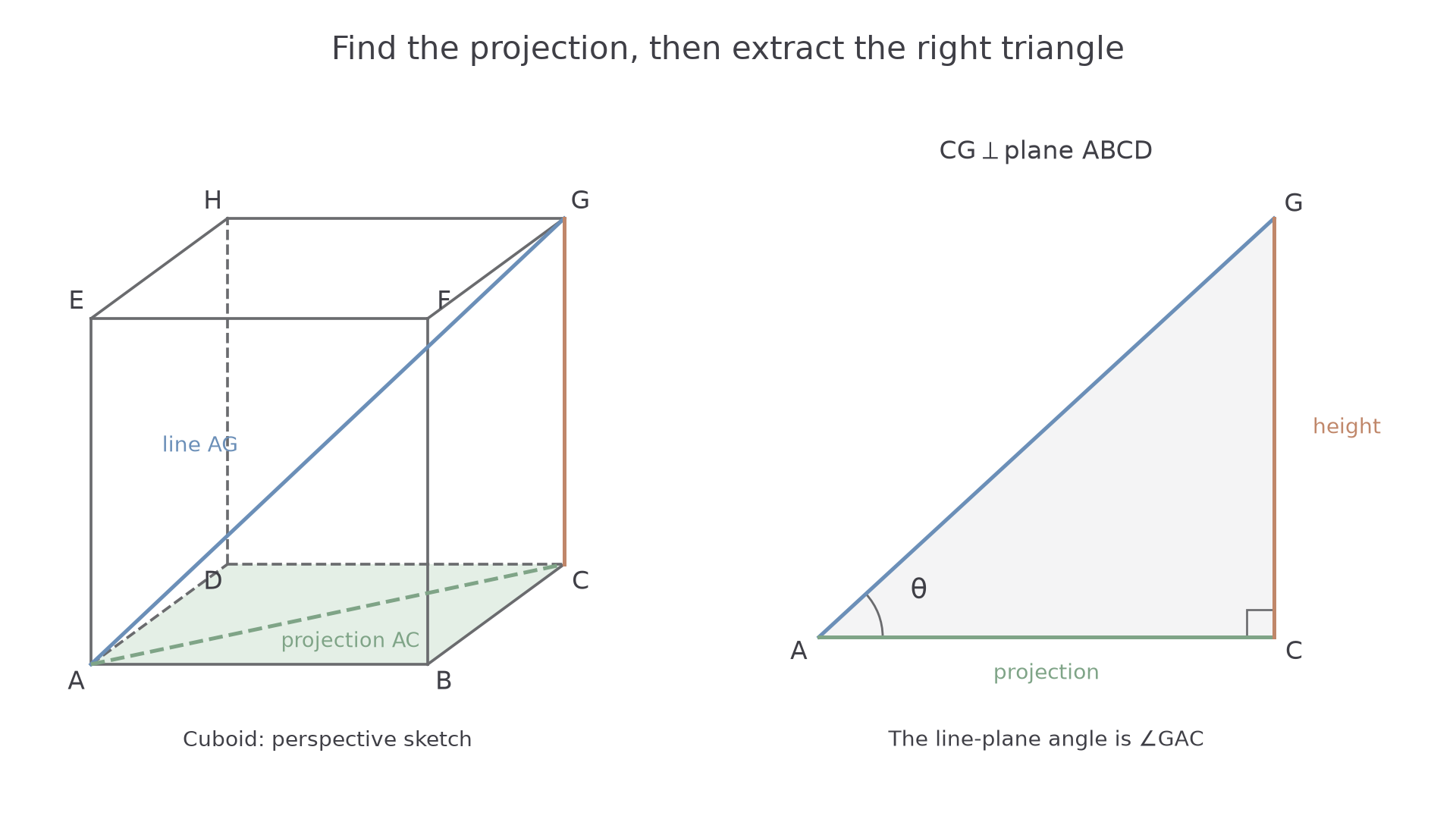
The two triangles explain why three squared edge lengths appear.
Cuboid space diagonal
For mutually perpendicular edge lengths ,
Use the positive square root for a length. Pythagoras and this derived result are absent from both tier sheets. Not in the formulae sheet: learn it.
Here is the rod from the opening question, found in two stages.
Worked example 1: a diagonal through the box
Question. A cuboid has , and . Find exactly.
Plan. Find across the base, then combine it with the vertical height.
Why use ? It reaches the foot of the vertical from , making a genuine right triangle with .
Answer. , so the ideal thin rod fits exactly along this diagonal.
Check. , and the diagonal exceeds each edge length.
Now change only which length is unknown. The same relationship works backwards.
Worked example 2: a missing perpendicular edge
Question. A cuboid has base edges and , and space diagonal . Find its height .
Plan. Subtract the two known edge squares from the diagonal square.
Why subtract? The hypotenuse square already includes all three edge squares.
Answer. The height is .
Check. , giving the stated diagonal .
The opening numbers have a neat feature: both triangles have whole-number sides, and . Three-dimensional distances can therefore be exact whole numbers too.
Watch out
The line measures a route along edges, not a straight diagonal. Add squares and take the square root: .
Try the forward calculation with different edge lengths. The two-triangle route and the three-square route should agree.
The angle between a line and a plane (Higher)
Imagine shining light straight down onto the base of the box. The diagonal rod casts a straight shadow across the base. That shadow gives the direction we need for the angle.
Perpendicular projection
To project a point onto a plane, drop a perpendicular to the plane. For a line meeting the plane, join its intersection point to the projected position of another point on the line. This segment is the line's perpendicular projection.
For , point is already in the base and projects onto . The projection is . The angle between the line and the plane is the smaller angle between and , namely . A line lying in or parallel to a plane has angle ; a line perpendicular to it has angle .
In right triangle , height is opposite this angle, projection is adjacent, and is the hypotenuse.
Right-triangle ratios
Choose the ratio containing the lengths you know. Use inverse functions in degree mode for an angle. These ratios are absent from both tier sheets. Not in the formulae sheet: learn it.
Use the original box to see how steeply the rod rises above its shadow.
Worked example 3: inclination to the base
Question. In a cuboid, , and . Find the angle between and base plane , to decimal place.
Plan. Find projection , then use height divided by projection in tangent.
Why choose ? Its base arm is the perpendicular projection of , rather than an arbitrary base edge.
Answer. The angle is .
Check. , so gives the same unrounded angle.
Change only the box's height from to . The projection stays the same, so the rod should be less steep.
Worked example 4: a lower box
Question. The same cuboid now has height . Find the angle between its space diagonal and its base, to decimal place.
Plan. Keep the base projection and change the opposite side.
Why keep ? Only the perpendicular height changed; the diagonal's projection did not.
Answer. The angle is .
Check. This is less than , as a lower box requires. Using confirms it.
You can also use an inclination to find a missing length. Keep the same projection triangle, but rearrange the ratio instead of applying an inverse function.
Continue this lesson.
You’re previewing NovaLearn without an account. Create a free account to read the rest.
Create free account