4.8 - Sine rule, cosine rule and triangle area
You will choose rules for triangles without a right angle, calculate missing sides and angles, and check whether more than one triangle is possible. You will also find area from two sides and their included angle. Use acute and obtuse trigonometry in degree mode.
The sine rule for lengths (Higher)
A triangle has sides and enclosing . Can you find its area before finding the third side? Yes: by the end you will have a direct method. First, learn how to work with a triangle that has no right angle.
You already know
Triangle angles total . Acute and supplementary obtuse angles have equal sine. Keep full calculator precision until the last step, and use degree mode.
Use matching letters: side is opposite angle , side is opposite , and side is opposite . For example, if and , then . The side opposite must be longer than the side opposite .
[DIAGRAM: asset_slug: m072_triangle_rules; caption: Triangle ABC with sides a b and c opposite their matching angles; description: Side BC is a opposite A, CA is b opposite B, and AB is c opposite C. Angle C is enclosed by sides a and b. The figure is schematic and supplies no measurements.; file: m072_triangle_rules.png; recommended_method: matplotlib]
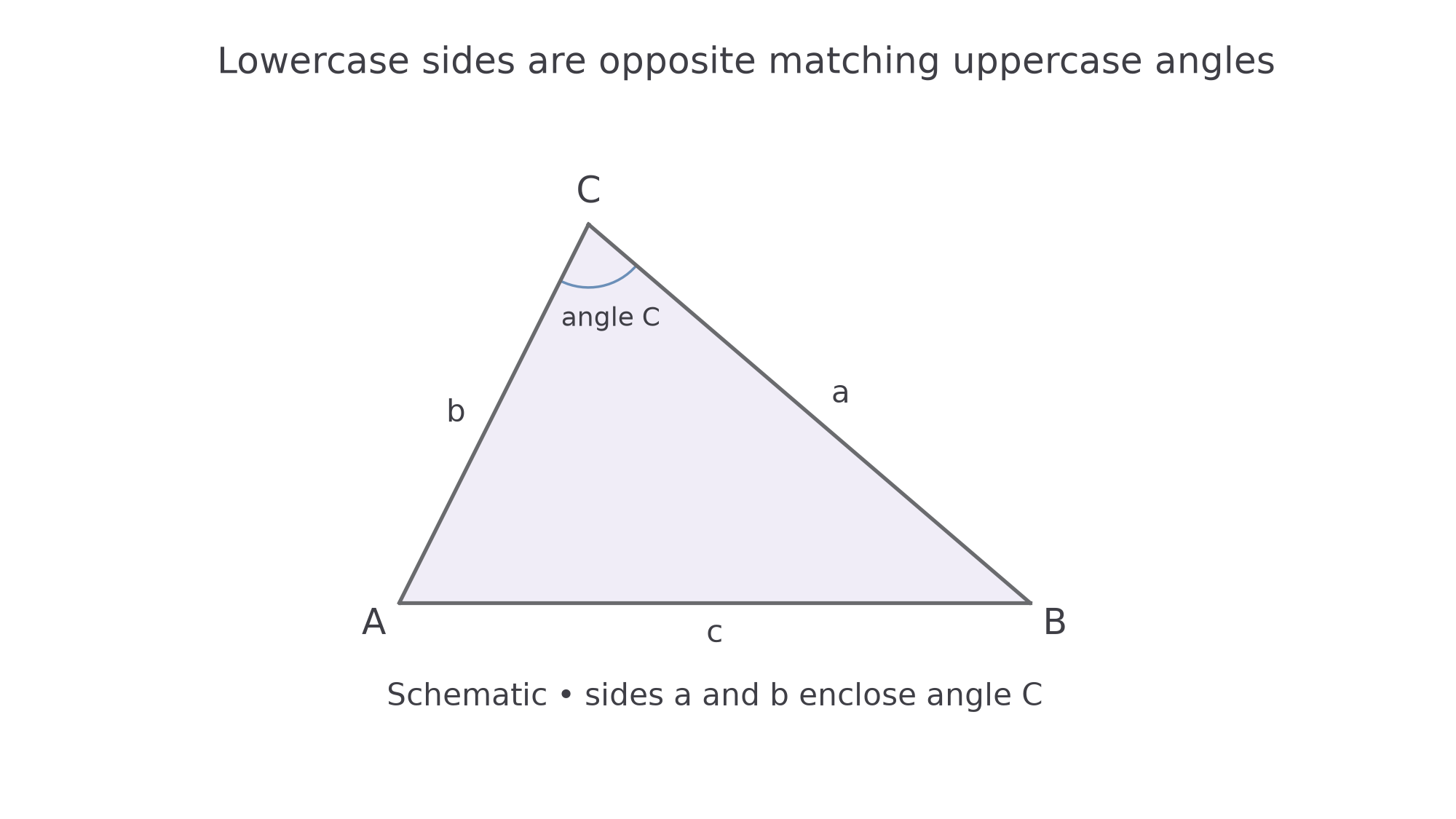
The sine rule compares a side with the sine of its opposite angle. A known complete pair gives you a starting point for finding another side.
Sine rule
In any non-degenerate triangle,
Each side must match its opposite angle. Supplied on the Higher sheet; absent from the Foundation sheet. In the formulae sheet.
Why does it work? Drop a perpendicular height from to the line . The height is both and , so . Dividing gives the sine-rule equality. For an obtuse triangle, a perpendicular may fall outside the triangle, but the supplementary-angle sine relationship keeps the equality valid.
Worked example 1: match opposite pairs
Question. Triangle has , and . Find to significant figures.
Plan. Use the known pair with the wanted pair .
Why put with ? The side and angle are opposite each other, regardless of how the diagram is rotated.
Answer. .
Check. , so . The remaining angle is .
Change only from to . Keep and its opposite side fixed.
Worked example 2: a larger opposite angle
Question. Triangle has , and . Find to significant figures.
Plan. Use the same known opposite pair with the changed angle.
Why is the method unchanged? We still have one known complete opposite pair and the angle opposite the wanted side.
Answer. .
Check. The third angle is , and the largest angle faces a side longer than .
Choose only the two pairs you need, rather than substituting everything into one long equation.
Watch out
The line swaps the opposite pairs. Use in the first example.
Try the same length method with new data.
The sine rule and ambiguous angles (Higher)
Finding a sine-rule angle needs a second decision after the calculator step. From , rearrange to . This rearrangement follows from the supplied Higher sine rule; it is not separately printed.
If the computed sine exceeds , no triangle exists. A value strictly between and gives an acute candidate and its obtuse supplement . These have the same sine, but each must leave a positive third angle: . Any stated acute or obtuse condition also applies.
[DIAGRAM: asset_slug: m072_ambiguous_case; caption: Two different triangles fit the same two sides and non-included angle; description: Both triangles have A equal to 30 degrees, side a equal to 7 centimetres and side b equal to 10 centimetres. The angle B is acute in one and obtuse in the other. Their bases have different lengths.; file: m072_ambiguous_case.png; recommended_method: matplotlib]
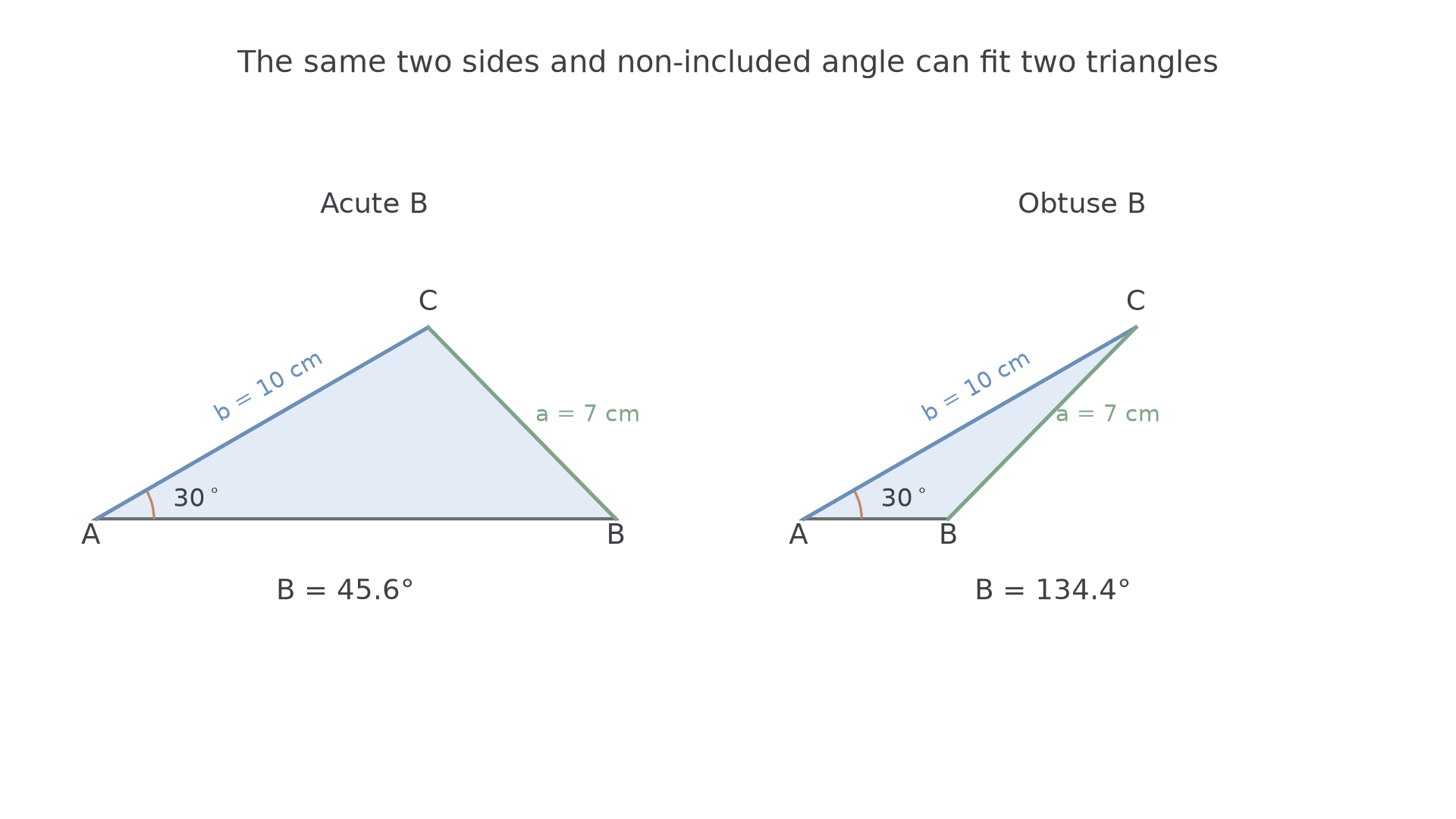
This is the ambiguous case: two sides and a non-included angle may describe two triangles. A schematic's appearance cannot select between them.
Worked example 3: two possible triangles
Question. Triangle has , and . Find all possible pairs of , to decimal place.
Plan. Find both sine candidates, then test the remaining angles.
Why keep both? Both third angles are positive, and neither candidate breaks a stated condition.
Answer. or .
Check. Each unrounded pair sums with to , and both values have sine .
Change only side from to . Keep and .
Worked example 4: reject an impossible supplement
Question. Triangle has , and . Find all possible pairs of , to decimal place.
Plan. Test both candidates even though only one may survive.
Why reject despite its correct sine? Together with , it already exceeds the triangle's angle total.
Answer. Only .
Check. The known sides satisfy , and their opposite angles satisfy , as required. The unrounded equals .
The input check can settle a case even earlier. With , and , the sine would be , so no triangle exists. If , the sine is : there is one candidate, and . A zero sine would give a zero or straight angle, so it cannot describe a non-degenerate triangle.
Watch out
“, so there is only one answer” misses a possible supplement. Consider , then test the angle sum before keeping it.
Apply both checks to new triangle data. You only need the possible values of .
The cosine rule for sides and angles (Higher)
The sine rule needs a useful opposite pair. If you have two sides and their included angle, or all three sides, the cosine rule gives a route instead. An included angle is the angle between the two sides being used; in the diagram, sides enclose .
Continue this lesson.
You’re previewing NovaLearn without an account. Create a free account to read the rest.
Create free account