2.2 - Completing the square
Rewrite a quadratic as a multiple of one squared bracket plus a constant. This form reveals values that are hidden in expanded algebra. You will handle positive, negative and fractional numbers inside the bracket and check that every coefficient stays the same.
Completing a monic quadratic (Higher)
How small can be when is any real number? Trying a few values may miss the smallest one. A squared bracket will make the answer visible.
You already know
Expand a squared bracket by multiplying two identical brackets. For example, , because both cross-products contribute .
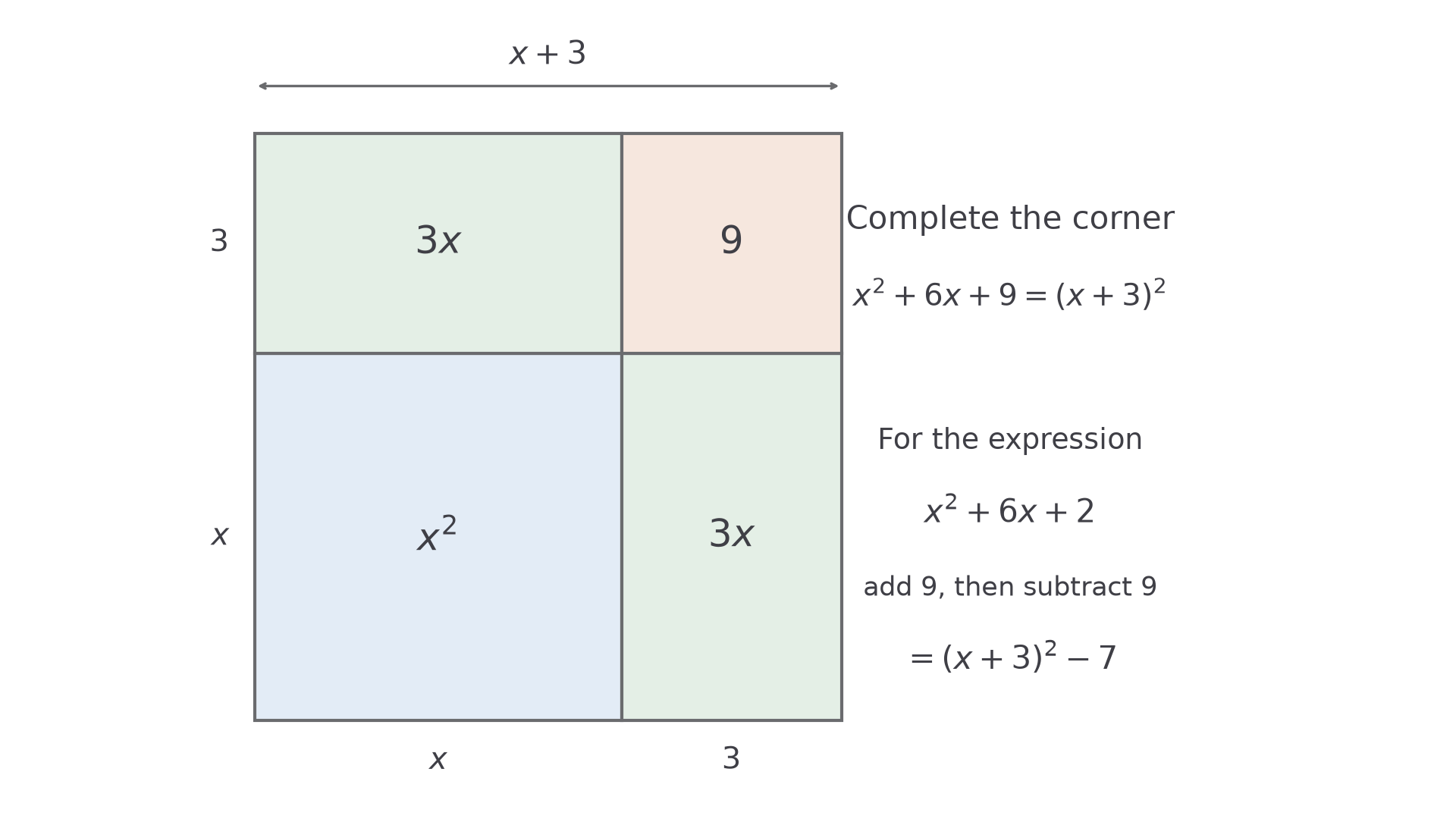
The picture shows why the extra appears. An -square and two strips of area almost make a larger square; its missing corner has area . This area picture uses , but the expanded identity works for every real .
[DIAGRAM: asset_slug: m028_completing_square; caption: Adding a corner of area 9 completes a square of side x plus 3; description: An x by x square, two x by 3 strips and a 3 by 3 corner form a square of side x plus 3. The four regions have areas x squared, 3x, 3x and 9. This area model assumes x is positive; file: m028_completing_square.png; recommended_method: matplotlib]
Monic quadratic
A quadratic whose squared term has coefficient , such as . The expression is quadratic but is not monic.
Completing the square means rewriting without changing the expression's value. Add the missing corner inside a square, then subtract it outside.
Squared bracket
For , take and write . Higher: Not in the formulae sheet: learn it.
The number inside the bracket is half the linear coefficient. Its square is positive even when is negative.
Worked example 1: a positive linear coefficient
Question. Write in the form .
Plan. Halve , form a squared bracket, then remove its extra constant.
Why subtract ? The bracket contributes , which the original expression did not contain.
Answer. .
Check. Expanding gives .
Now change only the sign of the linear term. The number inside the bracket changes sign; its square does not.
Worked example 2: a negative linear coefficient
Question. Write in the form .
Plan. Halve , then compensate for the constant introduced.
Why still subtract ? Squaring gives , not .
Answer. , with and .
Check. .
A tempting shortcut is to forget the compensation. That changes the expression.
Watch out
Wrong: . The right side has constant . Correct: .
Try a different negative linear coefficient. Keep the expression exact throughout.
Other leading coefficients (Higher)
If the squared term has coefficient , factor out from the squared and linear terms first. Complete the square inside the bracket. Every constant introduced inside is multiplied by the outside coefficient.
Completed-square form
Here . Match the squared coefficient first, then the linear coefficient and constant. Higher: Not in the formulae sheet: learn it.
The target is Pearson's form . A negative number inside the bracket is written naturally as subtraction.
Worked example 3: factor the leading coefficient
Question. Complete the square for .
Plan. Factor from the first two terms, then complete the monic square.
Why subtract overall? The outside multiplies the compensation too.
Answer. .
Check. .
Continue this lesson.
You’re previewing NovaLearn without an account. Create a free account to read the rest.
Create free account