4.8 - Right-angled trigonometry and bearings
You will connect an acute angle to the side ratios of a right triangle, calculate missing lengths and angles, and use these methods with bearings. Bearings turn a journey into perpendicular north–south and east–west distances. Keep your calculator in degree mode throughout.
Sine, cosine and tangent
A boat travels on bearing , then due east. How far is it from its start, and what bearing points straight to it? You can answer without sailing the route: start by understanding the triangle inside the first leg.
You already know
The hypotenuse is opposite a right angle. Similar triangles have equal corresponding angles and equal ratios of corresponding lengths. The two acute angles of a right triangle total .
For a right triangle, compares one shorter side with the hypotenuse. Enlarge every length and the ratio stays unchanged. This is why a ratio can describe an angle without specifying the triangle's size.
Opposite and adjacent
Relative to a chosen acute angle , the opposite side is across from . The adjacent side touches and is not the hypotenuse. Choosing the other acute angle swaps opposite and adjacent; the hypotenuse stays the same.
Name the sides before selecting a ratio. A sloping side is not automatically the hypotenuse: the right angle decides that.
[DIAGRAM: asset_slug: m070_ratio_triangle; caption: Opposite adjacent and hypotenuse relative to the chosen acute angle theta; description: A right triangle marks theta at its left vertex and the right angle at the bottom right. Opposite is the vertical leg and adjacent the horizontal leg. The schematic cannot supply measurements.; file: m070_ratio_triangle.png; recommended_method: matplotlib]
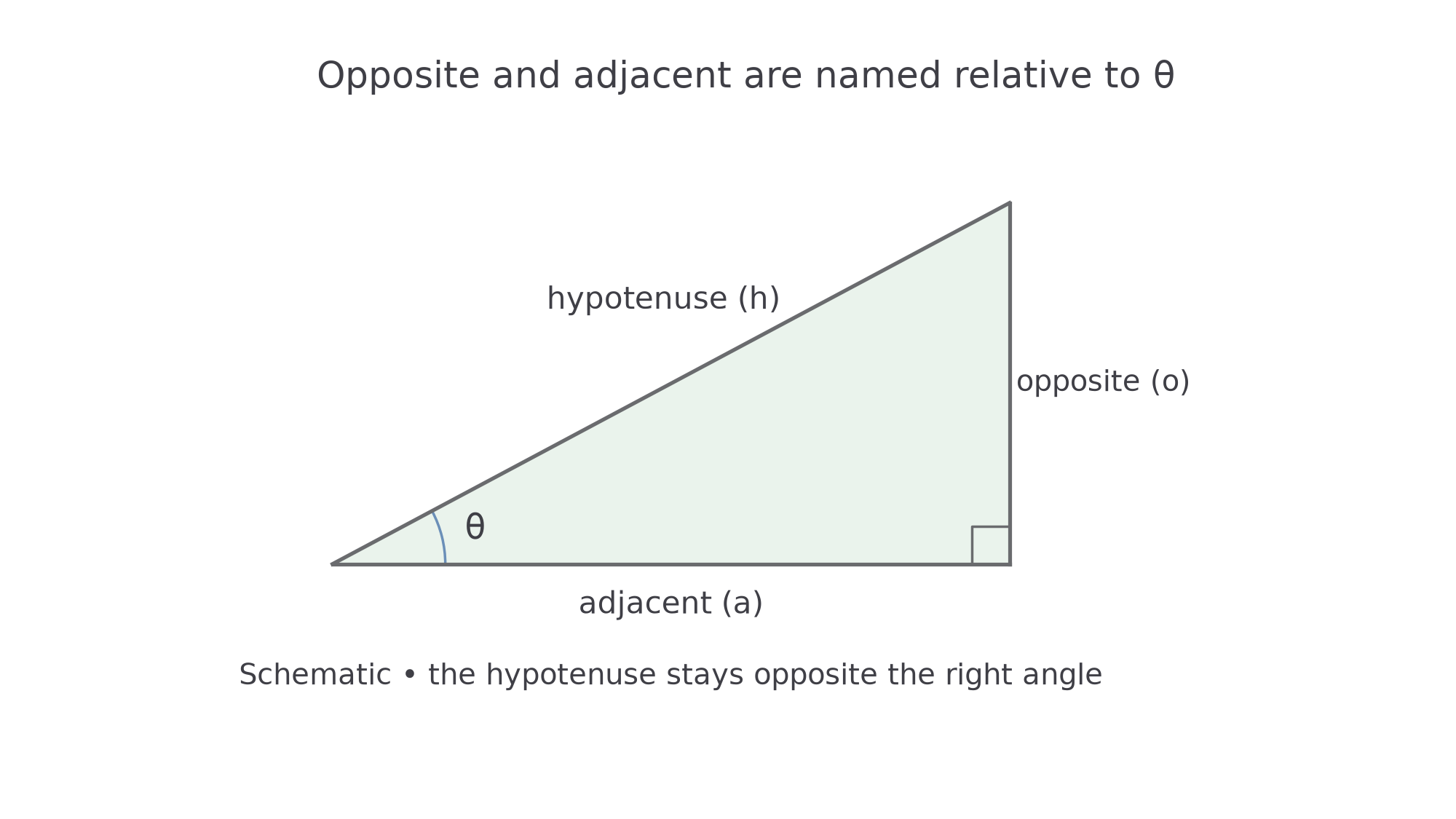
Sine, cosine and tangent are ratios of lengths in the same unit, so their units cancel.
Right-triangle ratios
For an acute angle in a right triangle,
SOH CAH TOA is a useful reminder. Absent from both the Foundation and Higher sheets. Not in the formulae sheet: learn it.
For an acute angle, all three ratios are positive. Sine and cosine are less than , while tangent can exceed .
Worked example 1: use the side names
Question. Relative to , a right triangle has opposite , adjacent and hypotenuse . Write all three trigonometric ratios.
Plan. Put the named sides into SOH CAH TOA.
Why is tangent's denominator ? Tangent uses the adjacent side, not the hypotenuse.
Answer. , , .
Check. , so these lengths form a right triangle.
Change only the chosen angle. Let be the other acute angle of this same triangle. The side lengths stay fixed, but the opposite and adjacent roles swap.
Worked example 2: look from the other angle
Question. For the same triangle, write all three ratios relative to .
Plan. Swap the shorter-side roles while keeping the hypotenuse.
Why is unchanged? It remains opposite the right angle, whichever acute angle you choose.
Answer. , , .
Check. , consistent with its opposite side being longer than its adjacent side.
A useful surprise is visible here: the sine of one acute angle equals the cosine of the other. Both compare the same shorter side with the same hypotenuse. Thus , for example .
Watch out
The line uses the hypotenuse. That is sine. The correct tangent ratio is .
Try a new triangle; the question supplies the side roles directly.
Calculating missing lengths
Choose the ratio containing the known length and the wanted length. Write an equation before using the calculator. The equation tells you whether to multiply or divide.
For instance, gives when the hypotenuse is known, but when the opposite is known. Similarly, gives or . These rearrangements are not supplied on either tier's sheet.
Worked example 3: the unknown denominator
Question. A right triangle has angle and adjacent side . Find the hypotenuse to significant figures.
Plan. Use cosine because the two relevant sides are adjacent and hypotenuse.
Why divide? The unknown is the denominator of the original ratio.
Answer. .
Check. The hypotenuse exceeds ; its unrounded value times returns .
Change only the role of the known length: it is now the hypotenuse. Keep the angle and the same two side roles.
Worked example 4: the unknown numerator
Question. A right triangle has angle and hypotenuse . Find the adjacent side to significant figures.
Plan. Write the cosine ratio, now with the unknown in its numerator.
Why multiply this time? The known denominator is ; multiplying clears it.
Answer. .
Check. , and the shorter side is below .
Use the actual side roles rather than memorising “trigonometry means multiply”.
Watch out
In the first example, would make the hypotenuse shorter than a leg. Rearrange to obtain .
The next problem changes the known angle and length, and asks for the other shorter side.
Calculating acute angles
Two known sides let you calculate a ratio first, then recover the angle with an inverse function. Use , or in degree mode. Here the superscript means inverse function; it does not mean a reciprocal.
Continue this lesson.
You’re previewing NovaLearn without an account. Create a free account to read the rest.
Create free account