OT1.5, OT2.1, OT2.3 - Reading and checking an unfamiliar mathematical passage
Turn an unfamiliar passage into definitions you can use, an argument you can check and a conclusion that means something. You will extract its mathematical structure, repair missing reasoning and decide exactly what its claims establish.
Definitions and domain
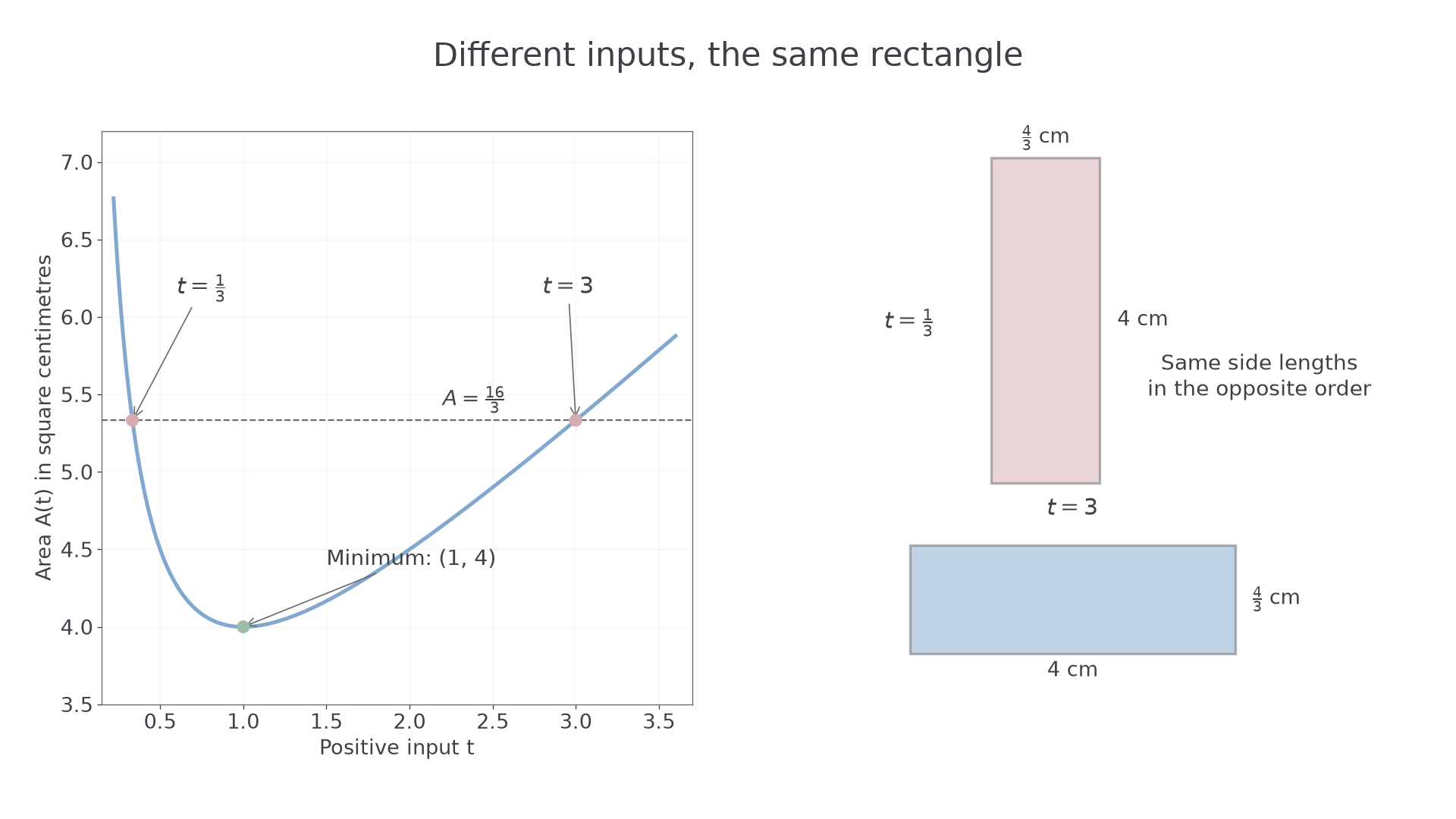
Can two different inputs describe exactly the same rectangle? Start with sides of and : turning the paper through a right angle swaps their order, without changing the rectangle. The passage below builds that small surprise into an entire family.
You already know
Substitute into a definition exactly as written. A reciprocal is undefined at zero, an area is the product of two lengths, and the domain says which inputs are allowed.
Read the whole passage before beginning its calculations. In MEI Paper 3, the unseen article supplies the unfamiliar ideas; your job is to connect them to familiar pure mathematics. Its Section B has marks, with linked questions that may refer to a particular line, formula or diagram.
A balanced rectangle
[R1] A designer studies rectangles with side lengths and centimetres, where . Write for the numerical area in square centimetres.
[R2] Define the dimensionless imbalance index by . Expanding the area gives .
[R3] The designer claims that the area is at least , attained only by a square. Replacing by interchanges the sides, so the area does not generally identify a unique input.
The word “imbalance” has a precise local meaning: use R2, rather than guessing a familiar formula. A new name often hides ordinary algebra. Conversely, familiar letters can be given a new meaning.
A passage's domain
The domain is the set of allowed inputs. Here it is the positive real numbers, . The input is excluded because is undefined; negative inputs are excluded by R1 even if a particular substitution happens to produce a numerical expression.
Simplifying a formula does not enlarge its domain. For example, if a different passage defines
the cancellation is valid only where the denominator is nonzero. The simpler expression gives at , but the defined function is still undefined there. Keep an excluded input excluded unless the passage explicitly defines an extension.
A compact symbol map prevents you from answering a different question. The numerical area has an associated physical area ; the index is dimensionless.
| Symbol or expression | Meaning in this passage |
|---|---|
| Positive, dimensionless input | |
| , | Numerical side lengths in centimetres |
| Numerical area in square centimetres | |
| Dimensionless index, defined by R2 |
The two definitions are supplied by the passage, not by the formula sheet. There is no new index to memorise: learn to locate and use its definition.
Worked example 1: extracting the defined quantities
Question. Use R1–R2 with to find both side lengths, the area and the index. Explain why is excluded. Give exact answers.
Plan. Substitute the same allowed input into each definition, keeping the index separate from the area.
- Find the lengths from R1:
- Multiply the lengths to obtain the area:
- Apply R2 to obtain the dimensionless index:
Why this step? is defined separately; it is not a shortened name for .
Answer. The lengths are and , the area is , and . Zero is excluded because the reciprocal would be undefined.
Check. R2 gives .
Worked example 2 changes only the input to its reciprocal. Keep all four requested outputs and the domain explanation; watch which quantities change.
Worked example 2: the reciprocal input
Question. Use R1–R2 with to find both side lengths, the area and the index. Explain why is excluded. Give exact answers.
Plan. Evaluate the reciprocal carefully, then use the same definitions as before.
- Substitute into the lengths:
- Multiply the lengths:
- Substitute into the index:
Why this step? The reciprocal of is ; replacing it by another would lose the symmetry.
Answer. The lengths are and , the area is , and the index is . Zero remains excluded because its reciprocal is undefined.
Check. The lengths have simply interchanged, so the equal areas agree with R3. Again .
An article can contain definitions, proved results and claims awaiting proof. Reading R3 tells you what the designer claims; it does not yet supply a justification of the minimum.
Watch out
Wrong: “, so the area is .” Right: R2 gives . Keep each symbol attached to its defined quantity.
Try a new reciprocal input. All the required definitions are in R1–R2 above.
Reconstructing an argument
To complete a missing argument, start from the supplied definitions and expose a familiar structure that proves the claim for every allowed input.
For the rectangle, that useful structure is a square divided by a positive number. The domain does two jobs: it keeps the expression defined and determines its sign. You need both jobs in the proof.
A general justification
A general justification establishes a result for every value in its stated domain. Checking , and verifies three cases; it does not prove a statement for all positive real .
A square is non-negative, including the case where it is zero. This makes it ideal for proving a minimum and finding exactly when the minimum is reached.
Non-negative square
For every real ,
Division by a positive number preserves this inequality.
Not in the formula sheet: learn it.
The graph illustrates the claim you are about to establish. The plotted cases are useful checks; the algebra will cover the whole domain.
[DIAGRAM: asset_name: Reciprocal inputs and a minimum area; asset_slug: h640_comprehension_rectangle; caption: Reciprocal inputs give the same area; the minimum occurs at the square; description: A graph of A(t)=2+t+1/t for t positive shows the minimum at (1,4), with equal-height points t=1/3 and t=3 at area 16/3. A separate panel shows the two interchanged side pairs 4 by 4/3 and 4/3 by 4 as congruent rectangles.]
Worked example 3: proving the passage's minimum
Question. Use R1–R2 to show that the area is at least . State exactly when equality holds and give the side lengths then.
Plan. Rewrite as a square over a positive denominator, then transfer the result to .
- Combine the terms and factor the numerator:
- Use the domain, rather than just the numerator:
- Transfer the inequality through R2 and check equality:
Why this step? A non-negative numerator alone is insufficient: division by a negative denominator would reverse its sign. R1 supplies the positive denominator.
Answer. The minimum area is , attained exactly at , when both lengths are .
Check. Substituting into the side definitions gives . For , the square is positive, so the area is strictly larger.
Continue this lesson.
You’re previewing NovaLearn without an account. Create a free account to read the rest.
Create free account