Me4, Me5 - Newton–Raphson and convergence failures
Can a tangent give an excellent approximation and still lead a calculation astray? Under Me4, you will use Newton–Raphson and represent its steps on a graph. Under Me5, you will explain Newton and fixed point failures through the actual paths, starting values and domains.
A tangent supplies the next approximation
How can the tangent at help solve ? It meets the axis at , already close to the positive root. The next tangent does better still.
You already know
A tangent at has equation . Put to find its intercept on the horizontal axis.
The curve is replaced locally by a line, and the line's zero supplies the next input.
Newton–Raphson step
For differentiable , with ,
In the formula sheet.
Draw the tangent from the point on the curve, not from the starting value on the axis.
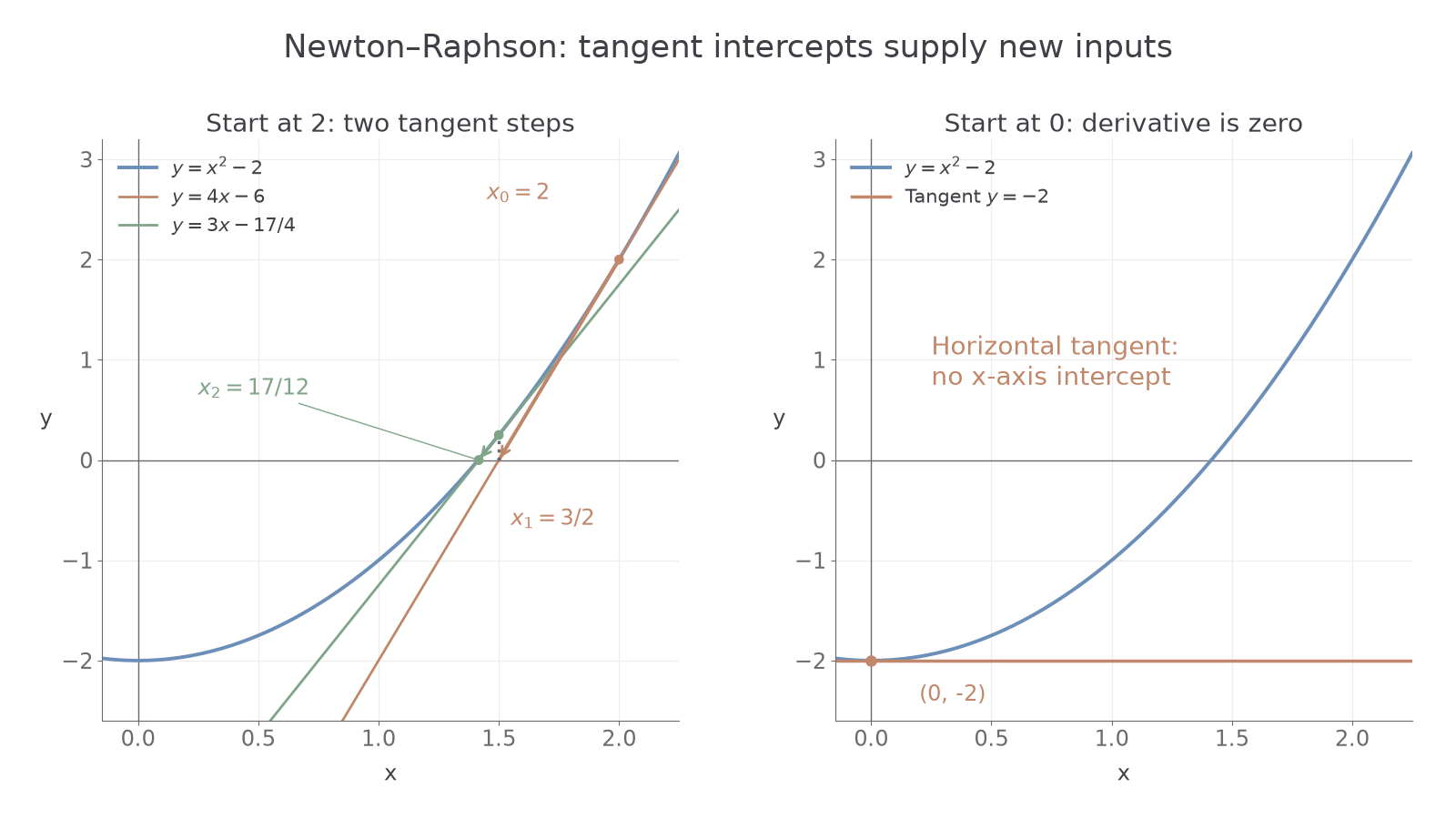
The left panel has tangent intercepts at and . Vertical moves take those intercepts back to the curve. The right panel shows a horizontal tangent at , which cannot supply a next intercept.
Worked example 1: from curve point to intercept
Question. Find the tangent at for , then its intercept.
Plan. Use the function value and derivative at the same input.
Why use a tangent? Its root is a readily calculated approximation to the nearby curve's root.
Answer. The tangent gives .
Check. , compared with the initial value .
Change only the current input to .
Worked example 2: building the second tangent
Question. Find the next tangent intercept.
Plan. Return vertically to the curve and recompute the gradient there.
Why recompute the derivative? A different point of the curve generally has a different tangent.
Answer. The tangent is , with intercept .
Check. , much nearer zero.
There is an exact explanation for the speed: for , the new value has error from . Squaring the old error can make a dramatic difference.
Watch out
The iterate is the tangent's intercept, not the height of the point on the curve. Label the curve, tangent, input and intercept when representing the method.
Use a changed constant to make the construction your own.
Compute and validate a Newton root
Use the bracket from the previous numerical lessons to choose a start for . The sign change on suggests looking there; it does not guarantee every Newton start will work.
Worked example 3: a cubic root calculation
Question. Use Newton–Raphson from to find the root of to four decimal places.
Plan. Form the recurrence and retain precision through successive steps.
Why show the recurrence? It identifies the requested method, rather than just a calculator's root output.
Answer. The suggested root is to four decimal places.
Check. and . Continuity proves that rounded value; gives local uniqueness.
Change only the constant from to .
Worked example 4: adapting the recurrence
Question. Use Newton–Raphson from to find the root of to four decimal places.
Plan. Change the function's constant, retaining its derivative.
Why alter only the numerator? Adding a constant changes the function values but not the derivative.
Answer. The root is approximately to four decimal places.
Check. For this new function, ; these rounding boundaries validate the answer.
Repeated ANS must use the current value in every occurrence of . A spreadsheet can record and in separate columns, filled down from the previous unrounded row. For comparison, Newton iteration on from begins : an initial overshoot can still lead to convergence.
Exam tip
Report the requested accuracy after retaining extra precision during calculation. If the command specifies Newton–Raphson or detailed reasoning, an unexplained solver value is insufficient.
Try a fresh constant with the same structure.
Recognise undefined steps and cycles
A zero derivative prevents the Newton division. For at , the tangent is horizontal and has no intercept. If both and are zero, you already have a root; the formula still contains an undefined . A very small nonzero gradient instead produces a large step, which can head away from the intended root.
A cycle is another failure, even when all the derivatives used are nonzero.
Worked example 5: a repeating pair
Question. Show that Newton–Raphson for fails from .
Plan. Calculate the next two tangent intercepts exactly.
Why calculate two steps? They return to the initial value, so all later steps repeat.
Answer. The sequence cycles , without approaching a root.
Check. and , so neither member of the cycle is a root.
Change only the start to the other member, .
Continue this lesson.
You’re previewing NovaLearn without an account. Create a free account to read the rest.
Create free account