Mt21 - Trigonometric models in context
A trigonometric function can describe a repeating measurement even when its input is time rather than a geometrical angle. Construct and interpret these models, find all threshold times, and use signed components in motion and force problems. Judge a prediction against the observations and assumptions that support it.
Building a periodic model from observations
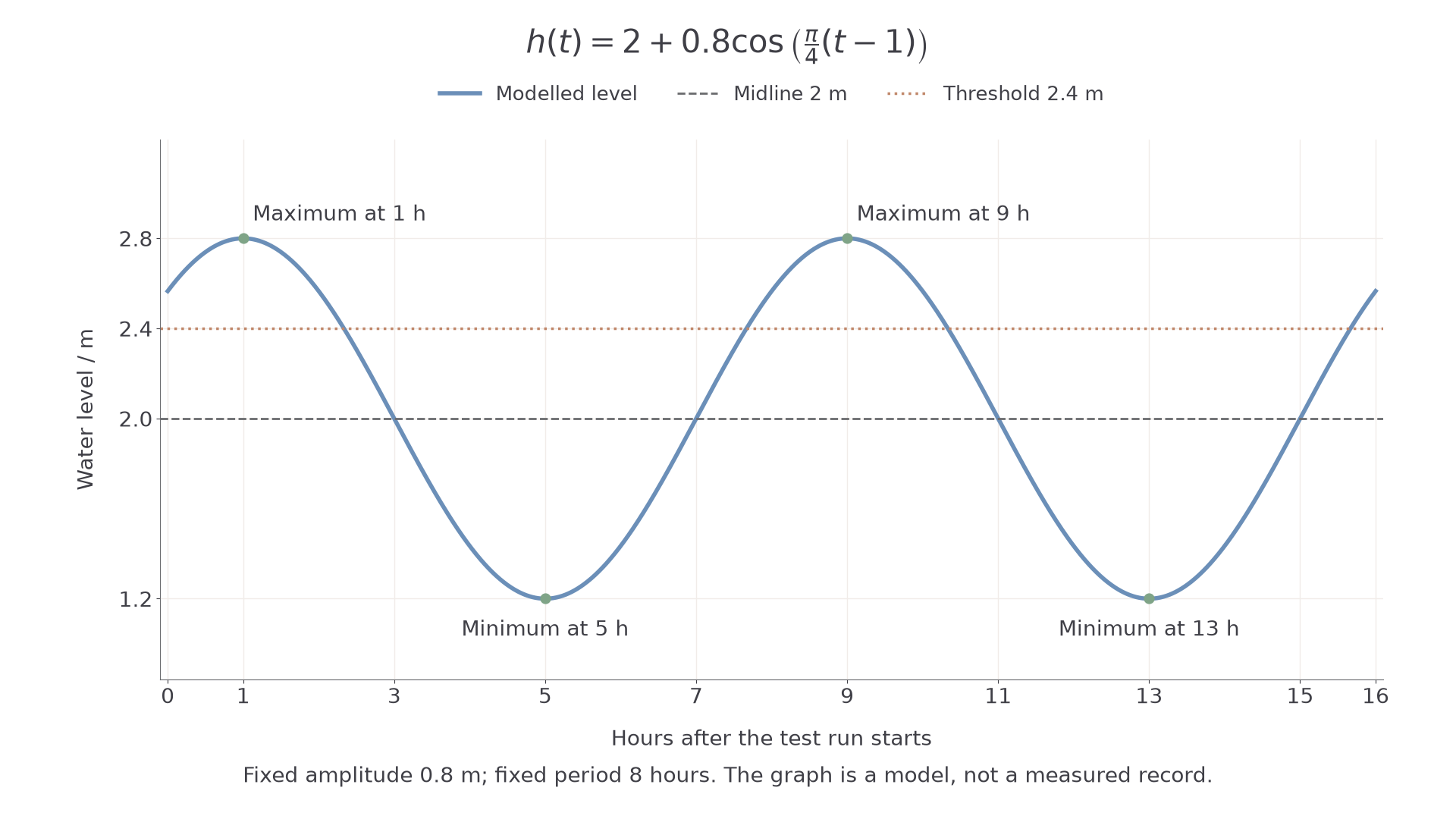
For how much of a test run is the water in a tank above ? A pump makes the level oscillate between and , with an -hour cycle and a first maximum one hour after the run starts. We need the timing of the whole wave, not just its highest point.
You already know
Sine and cosine have range and period in radians. Cosine has a maximum at input zero; sine crosses its midline upwards there. A horizontal translation changes timing rather than height.
Here the argument measures phase, or progress through the cycle. It need not represent an angle in a triangle. With time in hours, the multiplier has units of radians per hour, so the complete input is a radian phase.
Periodic model parameters
The midline is the average of the maximum and minimum; the amplitude is half their difference. The period is the time between successive repetitions. A phase shift determines when a reference feature occurs.
A cosine with positive amplitude is particularly convenient when a maximum has been observed.
Model from a maximum
For ,
The midline is , amplitude , period , and maxima occur at , , within the model's domain. Write for its angular frequency.
Not in the formula sheet: learn it.
The natural sine/cosine range becomes the model's range only if the specified time interval actually includes the extreme phases.
Worked example 1: a tank's repeating level
Question. Construct the tank-level model on , where is hours after the run starts and height is in metres. State its range.
Plan. Recover the centre and half-range, then place a cosine maximum at .
Why this step? At the observed maximum the cosine phase must be a whole number of turns; zero gives the simplest reference.
Answer. The model has domain hours and range metres.
Check. Maxima occur at hours and minima at hours. At , the level is , approximately , and is rising.
The picture connects the phase calculation with the complete observation window.
Change only the time of the first maximum, keeping the extreme heights and period.
Worked example 2: moving the reference event
Question. A later run has its first maximum at hours, with the same extremes and period. Construct its model on .
Plan. Keep the vertical parameters and frequency, changing the time translation.
Why this step? Replacing by delays every feature by two hours without altering its height.
Answer. Use the displayed model on , with the same range metres.
Check. Maxima are at hours and minima at hours; successive maxima remain hours apart.
A different phase convention is acceptable if it describes the same function.
Watch out
Wrong: take the number subtracted inside the cosine to be the minimum time. Right: a positive-amplitude cosine reaches its maximum when the phase is zero. Check the reference event by substitution.
Keep the second run's reference maximum but shorten its period.
Times and intervals that satisfy a condition
Solve a condition across the full time interval, paying attention to whether the endpoints themselves satisfy it.
Use the first run, , . Its phase interval is , so a single inverse-cosine output cannot describe every crossing.
Worked example 3: at least the threshold
Question. Determine all times in the test run when .
Plan. Find all threshold crossings, then check the portions of the wave above them.
The boundary times inside the domain are .
Why this step? The shifted phase means the first above-threshold interval began before the observation window; the answer must be clipped to .
Answer.
Check. The maxima at are in selected intervals. Also , so both observation endpoints are included.
Change only the condition to strictly above the same threshold. Check the observation endpoints separately from the crossings.
Worked example 4: strict crossings with included observation endpoints
Question. Determine all times when the same model gives .
Plan. Remove the equality crossings but retain any time-domain endpoint that is strictly above threshold.
Why this step? Strict inequality excludes equality values, not automatically the ends of the time domain. Here and are strictly above threshold.
Answer. The displayed three intervals, in hours after the run starts.
Check. Each internal crossing has height exactly , while the included outer endpoints have height about .
This is a small but useful surprise: a strict inequality can produce an interval with a closed endpoint when the domain stops inside the valid region. The range also settles impossible conditions immediately: never holds, while holds just at hours.
Exam tip
Interpret every answer within the stated domain. Boundary times answer an equality; an inequality requires the corresponding intervals and the correct inclusions.
Keep the non-strict condition and lower the threshold to the midline.
Combining effects with one frequency
A sum of same-frequency sine and cosine terms can be rewritten as one sinusoid whose phase has a contextual meaning.
A combined sine model
For ,
Here . Expand the right side using the supplied compound-angle identity to check the coefficients.
Not in the formula sheet: learn it.
This is a derived result, not an extra formula printed on the sheet. A negative cosine contribution can be handled by changing the phase sign.
Worked example 5: a sine form for two effects
Question. A level is metres, where radians per hour and . Determine the range and first maximum time, giving time to decimal places.
Plan. Match coefficients in , then set the sine phase to .
Why this step? A sine maximum has phase , whereas a cosine maximum has phase zero. The chosen form changes the equation for the time.
Answer. Range metres; first maximum at hours to decimal places.
Check. At the exact time, , , giving .
Change only the sign of the cosine contribution; the maximum shifts even though the range stays the same.
Worked example 6: reversing the cosine contribution
Question. Determine the range and first maximum time for , with the same frequency and domain.
Plan. Use the negative phase form, then select the first non-negative maximum time.
Why this step? The changed cosine sign corresponds to subtracting the phase, so the same maximum is reached later.
Answer. Range metres; first maximum at hours to decimal places.
Check. At the exact time, , , again giving height .
The amplitudes and combine to , rather than , because their individual maxima occur at different times. A cosine form gives the same function after the appropriate phase conversion. Contributions of different frequencies generally cannot be combined by this single-wave coefficient match.
Watch out
Wrong: quote the phase angle as a time. Right: solve the phase equation using , whose units are radians per hour, and retain the unrounded angle until the final time.
Change the coefficient ratio while keeping the signs and frequency.
Continue this lesson.
You’re previewing NovaLearn without an account. Create a free account to read the rest.
Create free account