Ms3–Ms5 - Rational binomial expansions and approximation
Turn a rational power into a polynomial that is easy to evaluate near a chosen input. You will expand fractional and negative powers, normalise a bracket, combine valid expansions and judge what a truncated approximation actually tells you.
Expanding a rational power
Can four binomial terms calculate with an error below ? Writing gives a promising small input. First we need an expansion that works when the exponent is negative.
You already know
A negative power is a reciprocal: . In an integer binomial expansion the descending coefficient factors eventually contain zero, so the expansion ends.
With , the factors never reach zero. Rational binomial expansions therefore need a validity condition and usually have infinitely many terms.
Binomial expansion for a rational power
For rational and ,
A positive integer exponent gives a finite exact identity for all real . At exponent , the value is for a non-zero base; exclude , which would give . Otherwise stopping after a few terms gives an approximation. Use the displayed descending factors to find specified terms; a general term is not required here.
In the formula sheet.
Coefficient signs come from both the exponent factors and the powers of the entire input.
Worked example 1: a negative integer exponent
Question. Expand through .
Plan. Substitute and retain the first four terms.
Why does it not stop after the quadratic? A negative integer exponent does not make a descending factor zero.
Answer. , for .
Check. Multiplying this polynomial by gives through cubic degree.
Change only the sign of the inner input. Keep the exponent and the degree unchanged.
Worked example 2: reversing the input sign
Question. Expand through .
Plan. Substitute into the same coefficient pattern.
Why are all four terms positive? The odd-power sign reversals cancel the negative odd coefficients.
Answer. , for .
Check. Multiplying by gives .
Fractional powers use the same pattern: . Those signs are different again; they follow from , rather than from a rule that all rational expansions alternate.
Watch out
Wrong: for all . Right: write the ellipsis for the infinite expansion, or use for the truncated polynomial, and keep .
Now change only the magnitude of the negative input.
Factor out the constant before expanding
An input close to a positive constant can be rescaled into a bracket close to . The outside scale must receive the exponent too.
Rescaling a binomial bracket
For , rational and a real input in the required domain,
This index-law rearrangement prepares the supplied expansion; it is not itself printed as a separate formula.
Not in the formula sheet: learn it.
For example, the outside factor of is . It is neither nor .
Worked example 3: retaining the outside power
Question. Expand through .
Plan. Factor out and use in the negative-square expansion.
Why multiply the quadratic by too? The outside factor multiplies the entire bracket.
Answer. , for .
Check. At , the constant is .
Double the entire bracket, changing its outside scale while keeping the inner input .
Worked example 4: a rescaled bracket
Question. Expand through .
Plan. Use the same inner expansion, now with outside factor .
Why is every coefficient a quarter of example 3? The whole expression has been multiplied by .
Answer. , for .
Check. The constant is , and each coefficient is a quarter of its counterpart in example 3.
The same care applies to roots: , for , since . If the factored constant is negative, check the real root convention first: near zero is real, but the square root of is not real there.
Watch out
Wrong: take out the constant, then leave it to its first power. Right: keep visible until every term has been multiplied by it. Substitution of catches a wrong constant immediately.
Scale the same bracket once more, so only the outside multiplier changes.
Validity and combining truncated expansions
Use on the whole inner input. Thus has the condition . A negative scale does not turn this into a one-sided restriction.
If two expansions are combined, use the intersection of their validity intervals. When multiplying, keep every way to make a required degree, including products of linear terms. A convergence proof is not needed; the open intervals used here do not settle special endpoint behaviour.
Worked example 5: cancellation of linear terms
Question. Expand through , and state the common validity interval.
Plan. Expand the reciprocal and reciprocal square root separately, then collect all terms through degree two.
Why is the linear term zero? The from one factor cancels the from the other; neither should be omitted before multiplying.
Answer. , for , the interval contained in both component ranges.
Check. Squaring the expression gives . Its denominator is , consistent with a reciprocal starting .
Change only the first denominator sign. Now the two linear contributions reinforce rather than cancel.
Worked example 6: reinforcing linear contributions
Question. Expand through , and state the common validity interval.
Plan. Replace the reciprocal factor by , retaining the reciprocal square-root factor.
Why does the quadratic include from a cross-product? The product of the two negative linear terms is positive.
Answer. , for . The restrictions and still apply.
Check. Multiplying by gives through degree two, recovering the reciprocal square root.
A linear coefficient of zero is useful information. Do not replace “first three terms” with “through ” automatically when powers cancel; read which truncation the question asks for.
Exam tip
Show enough of the multiplication to identify the constant, the two linear contributions and the three quadratic contributions. This makes a valid method visible even if a later coefficient has an arithmetic slip.
Change only the scale in the first denominator factor.
Using the polynomial as an approximation
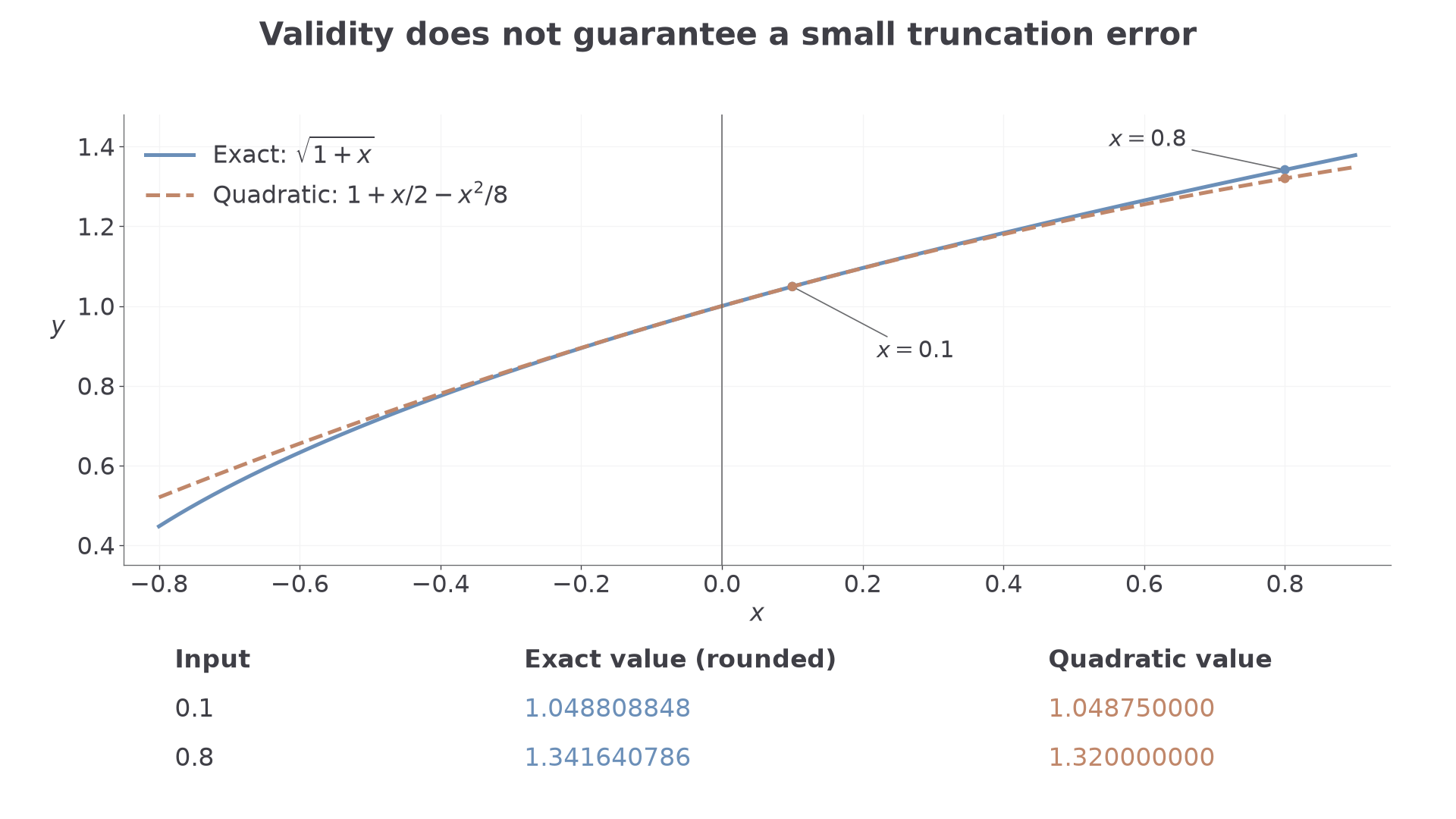
A valid binomial expansion need not have an accurate low-degree truncation. Compare with : at , the values are and ; at , they are and . Both inputs satisfy the condition, but the second gap is much larger.
[DIAGRAM: asset_name: Valid inputs can have different truncation errors; caption: Valid inputs can have different truncation errors; asset_slug: h640-binomial-approximation; description: The exact square-root curve and its quadratic binomial polynomial are plotted for inputs within minus 1 to 1, with the small discrepancy at 0.1 and larger discrepancy at 0.8 identified]
For the opening reciprocal, take out , then use a particularly simple polynomial: . This follows from the supplied binomial formula with ; it is not a separate formula-sheet entry.
Worked example 7: a four-term reciprocal
Question. Use the expansion through to approximate , and compare with a calculator value.
Plan. Write .
Why is the outside factor ? The power applies to the factor as well.
Answer. The polynomial gives , compared with . It is low by about .
Check. Multiplying the approximation by gives , very close to .
Change only the target denominator to . Keep the outside factor and the cubic truncation.
Worked example 8: a larger small input
Question. Use the same expansion to approximate , and compare with a calculator.
Plan. Set in .
Why compare with a calculator? The validity condition does not itself tell us the error after four terms.
Answer. , compared with ; it is low by about .
Check. , which is below , consistent with an underestimate.
There is a pleasing exact check for these particular reciprocals:
Subtracting the cubic polynomial from therefore gives , when . This identity is derived by multiplication, not a general error rule for all rational powers. At , the error after the outside factor is exactly , settling the opening puzzle.
Watch out
Wrong: “the first omitted term always bounds the error”. Right: a bound needs justification. The identity above justifies one reciprocal error; it does not establish the same claim for every rational exponent.
Use the same cubic reciprocal polynomial for a new denominator.
Quick Recap
- Rational powers use descending coefficient factors; most give non-terminating expansions.
- Normalise a bracket to , including the correct outside power.
- Keep every contribution to the required degree and intersect all validity intervals.
- A polynomial approximation has a truncation error; justify any claimed bound.
Four terms give . The exact reciprocal identity shows its error is less than .