Mv7 - Vectors in three dimensions
Use three-dimensional vector language, operations and position calculations, including spatial directions described by perpendicular projections. Extend distance, ratio, geometric-proof and force-resultant methods by checking all three components.
Components and magnitude in space
A drone's straight displacement is east, south and upwards. How long is the flight, and how can you describe its direction without losing the height? A floor-plan arrow alone cannot distinguish a climb from a descent.
You already know
Cartesian components use perpendicular axes. In a plane, a vector's modulus comes from Pythagoras, and its direction comes from a reference angle with a quadrant check. Divide a non-zero vector by its modulus for a unit vector.
Add a vertical unit vector to the horizontal . The drone's displacement is . The third component records vertical change; it cannot be swapped with another entry simply because the same three numbers remain.
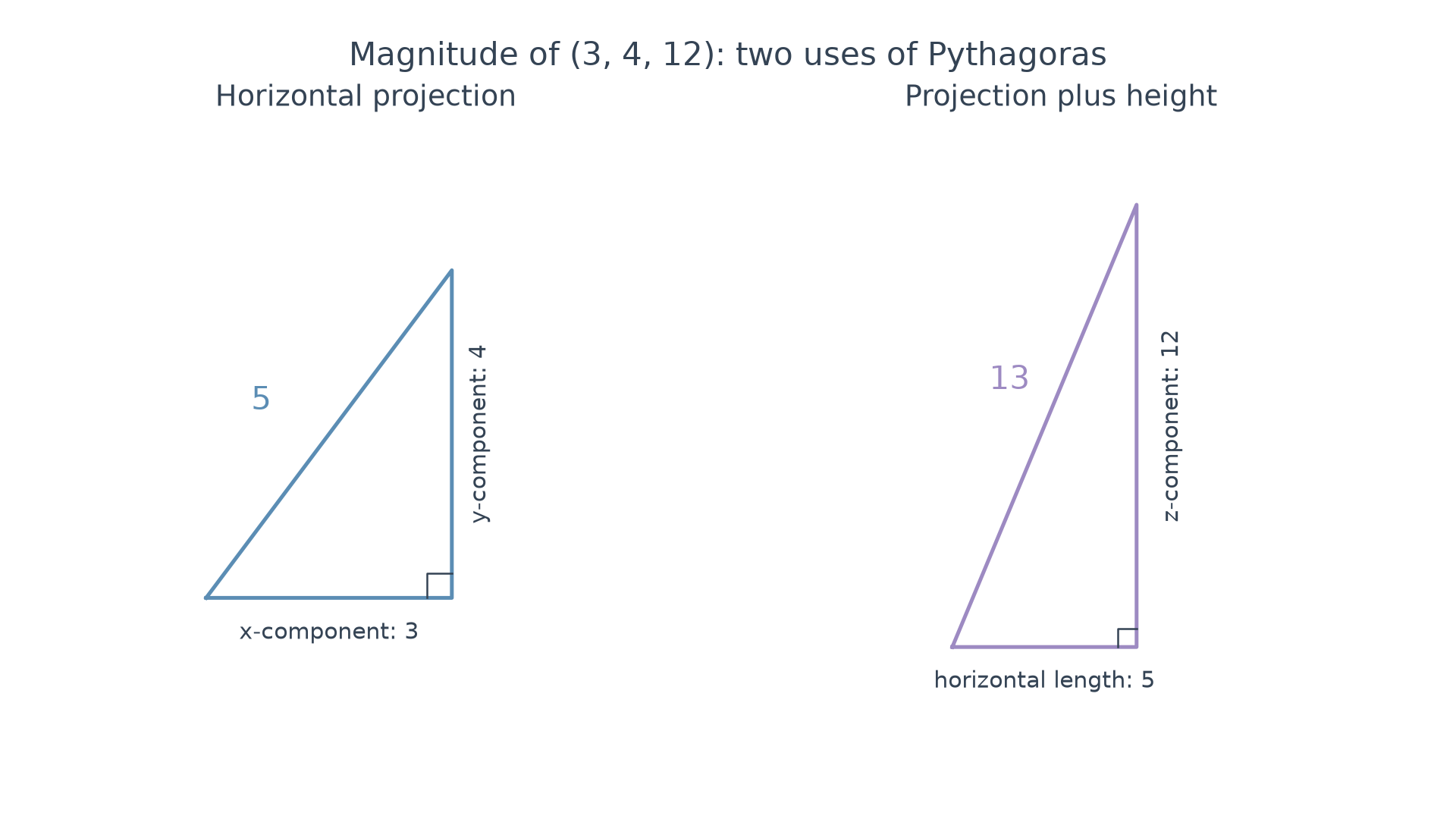
For the vector , the horizontal projection has length , and the second right triangle gives spatial length . The second panel's horizontal axis measures projection length, not the original -coordinate.
This example joins two integer right triangles: and . A three-dimensional diagonal can have an integer length even though it is not an edge of either horizontal component triangle.
Spatial modulus and unit vector
For :
For , is the unit vector in its direction.
Not in the formula sheet: learn it.
Addition, subtraction and scalar multiplication also extend to all three entries. For example, . A zero component indicates no change along that axis; it does not make the whole vector zero.
Worked example 1: a drone's unit direction
Question. Find the magnitude of and a unit vector in its direction.
Plan. Use all three squared components, then divide every component by the resulting modulus.
Why this step? Dividing by the floor-plan length would ignore the climb and would not give modulus .
Answer. Magnitude , unit vector .
Check. Its squared modulus is .
Change only the vertical sign, turning a climb into a descent.
Worked example 2: reflecting in the horizontal plane
Question. Find the magnitude and a unit vector of .
Plan. Keep the component signs in the vector but square them when calculating length.
Why this step? The reflected vector has the same length, but is not the negative of : its horizontal components did not reverse.
Answer. Magnitude , unit vector .
Check. Multiplication by restores , and the unit vector's modulus is .
A unit vector records direction without any angles. If a question instead supplies two angle conventions, use two perpendicular triangles. Let azimuth run anticlockwise from the positive -axis in the horizontal plane, and elevation run above that plane. State these meanings before using the words: another context may choose a different reference.
Spatial direction from two projections
For magnitude , azimuth in , and elevation :
For , recover elevation from and azimuth from the signed horizontal components. A vertical vector has no unique azimuth; the zero vector has no direction.
Not in the formula sheet: learn it.
The intermediate horizontal length makes the conversion manageable. For magnitude , azimuth and elevation , , giving . In general substitute to obtain , .
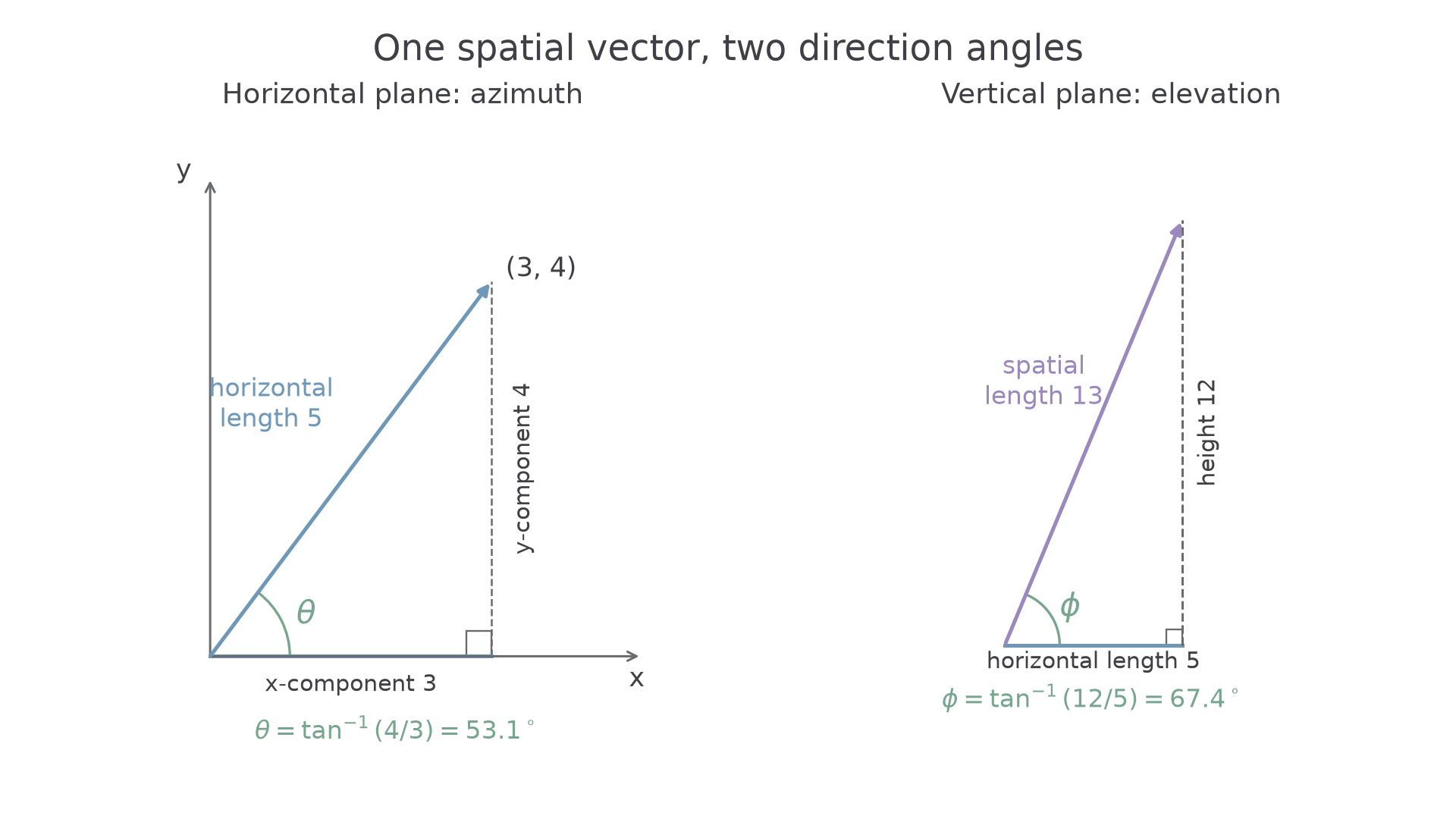
The same vector gives azimuth from the horizontal projection and elevation from height over the full horizontal length.
Worked example 3: reading two spatial angles
Question. Find the azimuth and elevation of using the conventions above, to the nearest .
Plan. Find the horizontal projection, then calculate one angle in that plane and one above it.
Why this step? Elevation compares vertical change with the whole horizontal projection, not just the -component.
Answer. Azimuth , elevation .
Check. With and unrounded angles, , then , and .
Change only the sign of the -component. Elevation stays fixed, but the floor-plan arrow crosses into the fourth quadrant.
Worked example 4: choosing the spatial quadrant
Question. Find the azimuth and elevation of , to the nearest .
Plan. Keep the horizontal length and elevation, then correct the azimuth using the horizontal signs.
Why this step? The principal inverse-tangent result is negative, while our stated azimuth lies between and .
Answer. Azimuth , elevation .
Check. Using the unrounded azimuth, and ; the height remains .
The opening drone has horizontal length , azimuth and elevation . Thus one straight displacement records both the floor-plan direction and the climb.
Watch out
Wrong: one planar angle describes the whole spatial direction. Right: retain all three unit-vector components, or use two explicitly defined angles. Never normalise , and never assign a unique azimuth to a vertical vector.
Change the sign of the remaining horizontal component from the last example.
Positions and distances in space
A spatial position vector locates a point from the origin. Its components are that point's coordinates, so finish minus start gives a three-dimensional displacement exactly as it did in a plane.
Spatial displacement and division of a segment
For positions :
A point at a specified fraction from has position . Internal ratio gives .
Not in the formula sheet: learn it.
Continue this lesson.
You’re previewing NovaLearn without an account. Create a free account to read the rest.
Create free account