MC6, Mg8 - Reciprocal graphs, asymptotes and intersections
Recognise reciprocal and inverse-square graphs from their signs, symmetry and proportional relationships. You will explain their asymptotes, find exact intersections and read a short mathematical definition without losing its domain restrictions.
The reciprocal curve
Can you swap the coordinates of every point on a graph and still stay on that graph? For , swaps to , and swaps to . Each coordinate product is 2, so the swap always works. Let's use that fixed product to understand the whole curve.
You already know
A quotient with zero denominator is undefined. The signs of numerator and denominator decide its sign: equal signs give a positive quotient, opposite signs a negative one.
Positive pairs can represent an inverse-proportion model. For example, keeping a rectangle's area fixed makes its length fall when its positive width grows. The mathematical curve also has a negative-input branch, even when a particular model does not use it.
Inverse proportion
Two variables are inversely proportional when their product is a fixed nonzero constant. Writing gives , with . Doubling a nonzero input halves its output.
The sign of the constant determines which quadrants hold the two branches.
Reciprocal curve features
For real ,
For , the branches lie in quadrants I and III; for , in II and IV. There are no axis intercepts. Opposite inputs give opposite outputs, so the graph is symmetric about the origin.
Not in the formula sheet: learn it.
Calculate points on both sides of zero and keep those sides separate.
Worked example 1: the fixed positive product
Question. Describe , including four points, quadrants and intercepts.
Plan. Divide 2 by two positive and two negative inputs, then check whether either coordinate can be zero.
Why this step? A nonzero product rules out either coordinate being zero, so neither axis is met.
Answer. The graph has separate smooth branches in quadrants I and III through , , , , and no intercepts.
Check. Each product is 2; swapping the coordinates preserves it and gives another point on the same curve.
Change only the numerator's sign. The new products are negative, so the coordinates must have opposite signs.
Worked example 2: the fixed negative product
Question. Describe the corresponding features of .
Plan. Negate the four outputs, then identify the new quadrants.
Why this step? Negating the numerator changes every output sign without changing the permitted inputs.
Answer. Branches in quadrants II and IV pass through , , , , with no intercepts.
Check. Every pair has product . The points still occur in opposite pairs about the origin.
The curve never provides a bridge between its two branches.
Watch out
Wrong: connect the negative-input branch to the positive-input branch through .
Right: omit zero completely. Neither coordinate can be zero when their product is or any other nonzero constant.
Change the constant, retaining the same sign reasoning.
Asymptotes describe limiting behaviour
The reciprocal curve gets close to its axes in two very different ways: small outputs far away and very large outputs near its excluded input.
For , increasing the positive input from 10 to 100 to 1000 changes the output from to to . Reducing it from to to gives 20, 200 and 2000.
Asymptote
An asymptote is a line approached by a curve in a specified limiting direction. A reciprocal curve , , has vertical asymptote and horizontal asymptote . The equations identify lines; they do not assign the function a value at zero.
These asymptote rules are not in the formula sheet: learn them. Describe the side and sign as well as the line.
Worked example 3: positive numerator near zero
Question. Describe how approaches each asymptote from both sides.
Plan. Use small inputs of opposite signs and large inputs of opposite signs.
Why this step? The input approaching zero from the left produces negative unbounded outputs, rather than the positive outputs on the right.
Answer. Towards , the right branch grows positively without bound and the left negatively without bound. As the input magnitude grows, each branch approaches , from above on the right and below on the left.
Check. Dividing the input magnitude by ten multiplies the output magnitude by ten, without changing its sign on that branch.
Reverse only the numerator sign. That reverses the approach heights, not the asymptote locations.
Worked example 4: negative numerator near zero
Question. Describe the corresponding behaviour of .
Plan. Negate the previous outputs and retain the same small and large inputs.
Why this step? The denominator still approaches zero at the same input; the negative numerator changes which branch goes upwards.
Answer. The vertical asymptote is : outputs are negatively unbounded on its right and positively unbounded on its left. The horizontal asymptote is , approached from below on the right and above on the left.
Check. At a small negative input both numerator and denominator are negative, so the large output must be positive.
The top panels make these signs visible. The bottom panels will show what changes when the denominator is squared.
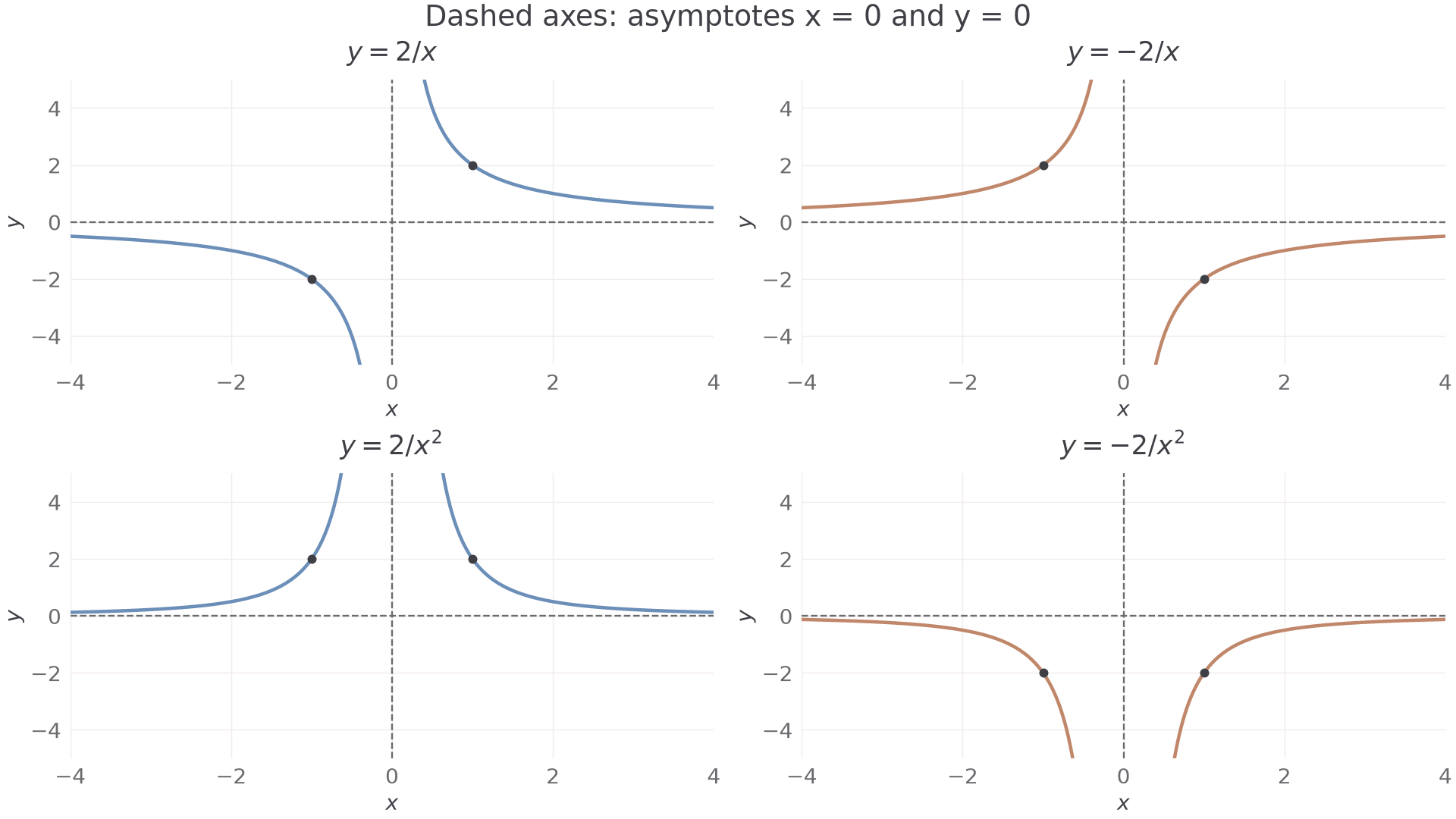
For a general curve, an asymptote can be crossed somewhere away from the limiting direction. In these families, specifically prevents from being reached.
Watch out
Wrong: the point at has height “infinity”.
Right: there is no point at . The outputs become unbounded as permitted inputs approach it from a stated side.
Apply the description to a different negative numerator.
The inverse-square curve
An inverse-square denominator removes the difference between a positive input and its negative.
Compare with , then compare with . The squared denominator is positive on both sides of zero.
Inverse-square curve features
For real ,
The graph is symmetric about the vertical axis; both branches have the sign of . The asymptotes are and , and neither axis is met. Doubling the input magnitude divides the output by four: it is inversely proportional to the square of the input.
Not in the formula sheet: learn it.
Check this factor of four directly rather than carrying across the halving rule from .
Worked example 5: two positive branches
Question. Describe , giving its values at , and .
Plan. Square each input first, then use the positive numerator to determine the two branch signs.
Why this step? The positive and negative inputs share a denominator after squaring, so their outputs match exactly.
Answer. Both branches are above the axis and mirror each other in the vertical axis. Both grow positively without bound towards zero and approach far away; is a vertical asymptote.
Check. Moving from magnitude 1 to 2 changes 2 to , dividing by four.
Change only the sign of the numerator. Both branches reflect together.
Worked example 6: two negative branches
Question. Describe the corresponding values and shape for .
Plan. Keep the same squared denominators, but negate the outputs.
Why this step? The input sign cannot reverse an already squared denominator, so it cannot move the left branch above the axis.
Answer. Both branches lie below the axis, with vertical-axis symmetry. They become negative without bound towards zero and approach far away. The other asymptote remains .
Check. Substituting gives , the same as substituting 2.
If , this description changes: the graph is with the input zero omitted. There is then no vertical asymptote because the values do not become unbounded.
Watch out
Wrong: doubling the input in an inverse-square curve halves its output.
Right: , so doubling divides the output by four. Do not confuse inverse proportion with inverse-square proportion.
Compare the two families at one negative input and explain their wider sign difference.
Solve intersections without losing restrictions
Intersections connect the geometry of two curves to one equation, but the equation is only valid on their shared domain.
You already know
Equate the outputs to find common inputs, then substitute each input to recover the common height. A point of intersection needs both coordinates.
Write before clearing denominators. This condition belongs to the mathematical problem, even if a later simplified equation happens to allow zero. The intersection and domain rules here are not in the formula sheet: learn them.
Worked example 7: a line meeting both branches
Question. Determine all intersections of and .
Plan. Equate heights on the permitted domain, clear the denominator, factor and calculate both heights.
Why this step? Multiplication by is reversible because zero has already been excluded; no other input restriction is introduced.
Answer. and .
Check. In the reciprocal equation, and . Both points also lie on the line.
The left and right intersections agree with the permitted reciprocal branches.
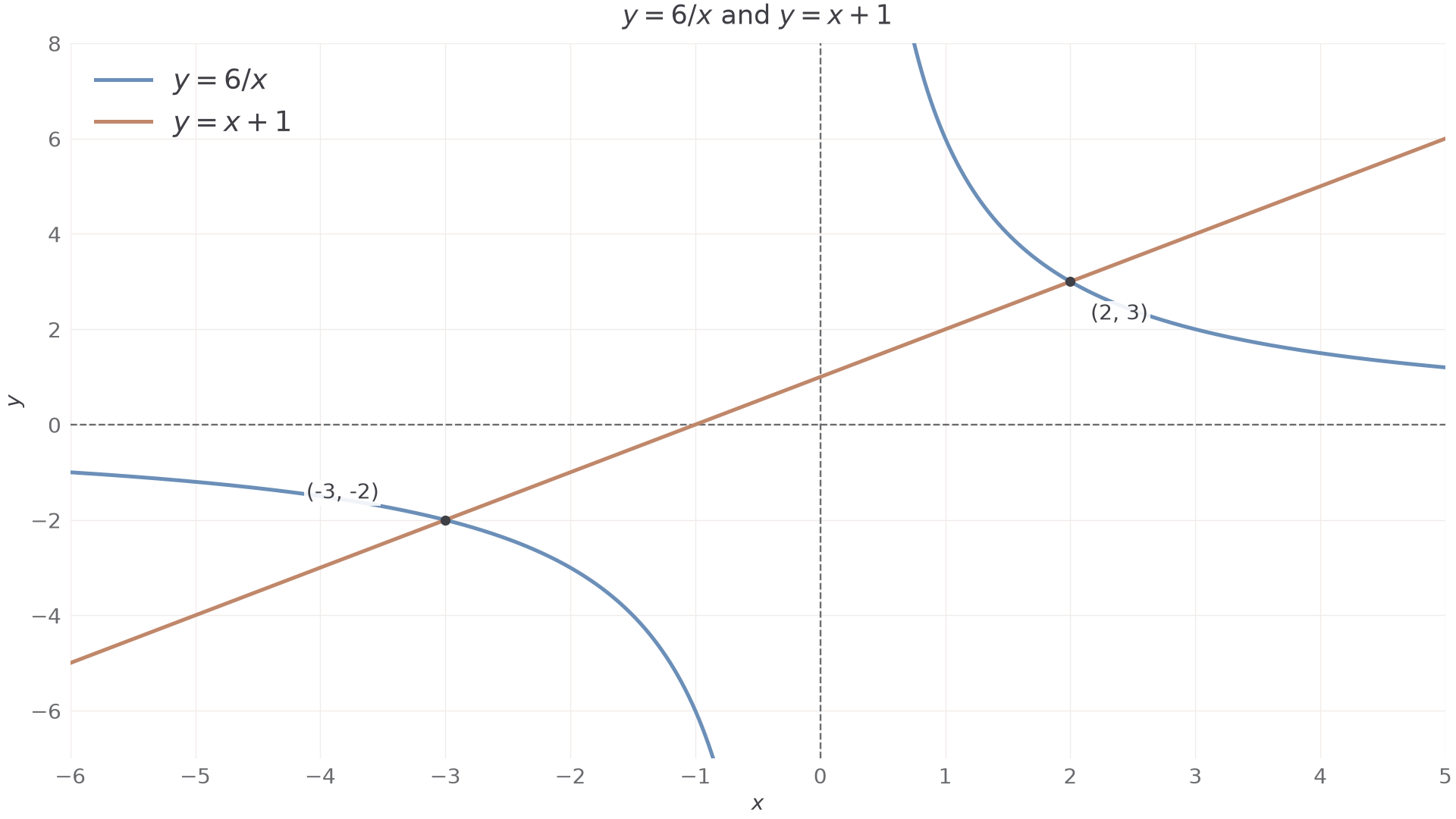
Now change the comparison from a line to an inverse-square curve. Read this short passage first; its new letters are definitions of familiar functions, rather than extra methods to memorise.
“A comparison system assigns two scores to any nonzero real input . Its first score is , and its second is . A balance input means an input for which the scores are equal. Both negative and positive inputs are allowed; their score signs follow the formulas.”
The word “balance” therefore means , not that either score is zero. The domain phrase applies to every subsequent equation.
Worked example 8: using a definition from a passage
Question. Determine the balance input and common score in the passage.
Plan. Translate its definition into equality, multiply by the nonzero squared input and recover the score.
Why this step? The new word is fully defined in the passage, so translating it carefully reduces the task to the same intersection principle.
Answer. The balance input is , with common score 12. The curves meet at .
Check. , and the input satisfies . Negative inputs cannot balance here because is then negative while is positive.
When reading unfamiliar mathematics, identify the defined words, write their equations and carry the domain with them. A symbol's letter does not change the method. Approximate intersections may instead be read from a complete scaled graph when exact algebra is inconvenient.
Watch out
Wrong: treat “balance” as , or accept a zero input after simplifying.
Right: use the passage's actual equality and its nonzero domain. A simplified expression cannot restore an input excluded by the definition.
The next self-contained passage changes the score constants. Translate its definition before calculating.
Quick Recap
- A reciprocal relationship has fixed nonzero product; doubling the input halves the output.
- An inverse-square relationship divides the output by four when the input magnitude doubles.
- Both families exclude zero and have asymptotes , when the numerator is nonzero.
- Intersections require equal outputs on the shared domain. Read a passage's definitions before translating them into equations.
Yes: swapping coordinates keeps every point on , because the product is unchanged. The same is true for every curve with .